
Starting a new hobby like painting can feel both exciting and a little daunting. That initial creative spark is powerful, but translating it onto a surface can be intimidating. The key is to begin with simple, rewarding projects that build confidence and teach fundamental skills without causing frustration. This guide is designed to provide you with a collection of actionable beginning painting ideas that are not only enjoyable but also foundational. We will skip the complex theory and jump straight into projects that help you practice core techniques like color mixing, brush control, and basic composition.
Every artistic endeavor begins with a foundation, much like preparing your workspace or finding your perfect blank canvas. From there, we will explore a variety of subjects, from serene landscapes built with basic shapes to vibrant abstract color studies. Each idea is broken down into manageable steps, ensuring you feel a sense of accomplishment with every brushstroke.
Whether you're looking for a relaxing new pastime, a fun family activity, or a way to express yourself, these projects offer a structured and stress-free path. Let's turn that empty space into your first masterpiece, starting today.
1. Simple Landscapes with Basic Shapes
One of the most approachable yet rewarding beginning painting ideas is tackling a landscape using only basic shapes. This method strips away the intimidating complexity of nature, allowing you to focus on the fundamentals. Think of mountains as simple triangles, the sun or moon as a circle, and fields or bodies of water as rectangles or ovals.
By deconstructing a scene into its geometric core, you learn essential skills without feeling overwhelmed. This approach is perfect for grasping composition, understanding how colors interact, and practicing basic brush control. It’s not about photorealism; it’s about translating the essence of a view onto your canvas in a clean, stylized, and manageable way.
Why This Method Works for Beginners
This technique excels because it builds a strong artistic foundation. Simplifying a landscape teaches you to see the world like an artist, identifying the core forms that give a scene its structure and depth. It directly trains your eye to compose a balanced and visually pleasing image. The focus shifts from tiny, frustrating details to the bigger picture of color, balance, and mood.
Key Insight: Painting a landscape with basic shapes isn't about avoiding detail; it's about mastering the structure that holds those details together. Once you can create a compelling scene with just a few shapes, adding complexity later becomes much easier.
Actionable Tips for Your First Geometric Landscape
To get started, follow a structured process that ensures a clean and successful result.
- Establish Your Anchor: Begin by creating a crisp, straight horizon line. You can use painter's tape to mask it off or a ruler and a light pencil mark. This single line will ground your entire painting.
- Work from Back to Front: The golden rule of landscape painting is to paint the farthest elements first. Start with the sky, then move to distant mountains or hills, and finish with the foreground elements like trees or fields. This layering technique prevents colors from becoming muddy.
- Use Color to Create Depth: Apply warm colors (reds, oranges, yellows) in the foreground and cooler colors (blues, purples, greens) in the background. This simple trick, known as atmospheric perspective, instantly creates a convincing illusion of distance.
- Limit Your Palette: Don't overwhelm yourself with too many tubes of paint. Stick to just 3-5 complementary colors. This forces you to learn the art of color mixing and guarantees your final piece will look harmonious.
This structured method is similar to guided art projects that help build confidence. For more structured and simple art projects, you can explore additional resources to help kickstart your journey. Find out more about art projects for beginners on paint-by-number.com.
2. Abstract Color Studies
One of the most liberating beginning painting ideas is an abstract color study. This approach removes the pressure of realism and instead focuses on the pure joy of color, texture, and emotion. You are not trying to paint something recognizable; you are exploring how colors interact, how different brushstrokes feel, and how the process itself can be a form of expression.

Inspired by pioneers like Wassily Kandinsky and Mark Rothko, this method allows you to connect directly with your materials. It’s an intuitive exercise in composition, balance, and mood, where the final piece is a record of your creative decisions. It’s less about a finished product and more about the experience of painting.
Why This Method Works for Beginners
This technique is powerful because it builds intuition and confidence. Without the constraint of having to make something "look right," you are free to experiment boldly. It teaches you the emotional weight of colors, how a thick application of paint feels different from a thin wash, and how to create harmony or tension purely through abstraction.
Key Insight: Abstract color studies are not random messes of paint; they are intentional explorations of relationships. By focusing on how colors and textures work together, you develop a personal artistic language that will strengthen all your future paintings, representational or not.
Actionable Tips for Your First Abstract Color Study
To get started with an abstract painting, embrace a process of free-form experimentation while keeping a few guidelines in mind.
- Limit Your Palette: Don't grab every color you own. Choose just 3-4 colors that you are drawn to, such as a primary color, a complementary color, and a neutral like white or black. This limitation forces you to focus on mixing and interaction.
- Vary Your Tools and Marks: Don't just use one brush. Experiment with large brushes for broad swipes, small brushes for detailed marks, palette knives for scraping and texture, and even sponges or cloths. Each tool creates a unique effect.
- Focus on Feeling, Not Thinking: Ask yourself how a color makes you feel. Does yellow feel energetic? Does blue feel calm? Paint according to that emotion. Let your hand move freely across the canvas without overthinking the composition.
- Know When to Stop: The biggest challenge in abstract painting is knowing when a piece is finished. Step back frequently. If you feel the composition is balanced and has visual interest, stop. Overworking it can make the colors muddy and lifeless.
3. Still Life with Fruit
Tackling a still life with fruit is a classic rite of passage for artists and one of the most effective beginning painting ideas. This exercise involves arranging simple objects like apples, oranges, or bananas and painting them from observation. Because your subjects don’t move, you have the luxury of time to focus on essential skills in a controlled and static setting.

From the iconic apple paintings of Cézanne to the foundational exercises in art schools, painting fruit teaches you how to see and represent three-dimensional form. You will learn to observe the subtle shifts in color, understand how light creates highlights and shadows, and translate those observations onto a flat canvas. This is where you truly begin to train your eye for realism.
Why This Method Works for Beginners
Painting a still life is like working in a controlled laboratory for art. You are in charge of the lighting, composition, and subject matter, removing the unpredictable variables of painting landscapes or people. This allows you to isolate and practice specific skills, such as rendering texture, depicting roundness, and mixing accurate colors.
Key Insight: A still life is not just about painting fruit; it's about learning to translate the three-dimensional world into a two-dimensional image. Mastering a simple apple gives you the foundational skills needed to paint virtually any other subject.
Actionable Tips for Your First Fruit Still Life
Set yourself up for a successful painting session by controlling your environment and process.
- Use a Single Light Source: Position a lamp or place your fruit near a window so that one strong light source illuminates your setup. This creates clear, defined highlights and dramatic shadows, making them easier to see and paint.
- Start with Simple Forms: Begin with round or simple fruits like an apple, orange, or pear. Their basic spherical or conical shapes are easier to draw and shade than more complex items like a pineapple or a bunch of grapes.
- Focus on One Fruit First: Before tackling a full composition, try painting just one piece of fruit. This micro-project allows you to solve all the visual problems of light, shadow, and color on a smaller scale, building confidence.
- Observe the Cast Shadows: Pay close attention to the shadow the fruit casts on the surface it sits on. Painting this shadow correctly is crucial for anchoring your object and making it look grounded and realistic.
Once you gain confidence, you can move on to more complex subjects. A great next step is learning how to turn a photo into a painting, which applies many of the same observational skills in a different context. You can get more information on turning photos into artwork on paint-by-number.com.
4. Monochromatic Paintings
Exploring monochromatic painting is one of the most powerful beginning painting ideas for developing a keen artistic eye. This technique involves creating an entire artwork using only one color, along with its tints (mixed with white) and shades (mixed with black). By eliminating the complexity of color theory and mixing, you can zero in on the core elements that give a painting its power: value, contrast, and form.
From the emotional depth of Picasso's Blue Period to the timeless elegance of Chinese ink wash paintings, this method proves that you don't need a full spectrum of colors to create a moving and sophisticated piece. It teaches you to see light and shadow, not just objects and colors, which is a fundamental skill for any artist.
Why This Method Works for Beginners
This approach dramatically shortens the learning curve by isolating one of the most critical aspects of painting: value. Value refers to the lightness or darkness of a color, and mastering it is the key to creating dimension, mood, and realism. Working with a single color forces you to focus entirely on creating a full range of tones, from the brightest highlights to the deepest shadows.
Key Insight: A monochromatic painting that has strong value contrast will always look more realistic and dynamic than a full-color painting with poor value structure. This exercise builds the backbone of your artistic skill.
Actionable Tips for Your First Monochromatic Painting
A structured approach will help you master tones and create a balanced composition.
- Create a Value Scale: Before you even touch the canvas, mix your chosen color with varying amounts of white and black on your palette. Create a reference strip with at least five distinct tones, from your lightest tint to your darkest shade. This will be your guide.
- Identify Your Extremes: Look at your subject and determine the absolute lightest and darkest points. Paint these areas first. This establishes your full value range and helps you place all the mid-tones accurately.
- Choose a High-Contrast Subject: For your first attempt, pick a subject with clear and dramatic lighting. A simple still life with a single light source, like a piece of fruit on a table, is an excellent choice. The defined shadows will make it easier to see and paint the different values.
- Use Your Brush to Create Texture: Since you are limited in color, use your brushwork to add interest. Apply thick paint (impasto) for highlights to make them pop, and use thin, smooth layers for shadows to make them recede.
This focus on value is a classic academic exercise for a reason. It builds a solid foundation that will improve all your future paintings, regardless of the subject or style.
5. Basic Seascapes
Painting a basic seascape is one of the most classic and rewarding beginning painting ideas. This project teaches you to capture the movement and energy of water and light, focusing on the dynamic relationship between the sky, the sea, and the shore. Unlike static objects, the ocean’s constant motion makes it very forgiving for new artists, as there’s no single “correct” way for a wave to look.
By focusing on simple elements like a straight horizon line, a blended sky, and basic wave shapes, you can create a powerful and atmospheric scene. This approach is ideal for learning crucial techniques like wet-on-wet blending for soft skies, creating texture for waves, and using color to suggest depth in the water. It’s a fantastic way to practice fluid brushwork and build confidence.
Why This Method Works for Beginners
Seascapes are excellent for beginners because they merge structure with freedom. The horizon provides a clear anchor, while the water and sky invite expressive, loose brushstrokes. This balance prevents you from getting bogged down in tiny details, encouraging you to focus on mood and energy instead. It also provides a natural setting to practice blending colors, a fundamental skill for any painter. The repetitive, organic nature of waves makes any imperfections look natural rather than like mistakes.
Key Insight: A successful seascape isn't about painting every single wave perfectly. It's about capturing the overall rhythm of the ocean and the quality of the light reflecting off the water. Focus on the big gestures first, and the details will fall into place.
Actionable Tips for Your First Seascape
Follow these steps to paint a compelling ocean scene that feels both dynamic and balanced.
- Secure the Horizon: Just like in landscapes, a straight, level horizon line is your foundation. Use a ruler or painter's tape to ensure it’s perfectly horizontal. Placing it either in the upper or lower third of the canvas, rather than the middle, creates a more dynamic composition.
- Paint the Sky First: Begin with the sky, applying your colors while the paint is still wet to achieve a smooth gradient. This wet-on-wet technique is perfect for creating soft, natural-looking clouds and atmospheric transitions.
- Use Horizontal Strokes for Calm Water: For the main body of the ocean, use long, horizontal brushstrokes. Vary the colors slightly, adding darker blues and greens in the foreground and lighter, cooler tones near the horizon to create the illusion of depth.
- Add Foam and Highlights Last: Once your sky and water base layers are complete, use a smaller brush and thicker paint (like titanium white) to add the foam on the crests of waves and bright highlights where the sun hits the water. These finishing touches will bring your scene to life.
For a visual step-by-step guide, this tutorial breaks down the process of painting a simple yet beautiful seascape.
6. Simple Floral Studies
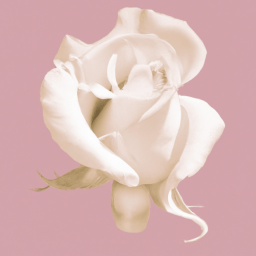
Flowers are a classic artistic subject for a reason, making beginning painting ideas centered on simple floral studies both beautiful and educational. This approach involves focusing on individual blooms or small arrangements, allowing you to practice organic shapes, color blending, and delicate brushwork. Think of iconic examples like Van Gogh’s sunflowers or Georgia O'Keeffe's magnified irises.
Unlike rigid geometric objects, flowers are forgiving. Their natural asymmetry means small mistakes often go unnoticed and can even add to the character of your piece. This freedom allows you to concentrate on capturing the essence of the flower—its color, form, and texture—rather than striving for perfect symmetry. It's a fantastic way to build confidence with more fluid and expressive brushstrokes.
Why This Method Works for Beginners
Floral studies are an excellent training ground for fundamental painting skills. You learn to observe and replicate gentle curves, overlapping shapes, and subtle shifts in color. Because you can start with a single, simple flower like a daisy or tulip, the project remains manageable. This focused practice on one subject helps develop your eye for detail and your ability to translate a three-dimensional object onto a two-dimensional canvas.
Key Insight: Painting flowers isn't about replicating every single petal perfectly. It’s about capturing the overall shape, gesture, and vibrant life of the bloom. Master the general form first, and the details will follow more naturally.
Actionable Tips for Your First Floral Study
A methodical approach will help you create a lively and convincing floral painting.
- Start with a Simple Subject: Choose a flower with a clear and distinct shape, like a tulip, poppy, or daisy. Use a real flower or a high-quality photograph as your reference to guide your shapes and colors.
- Block in the Basic Shapes: Before painting individual petals, lightly sketch or paint the overall shape of the flower head (a circle for a daisy, an oval for a rose) and the stem. This establishes your composition and proportions early on.
- Focus on Light and Shadow: Identify where the light hits your flower and where the shadows fall. Use lighter, warmer tones for the highlights and darker, cooler tones for the shadows to create a sense of volume and form.
- Use Varied Brushstrokes: Use the tip of your brush for fine lines, like veins on a leaf, and the flat side for broader petals. Varying your strokes adds texture and visual interest. For inspiration, knowing local wildflower bloom times can help you find fresh, vibrant subjects right in your area.
For those who enjoy the guided nature of this approach, you can explore ways to turn your own floral photos into structured projects. Learn more about how to make a paint-by-number on paint-by-number.com.
7. Cloud Studies
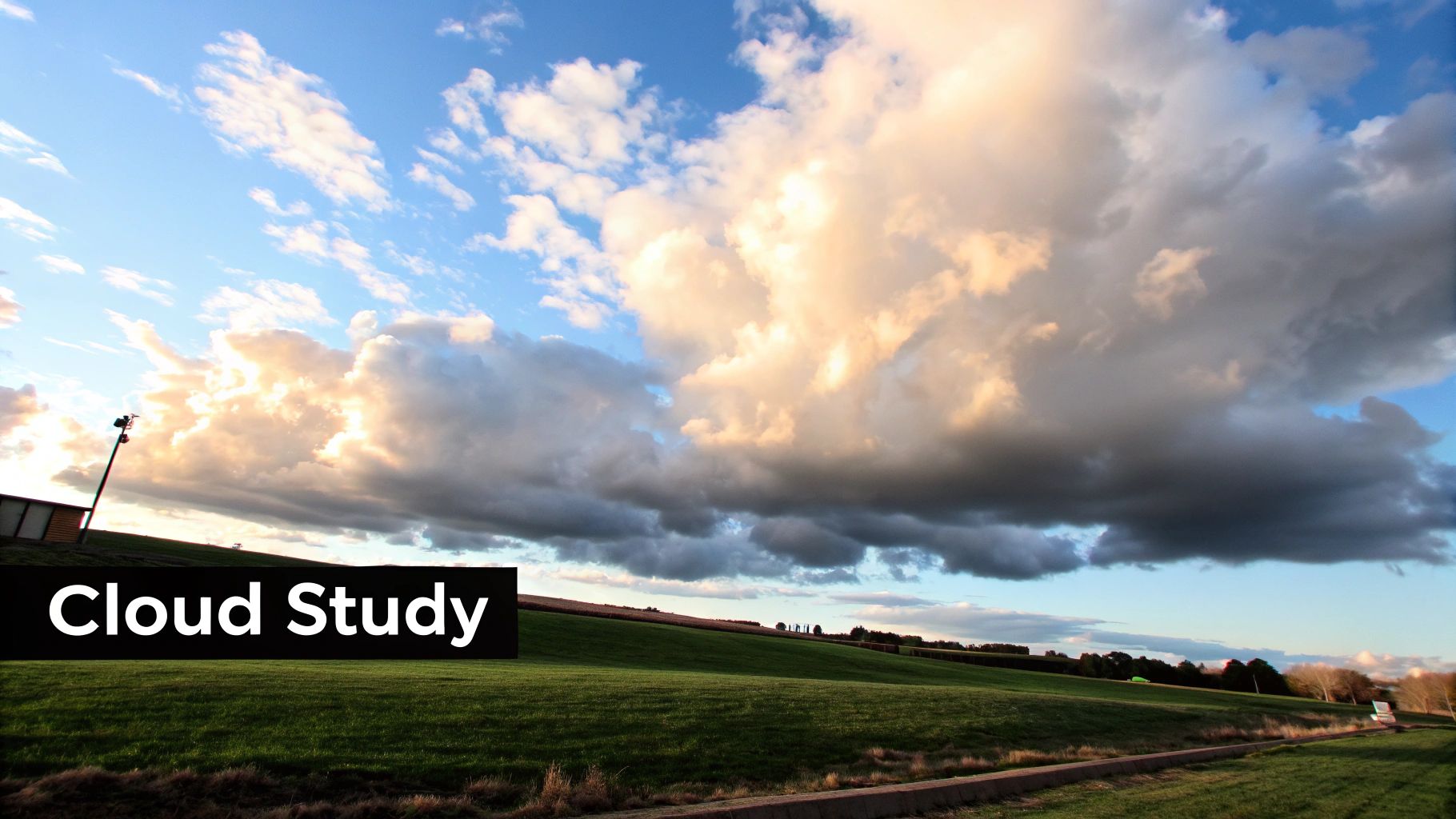
One of the most dynamic and forgiving beginning painting ideas is focusing exclusively on cloud studies. This involves painting different types of clouds and skies, from fluffy cumulus formations on a sunny day to the dramatic, moody skies of an approaching storm. Clouds are a superb subject because they are constantly changing, forcing you to work quickly and capture the essence of a form rather than getting lost in tiny details.
This practice is ideal for mastering some of painting’s most subtle yet crucial skills. By concentrating on the sky, you learn about creating soft, blended edges, understanding atmospheric effects, and manipulating color temperature to convey light and mood. Clouds are forgiving; there’s no “wrong” way to paint one, which frees you to experiment with brushwork and blending techniques without fear of failure.
Why This Method Works for Beginners
Cloud studies are effective because they teach you to paint light itself. You learn how sunlight filters through, reflects off, and is absorbed by vapor, which translates directly to painting any other object. Observing and painting clouds trains your eye to see subtle shifts in value and color, a skill championed by masters like John Constable, who used his famous cloud studies to understand the atmosphere.
Key Insight: Painting clouds isn't just about creating a background; it's a focused exercise in understanding form, light, and atmosphere. Mastering the sky gives you the technical ability to render soft, dimensional objects of any kind.
Actionable Tips for Your First Cloud Study
To start capturing the beauty of the skies, approach it with a clear strategy.
- Work Quickly and Decisively: Clouds morph and move constantly. Work alla prima (wet-on-wet) to capture their shape and light before they change. This forces you to make confident brushstrokes and avoid overthinking.
- Use Large, Soft Brushes: To achieve the soft, billowy look of clouds, use larger, softer brushes (like a filbert or a mop brush). This helps you lay down broad areas of color and blend edges seamlessly without leaving harsh lines.
- Paint the Sky First, Then the Clouds: Start by painting the blue of the sky. While it's still wet, begin adding the white, gray, and other colors of the clouds. This allows the colors to mix slightly on the canvas, creating natural, soft transitions.
- Observe How Clouds Overlap: Pay attention to how clouds are layered. The clouds closest to you will often appear brighter and more detailed, while those farther away become smaller and less defined. Painting clouds on top of other clouds creates a powerful sense of depth and realism.
7 Beginner Painting Ideas Comparison
| Painting Type | Implementation Complexity 🔄 | Resource Requirements ⚡ | Expected Outcomes 📊 | Ideal Use Cases 💡 | Key Advantages ⭐ |
|---|---|---|---|---|---|
| Simple Landscapes with Basic Shapes | Low 🔄 | Minimal ⚡ | Fundamental composition, color mixing, brush control | Beginners, art classes, quick practice | Builds confidence, easy to complete, teaches basics |
| Abstract Color Studies | Medium 🔄 | Moderate ⚡ | Understanding color harmony, personal style development | Creative exploration, emotional expression | No "wrong" way, encourages style, builds color confidence |
| Still Life with Fruit | Medium 🔄 | Basic setup (fruit) ⚡ | Observation skills, light and shadow practice | Controlled environment, art foundation courses | Static subjects, realistic practice, improves proportion |
| Monochromatic Paintings | Low-Medium 🔄 | Minimal ⚡ | Value relationships, tonal harmony | Focus on values, simplified color mixing | Eliminates color mixing confusion, cohesive look |
| Basic Seascapes | Medium 🔄 | Moderate (brushes, colors) ⚡ | Blending techniques, atmospheric depth | Fluid subjects, landscape workshops | Forgiving subject, teaches blending, calming |
| Simple Floral Studies | Low-Medium 🔄 | Minimal ⚡ | Organic shapes, color variety, brush control | Study of natural forms, beginner floral painting | Naturally beautiful, forgiving mistakes, good color practice |
| Cloud Studies | Medium 🔄 | Minimal ⚡ | Atmospheric perspective, soft edges, blending | Quick studies, atmospheric effects practice | Develops blending, always available subject |
Your Artistic Journey Has Begun
You’ve explored a vibrant collection of beginning painting ideas, from the tranquil simplicity of monochromatic landscapes to the energetic chaos of abstract color studies. Each project we've detailed is more than just a creative exercise; it's a foundational building block for your artistic future. Think of these ideas as your personal toolkit, designed to equip you with essential skills and, most importantly, the confidence to face any blank canvas.
The journey from a nervous beginner to a confident artist is paved with practice. Remember the core principles we covered: layering colors in a seascape, breaking down a landscape into basic shapes, and capturing light and shadow on a single piece of fruit. These are not just one-off tricks; they are the fundamental techniques that professional artists use every day. Mastering them opens a door to infinite creative possibilities.
Key Takeaways for Your Creative Path
The most valuable lesson from these projects is understanding that art is a process, not just a final product. Every brushstroke is a decision, and every finished piece, whether you deem it a success or a "learning experience," adds to your visual vocabulary.
Here are the essential takeaways to carry forward:
- Embrace Simplicity: Complex subjects are built from simple shapes. By starting with basic landscapes, fruit, and florals, you train your eye to see the world in manageable components.
- Color is Your Ally: Abstract color studies and monochromatic paintings teach you how colors interact, create mood, and build depth. This knowledge is crucial for every future painting you undertake.
- Don't Fear Mistakes: An unexpected color mix or a wobbly line isn't a failure. It’s an opportunity. Many beautiful artistic discoveries happen by accident, so allow yourself the freedom to experiment without pressure.
Your Actionable Next Steps
Your momentum is high, and the best way to keep it going is to act. Don't let this newfound inspiration fade. Pick one of the beginning painting ideas that sparked the most excitement for you and commit to starting it this week. Gather your supplies, set aside a little time, and just begin.
The most critical step is to keep your brush moving. The more you paint, the more intuitive the process will become. You'll learn how your specific paints behave, which brushes you prefer, and how to translate the image in your mind onto the canvas. Your artistic journey has well and truly begun; the only requirement now is to keep walking the path, one colorful step at a time. Enjoy every moment of bringing your unique vision to life.
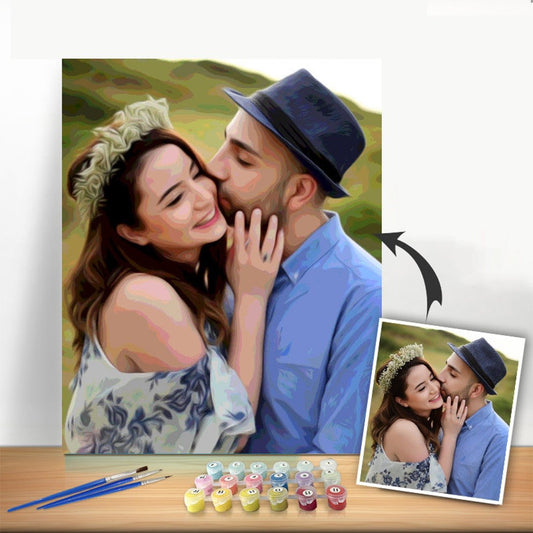
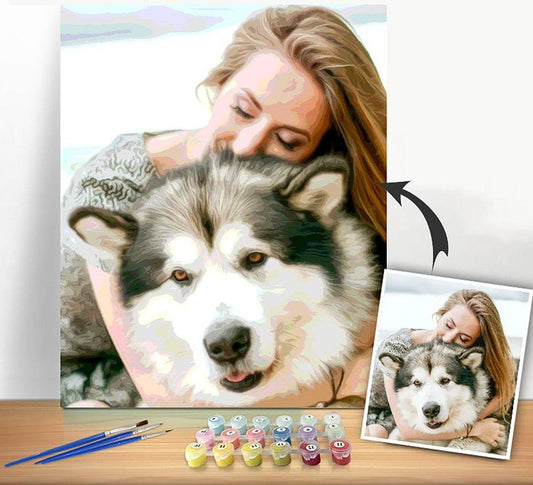
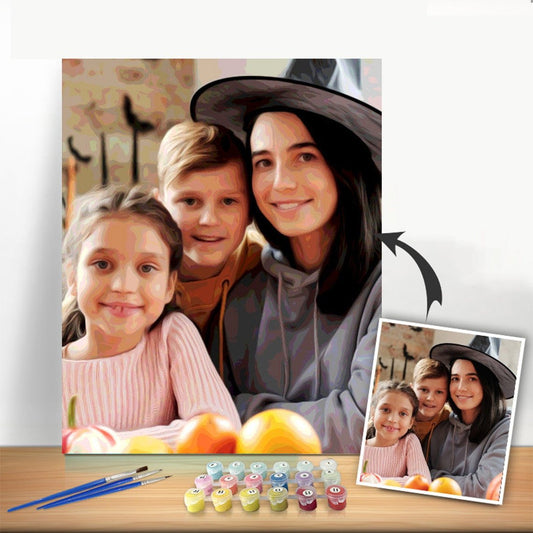
Ready to create a stunning, personalized masterpiece with a bit of expert guidance? Transform your favorite photo into an easy-to-follow project with a kit from Custom Paint By Numbers. It’s the perfect next step, combining the creative freedom you’ve been practicing with a structured path to a beautiful, frame-worthy painting.