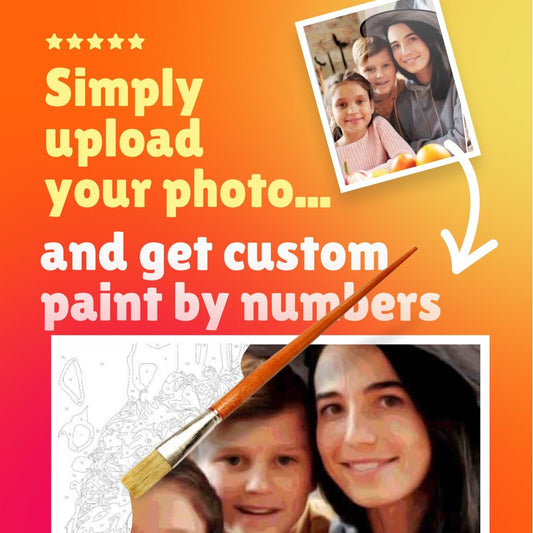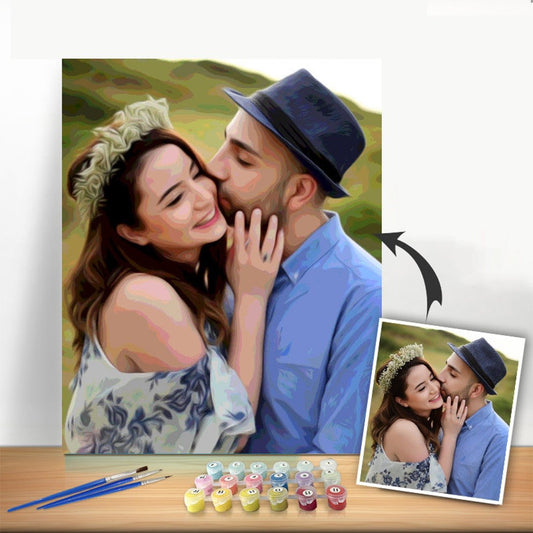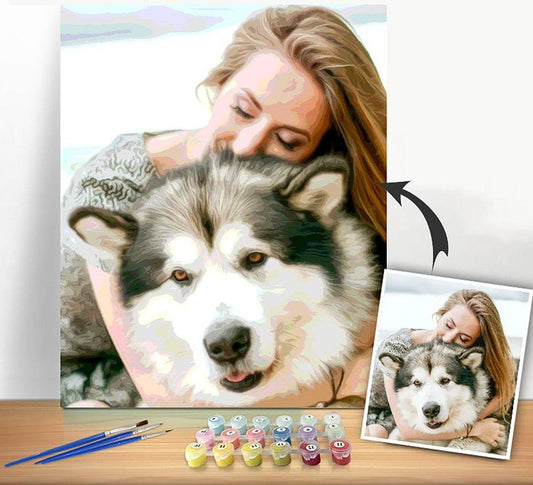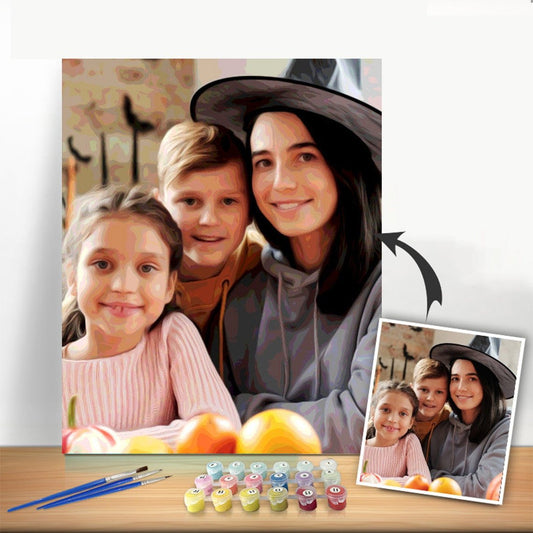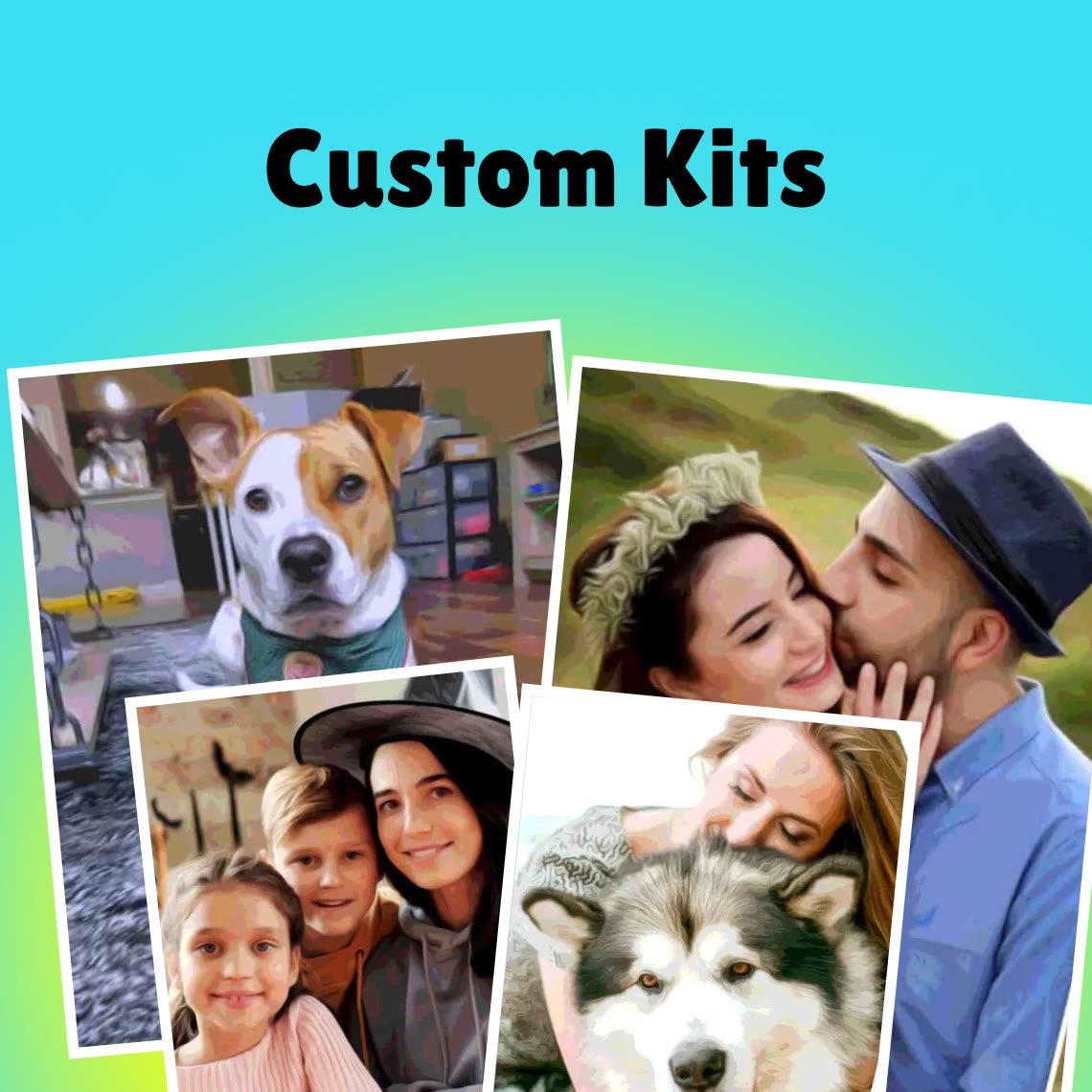

Picking the right size for a custom paint-by-number canvas really boils down to three things: the shape of your photo, the wall space you have, and how much detail you want to capture. This canvas sizing guide is your roadmap to getting those three elements to work together perfectly. The goal is to choose a canvas that honors your photo's original shape and looks fantastic in the room you plan to hang it in.
Your Quick Guide to Perfect Canvas Dimensions
Turning a favorite photo into a paint-by-number kit is such a cool idea. But that first step—choosing the canvas size—can feel a little daunting. If you pick the wrong dimensions, you might end up with an awkwardly cropped photo or a finished piece that just looks lost (or way too big) on your wall. This guide is here to take the guesswork out of the equation.
We'll start with the basics, like aspect ratio and resolution, but in simple terms. Think of it like this: you wouldn't force a tall, skinny photo of a skyscraper onto a wide, short canvas without lopping off the top. The same logic applies here. Getting it right from the beginning is the secret to a painting you'll be thrilled with.
Getting Started with Common Sizes
To make things even easier, let's look at what canvas sizes usually work best for different kinds of photos. This table is a great starting point for matching your picture—whether it's a close-up portrait or a sweeping landscape—to a standard canvas size.
Quick Canvas Size Recommendations by Photo Type
Here’s a simple chart to help you match your photo's subject to a canvas size that will really make it shine.
| Photo Type | Best For | Recommended Small Size (e.g., 12x16in) | Recommended Large Size (e.g., 24x36in) |
|---|---|---|---|
| Portrait/Headshot | A single person or pet, focusing on facial details. | 12x16 inches (30x40 cm) | 20x24 inches (50x60 cm) |
| Couples/Family (2-4 people) | Capturing interactions and upper body shots. | 16x20 inches (40x50 cm) | 24x30 inches (60x75 cm) |
| Group Photo (5+ people) | Wider shots that include multiple subjects. | 20x24 inches (50x60 cm) | 30x40 inches (75x100 cm) |
| Landscape/Scenery | Expansive scenic views and architectural photos. | 16x24 inches (40x60 cm) | 24x36 inches (60x90 cm) |
This chart gives you a solid feel for what dimensions work for most situations, helping you visualize the final piece.
It's no surprise that personalized art is booming. The paint-by-numbers market is one of the fastest-growing hobbies out there, and personalized kits are expected to make up 40% of the adult market by 2027. People are clearly craving creative projects that feel personal and meaningful. You can dig into more of these trends in this industry analysis on growthmarketreports.com.
Once you have a size in mind, it's a good idea to browse different options for custom canvas prints to see how professionals display them. The most important thing is feeling confident in your choice before you place your order. When you understand how your photo, your canvas, and your wall all connect, you're setting yourself up for a painting you’ll be proud of for years to come.
How to Match Your Photo to the Right Canvas
Choosing the right canvas size is probably the most critical decision you'll make when turning a photo into a paint-by-number kit. This is where art and a little bit of simple geometry come together. If you get this part right, you’re set up for a stunning result.
There are two key ideas you need to get a handle on: aspect ratio and image resolution. Don't worry, they're not as technical as they sound. Once you understand them, you'll be able to pick the perfect canvas every single time, avoiding any weird stretching or blurry outcomes. Think of it this way: aspect ratio gets the shape right, and resolution makes sure the final painting is sharp and clear.
Understanding Aspect Ratio
So, what is aspect ratio? It’s just a way to describe the relationship between an image's width and its height. For example, a perfect square photo has a 1:1 aspect ratio because its width and height are exactly the same. Your typical landscape photo, on the other hand, might have a 3:2 ratio, making it a good bit wider than it is tall.
Here’s a simple analogy: imagine trying to watch a modern widescreen movie on an old, square TV. You’d end up with those big black bars at the top and bottom, or worse, the image would be stretched out to fill the screen, making everyone look short and wide. The exact same thing happens with your photo. If you try to force a tall, skinny portrait onto a short, wide canvas, it's just not going to look right.
To prevent this, our system will guide you to crop your image so it perfectly matches the canvas shape you pick. This is the secret to making sure your final painting looks natural, not squished or stretched. For the best results, always try to choose a canvas that has a similar shape to your original photo from the start.
This quick decision guide can help you find that sweet spot between what your photo can handle, how much wall space you have, and the level of detail you're hoping for.
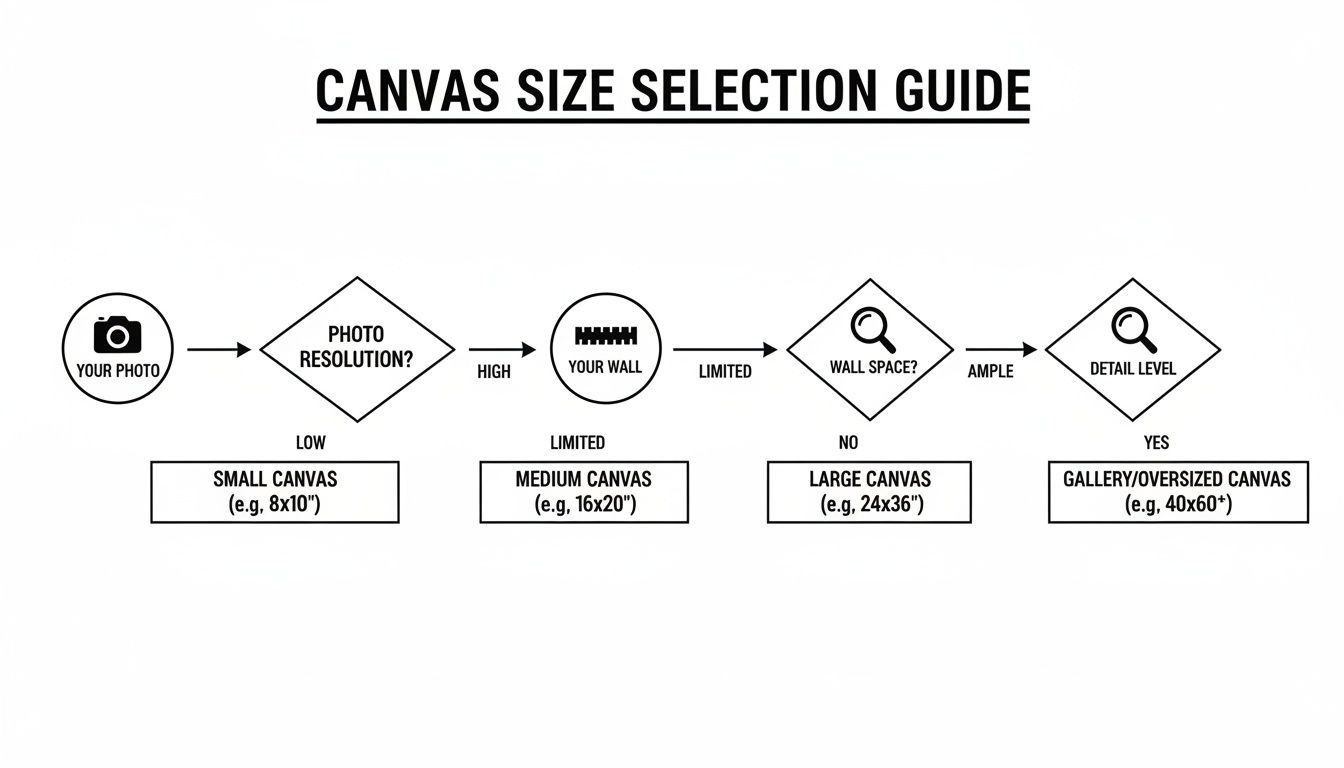
As you can see, it's a balancing act. Your photo's quality sets the upper limit on size, while your wall and artistic vision help you zero in on the perfect choice.
Why Image Resolution Is So Important
If aspect ratio is about the shape, image resolution is all about the quality. Think of your photo as being made up of thousands of tiny little building blocks called pixels. The more pixels you have, the more detail you can pack into the picture.
A photo that looks crystal clear on your phone screen might not have enough of those pixel "building blocks" to look good when blown up to a large canvas size. When you stretch a low-resolution image too far, the individual pixels start to become visible, making the image look blurry, blocky, or what people call "pixelated." This is precisely why starting with a high-quality, original photo file is a non-negotiable for a beautiful result.
Key Takeaway: A bigger canvas needs a photo with a higher resolution (more pixels) to stay sharp. Steer clear of photos you've downloaded from social media for larger canvases—they are always compressed and lose a ton of that essential detail.
For more pro tips on getting the best results, take a look at our complete guide on how to turn photo into canvas painting.
How to Check Your Photo's Resolution
Don't worry, you don't need any special software to figure out if your photo is up to the task. It's actually a really simple check you can do right on your computer or phone.
On a Windows PC:
- Right-click on your image file.
- Choose “Properties” from the menu.
- Click on the “Details” tab.
- You'll see the dimensions listed right there (e.g., 4032 x 3024 pixels).
On a Mac:
- Right-click (or Control-click) your image file.
- Select “Get Info”.
- In the window that appears, look for the “More Info” section and expand it.
- The pixel dimensions will be listed there.
On an iPhone or Android Phone:
- Open the picture in your phone’s photo gallery.
- Look for an "Info" button (it’s often an "i" in a circle) or tap the three-dot menu.
- The image details, including the resolution in pixels, will pop up.
Once you have those numbers, you can use them to choose a canvas size that your photo can truly support.
To make this even easier, here’s a handy chart that shows the minimum resolution we recommend for some of our most popular canvas sizes.
Minimum Photo Resolution for Popular Canvas Sizes
This table gives you the pixel dimensions your photo needs to have to ensure it looks sharp and detailed when printed on different canvas sizes. Aim for the "Ideal" dimensions if you can, but the "Minimum" will still give you a great result.
| Canvas Size (Inches) | Aspect Ratio | Minimum Required Photo Dimensions (Pixels) | Ideal Photo Dimensions (Pixels) |
|---|---|---|---|
| 16 x 20 | 4:5 | 1200 x 1500 | 2400 x 3000 |
| 16 x 24 | 2:3 | 1200 x 1800 | 2400 x 3600 |
| 20 x 20 | 1:1 | 1500 x 1500 | 3000 x 3000 |
| 20 x 30 | 2:3 | 1500 x 2250 | 3000 x 4500 |
| 24 x 36 | 2:3 | 1800 x 2700 | 3600 x 5400 |
By checking your photo's resolution against this chart, you can confidently pick a size that guarantees your final painting will be a work of art you’re proud to display.
Finding the Perfect Fit for Your Wall Space
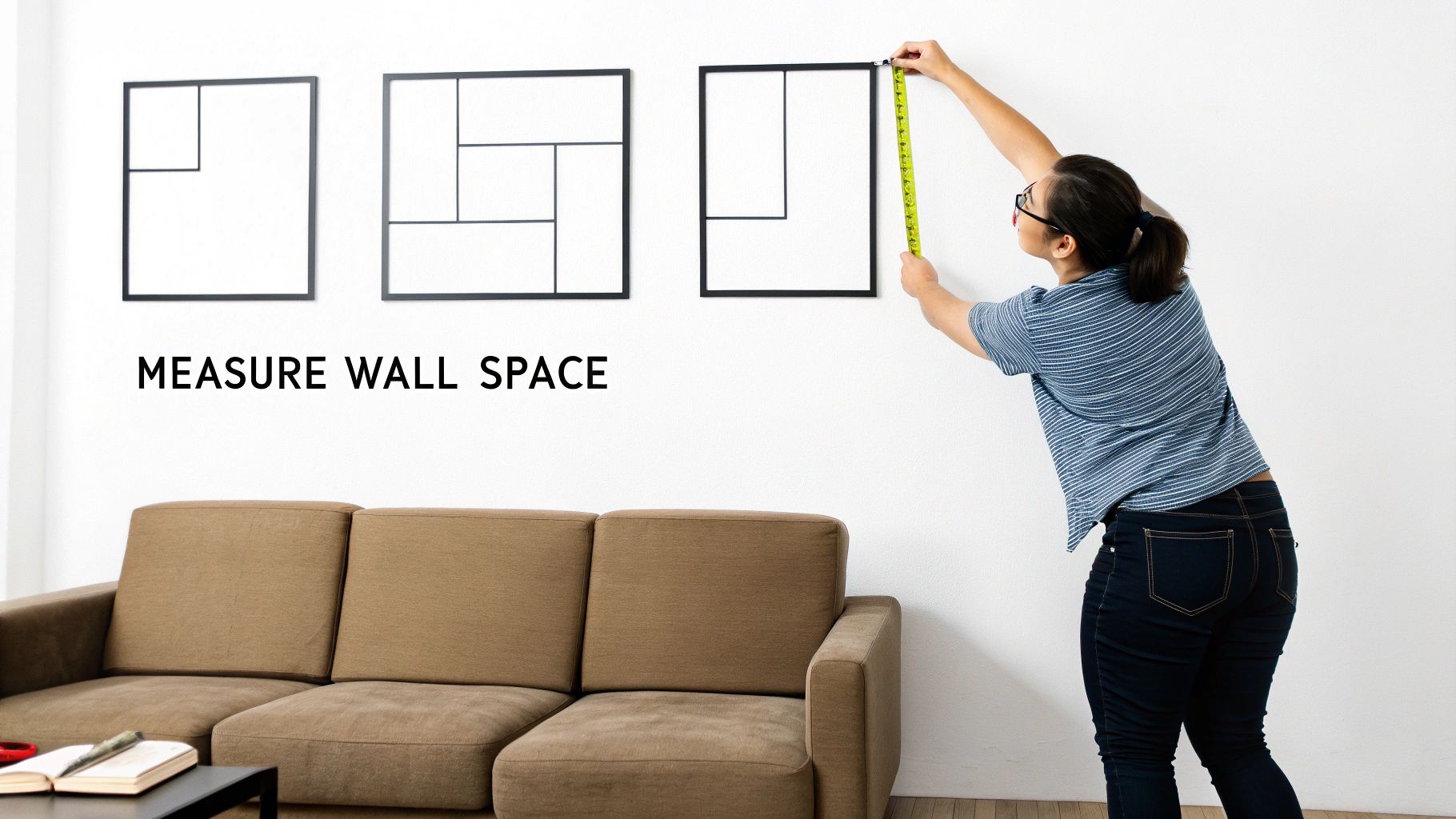
So you've perfectly matched your photo to a canvas size. That’s a huge step! But there's one last piece to the puzzle: your wall. A canvas that looks great on the screen can feel totally out of place if it swallows a small nook or gets lost on a big, empty wall. Taking just a few minutes to measure will make sure your finished masterpiece looks like it was always meant to be there.
Think of it like buying a new sofa. You wouldn't just guess and hope it fits, right? The same logic applies here. This final check bridges the gap between your digital photo and its real-world home, ensuring everything looks balanced and beautiful.
Mastering Proportions with the Two-Thirds Rule
Interior designers have a few go-to tricks for making a room feel just right, and you can borrow them. One of the best is the two-thirds rule, which works wonders when you're hanging art above furniture like a sofa, bed, or console table.
Here’s how simple it is: your artwork should be about two-thirds the width of the furniture below it. This simple proportion creates a visual anchor, tying the art and the furniture together. If the canvas is too small, it will look like it's floating aimlessly. Too wide, and it can make your furniture look tiny.
Let’s see it in action:
- Say your sofa is 90 inches wide.
- Multiply that by two-thirds: 90 x (2/3) = 60 inches.
- Your sweet spot is a canvas (or a group of them) with a total width of around 60 inches.
Also, aim to hang the bottom of the frame about 6-10 inches above the furniture. That little bit of breathing room is the sweet spot—enough to create separation without making the art feel disconnected.
Finding the Right Eye Level
What about a blank wall with no furniture? The goal here is simple: hang your canvas at a comfortable viewing height. Art galleries have this down to a science. They hang art so the center point is at eye level, which for most people is between 57 and 60 inches off the floor.
Pro Tip: If you have family members of all different heights, just split the difference and use 58 inches as your center point. It’s a foolproof standard that ensures people see your art at a comfortable gaze, not by craning their necks up or looking down.
This one measurement is the secret to avoiding the most common decorating mistake: hanging art way too high.
Visualize Before You Commit
Before you hit that "buy" button, it's a great idea to do a quick mockup on your wall. You don't need fancy software—just some painter's tape or a sheet of craft paper will do the trick.
- Cut It Out: Cut a piece of paper to the exact size of the canvas you're thinking about.
- Tape It Up: Use painter's tape to stick your paper template on the wall right where you plan to hang your art.
- Stand Back: Now, walk around the room. Look at it from the doorway, from the couch, from different angles. How does it feel? Does it fit the scale of the wall and the room?
This test takes five minutes but gives you so much confidence. You’ll know for sure how the final canvas will fill the space, and you can say goodbye to any size-related regrets.
It's no surprise that people are getting more creative at home. The market for non-commercial acrylic paint in the U.S. was estimated at USD 312.8 million in 2025 and is expected to grow to USD 485.7 million by 2035. The high-quality Artist Grade paints actually make up 57.5% of that market, showing that people are serious about getting good results. If you're interested, you can find more details on U.S. acrylic paint market trends over at futuremarketinsights.com.
Choosing Your Canvas Display Style
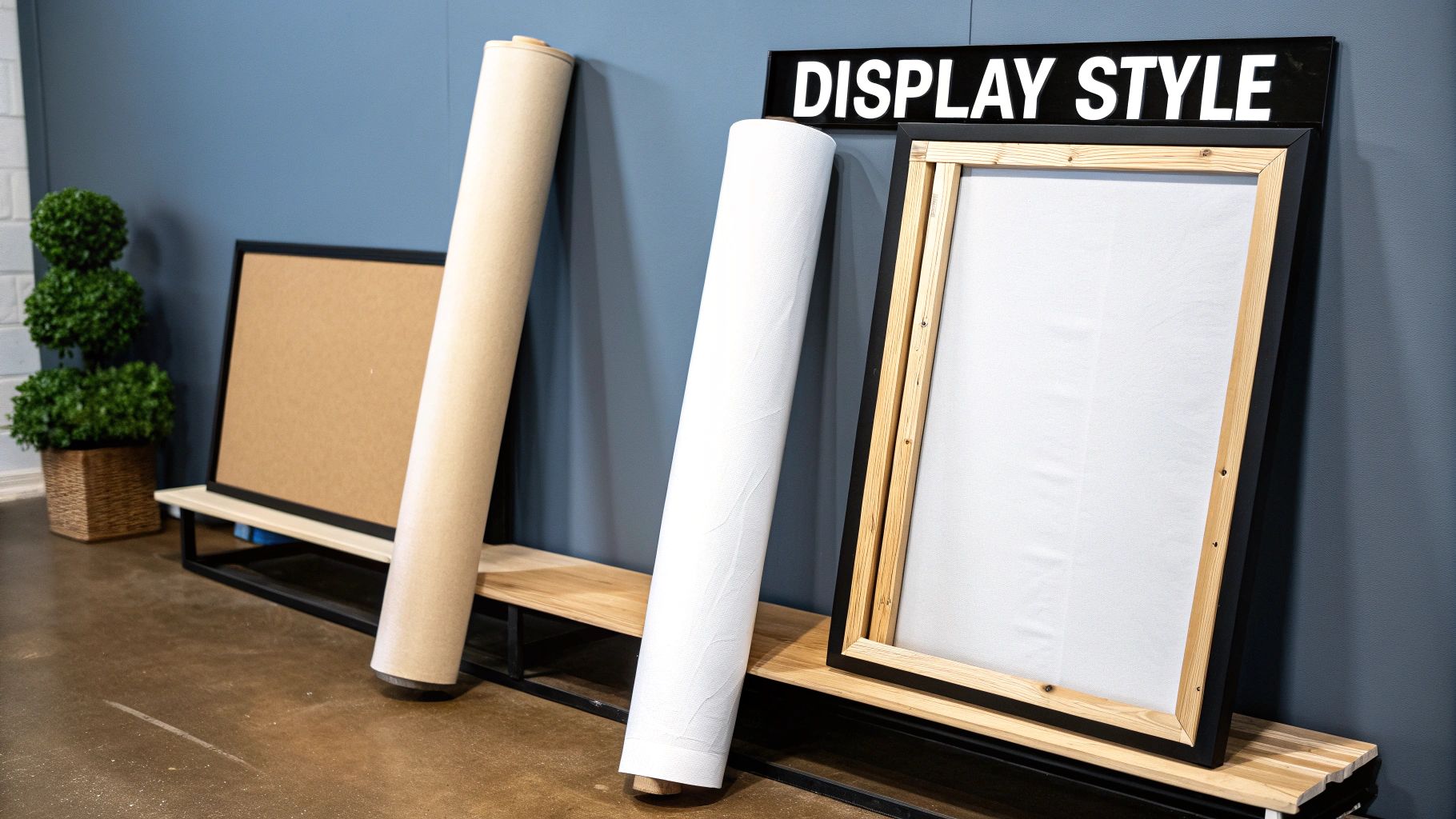
How you present your finished painting is just as important as the artwork itself. This is the final, crucial step in our canvas sizing guide, and it affects both the look of your piece and its final dimensions on your wall. You've got three main options, each with its own vibe and level of hands-on involvement.
Your choices are the rolled canvas (a blank slate for future framing), the DIY stretcher frame (for a classic gallery look), or a pre-framed canvas that’s ready to hang right out of the box.
Rolled Canvas vs. DIY Stretcher Frame
A rolled canvas is exactly what it sounds like—it’s the most basic option, giving you total freedom to pick out your own frame later. But for most people, the DIY stretcher frame is the perfect middle ground. Think of it as a simple, satisfying puzzle where you assemble a wooden frame and stretch your canvas over it.
This process gives your painting that taut, professional structure you see in galleries. It's a great little project that really connects you to the final piece. If you're new to this, we have a complete walkthrough on how to frame canvas paintings that breaks it all down.
The Impact of Framing on Final Dimensions
Here’s a detail people often forget: the frame adds to the overall size of your art. It’s not just a decorative border; it physically expands the footprint of your painting.
A standard 16x20 inch canvas can easily become an 18x22 inch piece once you add a decorative frame. Always account for this extra size—usually one to three inches on each side—when you’re measuring your wall space.
This is a huge deal for tight spaces or carefully planned gallery walls where every inch counts. Forgetting to factor in the frame can turn what you thought was a perfect fit into a piece that’s just a little too big.
Gallery Wraps vs. Decorative Frames
The display style you choose really plays into your home’s decor. A DIY stretcher frame creates what’s called a gallery wrap, where the image extends around the sides of the frame. This gives you a clean, modern, and borderless look that lets the art be the hero. It’s perfect for contemporary and minimalist spaces.
On the other hand, a traditional decorative frame adds a classic, polished finish. It can be ornate or simple, but its job is to create a distinct border that draws the eye inward. This style works beautifully with traditional, rustic, or eclectic decor, helping you tie the artwork into the room's overall color palette and style.
Making sure your canvas truly complements your space goes beyond just size. You can explore more tips for choosing and displaying artwork in interior design to get it just right.
The explosion of at-home art is backed by a serious industry. The North American painting tools market, which covers all the supplies you need for paint-by-numbers, was valued at USD 3.79 billion in 2024 and is only expected to grow. This just shows how much people love creative projects like these.
Selecting a Canvas for Any Occasion
Picking the right canvas is about more than just measurements and pixels. It’s an emotional choice. The right size can transform a simple photo into a treasured keepsake, a fun group activity, or a gift that truly wows. Your goal for the final painting should be the first thing you think about.
By considering the purpose behind your custom paint-by-number kit, you can quickly narrow down your options and find the perfect fit. Let's walk through the three most common reasons people create these paintings—as a gift, for family fun, or to create a personal masterpiece—and I'll share some practical advice for each.
The Perfect Gift for Someone Special
When you’re making a gift, you want it to feel personal and impressive. The tricky part is, you probably don't know the exact dimensions of their available wall space. This is where a versatile, mid-range canvas becomes your secret weapon.
For most big moments like weddings, anniversaries, or milestone birthdays, the 16x20 inch (40x50 cm) canvas is the gold standard. It's large enough to have a real "wow" factor when it's unwrapped, capturing all the important details in a portrait or a photo of a couple. But it's not so huge that they'll struggle to find a spot for it.
A 16x20 inch canvas strikes that perfect balance between impact and practicality. It feels like a significant piece of art but is still flexible enough to fit into most homes, whether on a gallery wall or as a standalone feature in a bedroom.
Here are a few popular gift scenarios and the sizes that work best:
- For a Wedding or Anniversary: A 16x20 or 20x24 inch canvas of an engagement photo is a classic choice that never fails.
- For a Pet Lover: A 12x16 inch portrait is just right for capturing the personality of a beloved pet without taking over a room.
- For a Housewarming: A beautiful landscape from a special place on a 16x24 inch canvas adds a thoughtful, personal touch to a new home.
The key is to pick a size that feels generous without being a burden. It's a safe bet that's always appreciated.
The Fun Family Project
If your goal is a shared activity, the focus shifts from tiny, perfect details to collaborative fun. A paint-by-number project is a fantastic way to get the family together, but a canvas with thousands of microscopic sections can quickly turn into a frustrating chore, especially for kids.
For a family project, think bigger and simpler. A larger canvas, like a 24x30 inch or even a 30x40 inch one, gives everyone elbow room to work together. More importantly, the numbered sections themselves will be bigger and much easier for little hands to paint.
To really set yourself up for success, choose a photo that's more about bold shapes and colors than fine details. A family photo against a clean background or a vibrant, colorful landscape works perfectly. This way, the project becomes a fun team effort where everyone can see their contribution come to life, rather than a painstaking solo mission.
The Cherished Memory Turned Centerpiece
Every once in a while, you capture a photo that's so special it deserves to be the star of the show. It might be a professional family portrait, a breathtaking travel shot, or a once-in-a-lifetime candid moment. For these memories, you're not just making a painting—you're creating a focal point for an entire room.
This is your moment to go big. Don't shy away from statement sizes like 24x36 inches or 30x40 inches. These larger canvases give your most precious photos the scale they deserve, turning them from a simple picture into a commanding piece of art. A large canvas lets every detail shine, from the subtle expressions on faces to the rich textures in a landscape.
Just one final check: before you commit to a huge canvas, make sure your original photo has a high enough resolution to handle being enlarged. A crisp, high-quality photo is the non-negotiable ingredient for a stunning centerpiece. When you give a powerful image the space it needs to breathe, you create more than just a painting—you create an heirloom.
Your Final Checklist Before Ordering
You've done the heavy lifting and are just one click away from starting an incredible art project. Think of this as your final pre-flight check before you take off on this creative journey.
Running through these quick questions will give you total confidence in your order. It's the best way to make sure every little detail, from photo quality to wall space, is perfectly aligned for a fantastic result.
Photo and Canvas Match
First, let's double-check the technical stuff. This is the foundation of a great custom paint-by-number kit.
- Aspect Ratio: Does the canvas shape you picked (like a 4:5 ratio) match the shape of your photo? Getting this right is the secret to avoiding weird or unwanted cropping.
- Image Resolution: Does your photo have enough pixels for the canvas size you want? A bigger canvas needs more pixels to look sharp and clear.
- Photo Source: Are you using the original, high-resolution file? It's best to steer clear of images you've saved from social media, as they're usually too compressed and won't print well.
Final Check: Take one last look at the resolution chart. This confirms your photo has enough "pixel power" to create a crisp, detailed painting you'll be proud to show off.
Wall Space and Display Style
Now, let's think about where your finished artwork will live. This step ensures your painting looks like it truly belongs in your space.
Have you measured the wall where your masterpiece will hang? A great rule of thumb is the two-thirds rule for hanging art over furniture—it helps create a really balanced, professional look.
Also, have you landed on a display style? Don't forget that a decorative frame will add a few extra inches to the final dimensions, which is a crucial detail for getting the placement just right. After you've completed your beautiful painting, you'll want to protect it. Our guide on how to seal acrylic paint on canvas gives you simple steps to preserve your work for years.
By running through this quick list, you’re not just ordering a kit. You’re setting yourself up for a truly rewarding experience. You're ready—go create something amazing.
Still Have a Few Questions About Sizing?
Even after you've done all the measuring and checking, a few last-minute questions can pop up right before you hit "order." Don't worry, that's completely normal. This section tackles the most common uncertainties we see, acting as a final check-in to make sure you're feeling 100% confident in your choice.
We'll run through some quick, clear answers to clear up any lingering doubts. From photo quality concerns to gift-giving dilemmas, we've got you covered.
What Happens if My Photo Shape Doesn't Match the Canvas?
This is a great question, and it comes up all the time. If your photo's aspect ratio—its basic shape—is different from the canvas you’ve chosen, your image will need to be cropped to fit.
Think about trying to fit a square Instagram photo onto a rectangular 16x20 inch canvas. Something's got to give. To make it work, you'd have to trim parts off the top and bottom or the sides of your picture. Our online tool is fantastic for this because it gives you a live preview, showing you exactly what will be cut so there are no surprises.
Still, the best approach is to avoid losing important details in the first place—like the top of someone’s head or a key part of the background. Try to pick a canvas shape that mirrors your original photo as closely as you can right from the start.
Can I Use a Photo From Social Media for a Large Canvas?
I'm going to be direct here: please don't. We strongly recommend against using photos from social media for any large canvas, like a 24x36 inch piece. It's almost always a recipe for disappointment.
Here’s the thing: social media platforms like Instagram and Facebook squash your photos. They compress them heavily to save server space and help them load faster, but this process permanently strips away the photo's resolution and quality.
An image might look perfectly sharp on your phone screen, but that low resolution becomes painfully obvious when it's blown up. The final painting will likely turn out pixelated, blurry, and missing all the crisp detail you were hoping for. For the best results, you always want to use the original, high-resolution photo file straight from your camera or smartphone.
What's the Best Canvas Size for a Gift?
If you want a guaranteed winner for a gift, you can't go wrong with the 16x20 inch (40x50 cm) canvas. It's our most popular size for a reason and has earned its reputation as the perfect gift.
It's large enough to have a real visual impact and show off plenty of detail, making the recipient feel like they've received something substantial and special. At the same time, it’s not so huge that they'll have a hard time finding a place to hang it.
The 16x20 inch size is just incredibly versatile. It works beautifully for solo portraits, pet pictures, and couple photos, making it a thoughtful and safe bet for almost any occasion, from an anniversary to a birthday.
How Does the Level of Detail Affect Canvas Size?
The amount of detail packed into your photograph should be a major factor in your decision. You have to give your image enough room to breathe.
If you have a really detailed picture—like a busy cityscape, a dense forest scene, or a group photo with a lot of faces—you’ll want to go with a larger canvas. A bigger surface area means the little numbered painting sections will be larger and easier to see and paint, which makes the whole process way more enjoyable.
On the other hand, simpler photos with big, bold blocks of color or a clean, simple background look fantastic on just about any size canvas. They’re especially great for smaller formats and are a perfect choice if you're a beginner or just looking for a more relaxed painting session.
Ready to turn that favorite memory into a piece of art? At Custom Paint By Numbers, our tool makes it simple to upload your photo, pick the perfect size, and order a high-quality kit with everything you need. Create your personalized masterpiece today by visiting https://paint-by-number.com.