
Just as our bodies need physical exercise to stay strong and healthy, our brains require regular workouts to maintain sharpness, memory, and overall function as we age. Engaging in stimulating mental exercises isn't merely a way to pass the time; it is a vital component of healthy aging that can significantly improve quality of life, preserve independence, and may even help delay the onset of cognitive decline. These activities provide the mental resistance needed to build and maintain cognitive reserves, helping the brain become more resilient and adaptable.
This guide moves beyond generic advice to provide a comprehensive and actionable roundup of 10 powerful cognitive activities for seniors. We created this list for anyone seeking structured and engaging ways to support brain health, from individuals wanting to enrich their own daily routines to family members and professional caregivers looking for meaningful ideas. Each activity is broken down with a clear focus on practical implementation.
Inside this article, you will discover:
- Specific Cognitive Benefits: Understand exactly which mental skills each activity targets.
- Step-by-Step Instructions: Clear, simple guidance on how to get started right away.
- Practical Adaptations: Modifications for varying levels of mobility or cognitive impairment.
- Helpful Tips: Actionable advice for seniors and their caregivers to maximize engagement and enjoyment.
We’ll explore everything from creative arts like paint-by-number to strategic games like chess, and social learning through local classes. This resource is designed to be your go-to reference for proven, enjoyable, and effective strategies to nurture a vibrant, active mind for years to come.
1. Brain Training Games and Apps
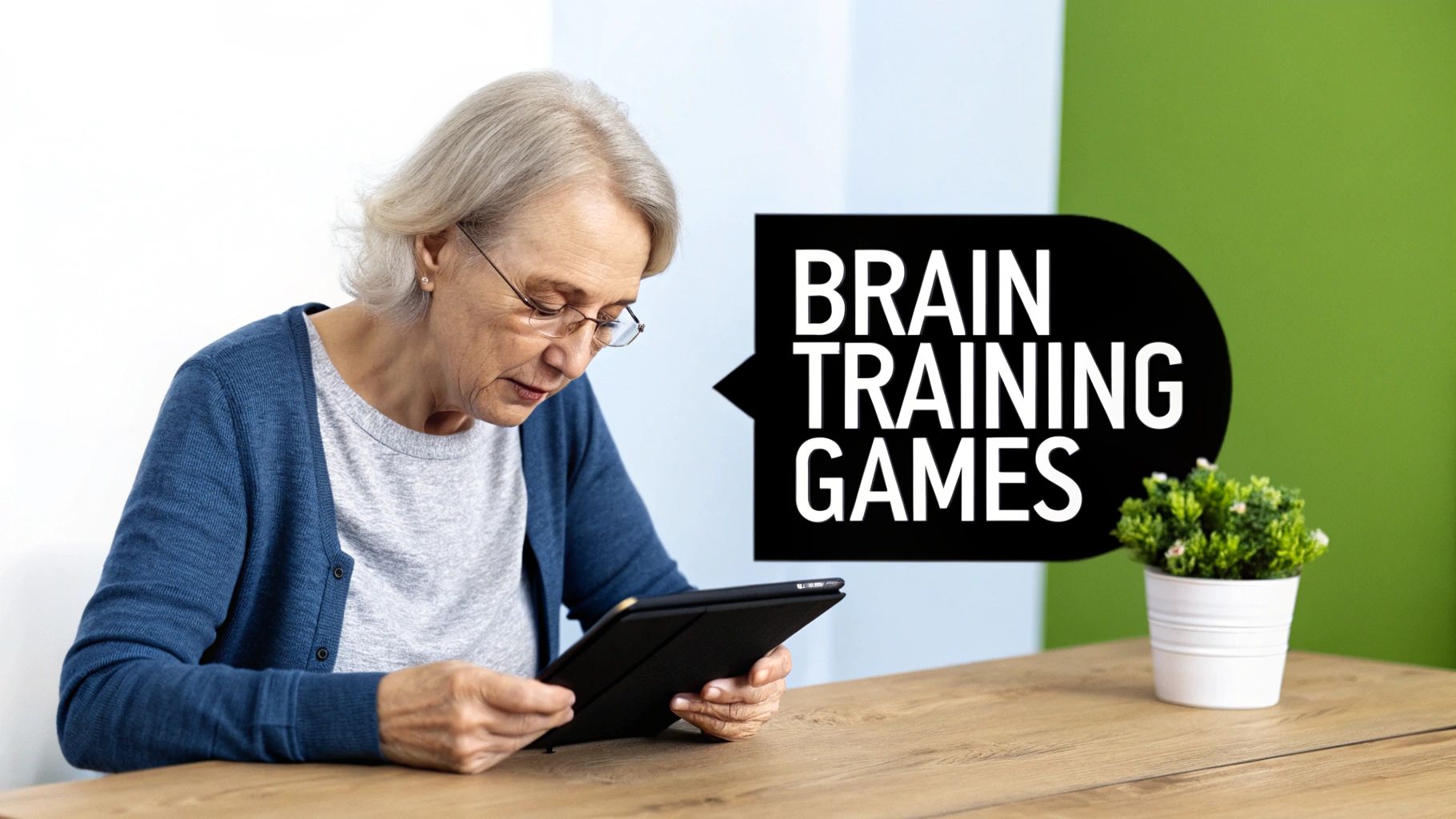
Brain training games and apps offer a convenient and engaging way to stimulate the mind. These digital tools are specifically designed to target and strengthen key cognitive functions like memory, attention, problem-solving, and processing speed. They often adapt to the user's performance, providing a personalized challenge that is neither too easy nor too frustrating. This makes them one of the most accessible cognitive activities for seniors in the digital age.
Cognitive Benefits
Engaging with these apps provides a structured mental workout. Consistent use can lead to improved short-term memory, quicker reaction times, and enhanced focus. The variety of games ensures that multiple areas of the brain are activated, promoting overall cognitive resilience and flexibility.
Getting Started: A Sample Session
A typical session can be simple and effective.
- Choose a Platform: Select an app like Lumosity, Elevate, or even a digital version of Sudoku or a crossword puzzle.
- Set a Timer: Start with a manageable 15-20 minute session to avoid fatigue.
- Warm-Up: Begin with a familiar game that targets attention or processing speed.
- Main Activity: Move on to more challenging puzzles focused on memory or problem-solving.
- Cool-Down: End with a relaxing game, such as a simple pattern-matching activity.
Adaptations and Tips
- For Mobility Issues: These apps are ideal as they only require a tablet or smartphone and can be used while seated. A stylus can assist those with limited hand dexterity.
- For Cognitive Impairment: Choose apps with adjustable difficulty settings. Start at the lowest level and focus on celebrating small victories rather than high scores.
- Caregiver Tip: Participate with your loved one. Turn it into a friendly competition or a collaborative effort to solve puzzles together, adding a valuable social component to the activity.
- Frequency: Aim for daily sessions of 15-20 minutes for best results. Consistency is more important than duration.
2. Puzzle and Crossword Solving
Puzzles and crosswords are timeless mental exercises that provide a tangible and satisfying cognitive challenge. Activities like jigsaw puzzles, Sudoku, and word games are excellent for strengthening vocabulary, pattern recognition, and logical reasoning. They demand focus and patience, offering a rewarding, screen-free way to engage the mind and are a cornerstone of traditional cognitive activities for seniors.
Cognitive Benefits
Working on puzzles exercises both the left and right sides of the brain, simultaneously engaging logic and creativity. This activity can improve short-term memory, visual-spatial reasoning, and problem-solving skills. The process of searching for the right piece or word enhances attention to detail and can create a meditative state, reducing stress.
Getting Started: A Sample Session
A focused puzzle session can be both stimulating and relaxing.
- Choose Your Puzzle: Select a crossword from a newspaper like the New York Times, a Sudoku book, or a 500-piece jigsaw puzzle with a clear image.
- Prepare Your Space: Set up in a well-lit area with a comfortable chair. For jigsaws, a dedicated table or puzzle mat is ideal.
- Start the Process: For crosswords or Sudoku, begin with the clues you know immediately (the "fill-ins"). For jigsaws, start by finding all the edge pieces and sorting the rest by color.
- Work for 20-30 Minutes: Engage with the puzzle for a set time, focusing on making steady progress without pressure.
- Take a Break: Step away and return later with a fresh perspective. Jigsaw puzzles are great for leaving out and returning to over several days.
Adaptations and Tips
- For Vision Issues: Use large-print puzzle books or a magnifying glass. For jigsaws, choose puzzles with large pieces and high-contrast images.
- For Cognitive Impairment: Start with simpler puzzles, like 100-piece jigsaws or easy-level Sudoku. The goal is engagement, not completion speed. Themed puzzles related to personal interests can be more motivating.
- Caregiver Tip: Turn puzzle-solving into a collaborative social activity. Work on a jigsaw together or take turns solving clues in a crossword. This adds connection and makes the task less daunting.
- Frequency: Aim for 20-30 minutes of puzzle time most days of the week. For larger jigsaw puzzles, working on them a little each day creates a rewarding ongoing project.
3. Reading and Book Clubs
Reading offers a powerful mental escape and a direct way to exercise the brain's language and comprehension centers. When combined with the social dynamic of a book club, it transforms from a solitary hobby into a multi-faceted cognitive activity. Discussing plots, characters, and themes requires critical thinking, memory recall, and articulate expression, making it a comprehensive workout for the mind.

Cognitive Benefits
Regular reading helps maintain and even expand vocabulary while strengthening analytical and abstract reasoning skills. The social interaction of a book club adds another layer, stimulating emotional intelligence, perspective-taking, and active listening. This combination combats social isolation and keeps the brain agile and engaged.
Getting Started: A Sample Session
Joining or starting a book club is a straightforward process.
- Find or Form a Group: Check for existing clubs at local libraries, community centers, or online platforms like Goodreads. Alternatively, invite a few friends to start your own.
- Select a Book: Choose a book of mutual interest. Mix genres, including both fiction and non-fiction, to explore different topics and writing styles.
- Read and Prepare: Read the book at a comfortable pace before the meeting. To maximize the cognitive benefits and foster engaging dialogue, explore effective book club discussion questions.
- Meet and Discuss: Schedule a regular meeting, either in person or virtually. Dedicate 60-90 minutes to a guided discussion.
- Choose the Next Book: End the session by collectively deciding on the next selection to maintain momentum.
Adaptations and Tips
- For Vision Impairment: Audiobooks are an excellent alternative to physical books. Most library apps, like Libby, offer free audiobook rentals. E-readers with adjustable font sizes and backlights also improve readability.
- For Cognitive Impairment: Select shorter books, novellas, or even a collection of short stories to make the reading more manageable. Focus the discussion on personal feelings and simple plot points rather than complex literary analysis.
- Caregiver Tip: Help your loved one prepare for the discussion by reviewing key characters or plot points with them beforehand. You can also listen to an audiobook together, pausing to discuss what you've heard.
- Frequency: A monthly meeting is a common and sustainable schedule for most book clubs. This provides ample time to read the book without feeling rushed.
4. Learning a New Language
Embarking on the journey of learning a new language is a powerful and rewarding mental exercise. This activity stimulates multiple regions of the brain at once, from areas responsible for memory and sound processing to those governing executive function. It challenges the mind to create new neural pathways, making it one of the most comprehensive cognitive activities for seniors.
Cognitive Benefits
Studying a new language is known to improve memory, enhance concentration, and sharpen problem-solving skills. The process of switching between languages, known as code-switching, strengthens the brain's executive control system. This can delay the onset of cognitive decline and improve overall mental flexibility and multitasking abilities.
Getting Started: A Sample Session
A daily language practice session can be structured for maximum benefit.
- Choose a Platform: Pick a tool that suits your learning style, such as the Duolingo app, Rosetta Stone software, or a local community college class.
- Set a Timer: Aim for a focused 20-30 minute session to maintain concentration without burnout.
- Warm-Up: Spend 5 minutes reviewing vocabulary from a previous lesson using flashcards or an app's review feature.
- Main Activity: Dedicate 15 minutes to a new lesson, focusing on grammar, new words, or pronunciation.
- Cool-Down: End by listening to a short song or watching a brief clip in the target language to practice comprehension in a relaxed way.
Adaptations and Tips
- For Mobility Issues: Language apps like Babbel and Busuu are perfect, as they can be used from any comfortable seated position on a smartphone or tablet.
- For Cognitive Impairment: Start with basic vocabulary related to familiar topics like family or food. Focus on repetition and recognition rather than complex grammar rules.
- Caregiver Tip: Learn the language alongside your loved one. Practice simple conversations together and label items around the house with their new names to create an immersive environment.
- Frequency: Consistency is key. A daily 20-minute practice is far more effective than a long weekly session. For those looking to dive into a new language without initial investment, exploring options like free Korean classes can be a great starting point.
5. Creative Arts and Crafts
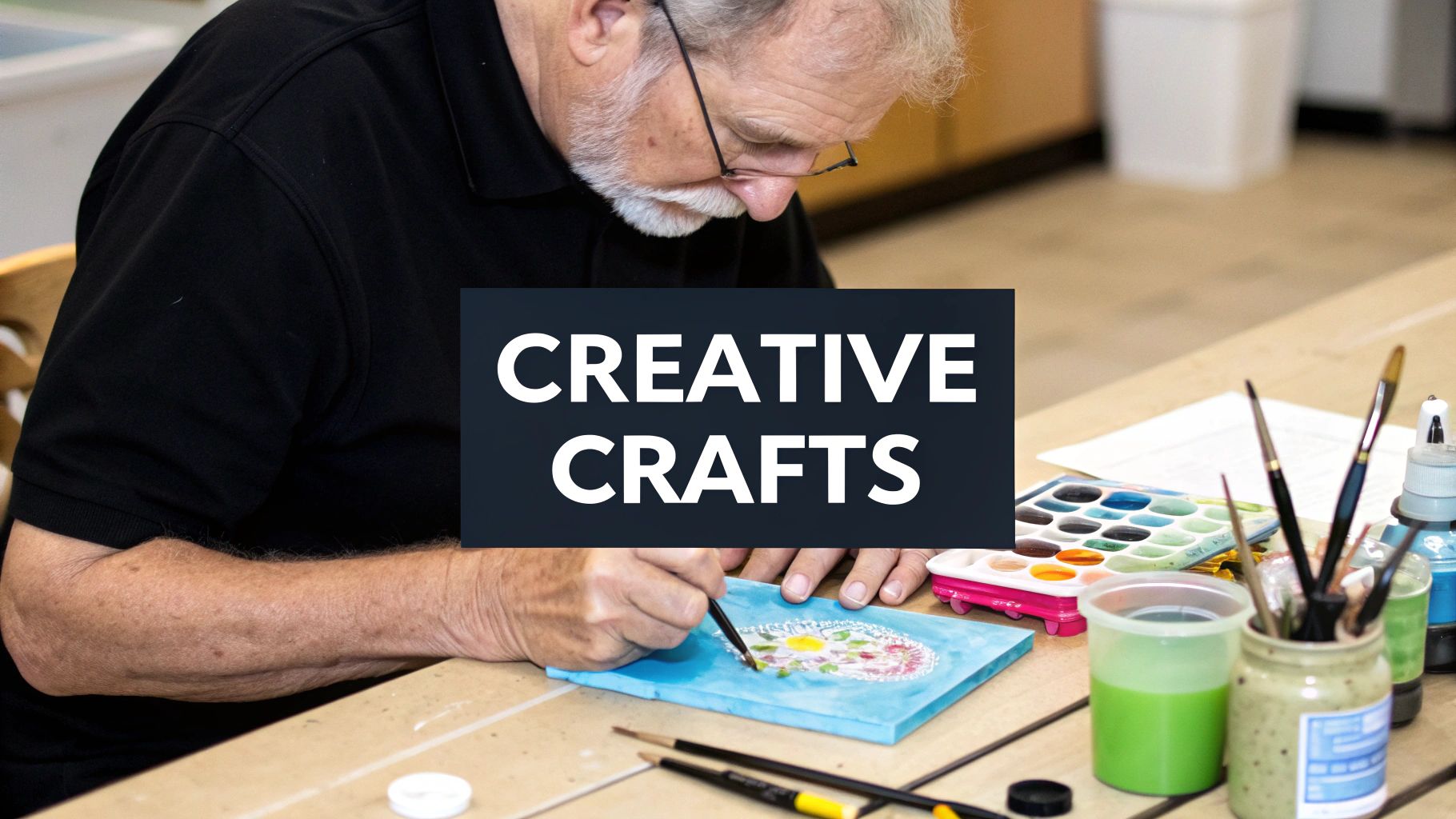
Engaging in creative arts and crafts offers a powerful, multi-sensory way to boost brain health. Activities like painting, knitting, pottery, or woodworking involve planning, problem-solving, and fine motor skills, all of which challenge the brain in unique ways. This hands-on engagement fosters creativity and provides a sense of accomplishment, making it one of the most fulfilling cognitive activities for seniors.
Cognitive Benefits
Artistic pursuits strengthen neural connections by integrating cognitive, sensory, and motor functions. The process can improve visual-spatial skills, enhance concentration, and reduce stress by promoting a state of mindfulness. Creating something tangible also boosts self-esteem and provides a non-verbal outlet for emotional expression, supporting overall mental well-being.
Getting Started: A Sample Session
A simple watercolor painting session can be a great starting point.
- Gather Materials: You will need watercolor paper, a basic set of paints, a few brushes of different sizes, and a cup of water.
- Set Up a Space: Find a well-lit area with a flat surface. Protect the table with newspaper or a cloth.
- Choose a Subject: Start with something simple, like a piece of fruit, a flower, or an abstract pattern.
- Explore and Create: Spend 30-45 minutes experimenting with colors and techniques. Focus on the process, not the final product.
- Clean Up and Display: Cleaning brushes and organizing supplies is part of the mindful process. Display your finished work to enjoy.
Adaptations and Tips
- For Mobility Issues: Choose seated activities like drawing, knitting, or using an tabletop easel. Adaptive tools with larger grips are available for brushes and pencils.
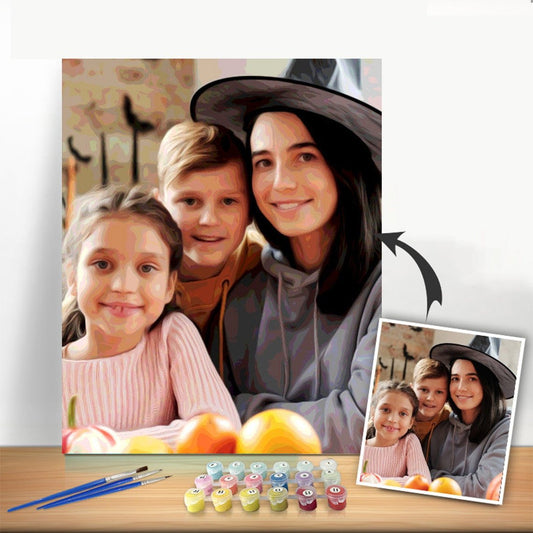
- For Cognitive Impairment: Structured projects like paint-by-number kits can be excellent. They provide clear guidance, reduce decision fatigue, and ensure a satisfying result. Learn more about the benefits of paint-by-numbers for seniors.
- Caregiver Tip: Join in the creative process. Work on your own project alongside your loved one to create a shared, calming experience. Offer encouragement and assistance with setup or difficult steps.
- Frequency: Aim for one or two creative sessions per week, each lasting 30-60 minutes, to build skills and maintain engagement without pressure.
6. Memory Training and Mnemonic Techniques
Memory training involves the systematic practice of strategies designed to enhance the brain's ability to encode, store, and retrieve information. Unlike passive memory recall, these techniques actively teach the mind more efficient ways to organize data. By using structured methods like mnemonics or the "memory palace," seniors can build powerful mental frameworks, making this one of the most empowering cognitive activities for seniors.
Cognitive Benefits
These techniques directly target executive functions, including organization, association, and visualization. Regular practice can lead to significant improvements in recalling names, lists, and important dates. It strengthens neural pathways associated with memory, boosts self-confidence, and provides a structured approach to learning new information.
Getting Started: A Sample Session
Here is how to practice a simple mnemonic technique, like an acronym.
- Identify the Goal: Choose a short list you want to memorize, such as the five Great Lakes (Huron, Ontario, Michigan, Erie, Superior).
- Create the Mnemonic: Form an acronym using the first letter of each word. A common one is HOMES.
- Visualize and Associate: For 5-10 minutes, mentally picture a house (HOMES) sitting on the shore of a giant lake. Say the full names aloud as you associate them with each letter.
- Practice Recall: Cover the list and try to recall the names using only your acronym cue.
- Spaced Repetition: Revisit the acronym and the list a few hours later, and then again the next day, to strengthen the memory.
Adaptations and Tips
- For Mobility Issues: Memory training is a purely mental exercise and can be done anywhere, whether seated or lying down. A journal or whiteboard can be helpful but is not required.
- For Cognitive Impairment: Start with very simple, personally meaningful information, like the names of two or three family members. Use strong visual and emotional cues to aid association. Learn more about art activities that can support memory for seniors with dementia on paint-by-number.com.
- Caregiver Tip: Turn it into a game. Create funny acronyms or silly "memory palace" journeys together. Your engagement and encouragement are crucial for making the practice feel fun rather than like a chore.
- Frequency: Dedicate 10-15 minutes daily to practicing one specific technique. Focus on mastering one method before moving to another.
7. Musical Engagement and Instrument Learning
Engaging with music, whether by learning an instrument, singing, or simply listening actively, is a powerful and joyful way to support brain health. The process of learning and playing music activates multiple brain regions simultaneously, including auditory, motor, and emotional centers. This comprehensive workout makes it one of the most holistic cognitive activities for seniors, offering profound benefits that extend beyond simple memory enhancement.
Cognitive Benefits
Learning to play an instrument strengthens the connections between the brain's hemispheres and improves auditory processing, memory recall, and fine motor skills. The discipline of practice enhances focus and patience, while the emotional connection to music can reduce stress and elevate mood. Group activities like choirs or bands also add a crucial social dimension, combating isolation and fostering a sense of community.
Getting Started: A Sample Session
A beginner's practice session can be structured for success.
- Choose an Instrument: Select an accessible instrument like a ukulele, harmonica, or keyboard.
- Warm-Up: Spend 5 minutes on simple finger exercises or breathing techniques. Playing an instrument requires good hand dexterity, and a warm-up helps prepare the hands.
- Learn a New Skill: Dedicate 10-15 minutes to learning a new chord, a small section of a song, or a new scale using an online tutorial or a lesson book.
- Practice Familiar Pieces: Spend 5-10 minutes playing songs or exercises you already know to build confidence and reinforce learning.
- Listen Actively: Conclude by listening to a piece of music featuring your chosen instrument, paying close attention to its role.
Adaptations and Tips
- For Mobility Issues: Choose lighter instruments like a ukulele or harmonica. Adaptive equipment, such as keyboard stands or guitar straps, can provide support.
- For Cognitive Impairment: Focus on the rhythmic and sensory aspects. Drum circles using simple percussion instruments can be highly engaging. Use color-coded keys or simplified musical notation.
- Caregiver Tip: Learn an instrument alongside your loved one. This creates a shared goal and a fun, supportive learning environment. Attend local concerts or musical performances together to inspire and motivate.
- Frequency: Aim for 15-30 minutes of practice daily. Regular, short sessions are more effective for building skills and cognitive benefits than infrequent, long ones.
8. Trivia and Quiz Competitions
Trivia and quiz competitions are fantastic social and mental workouts that challenge memory and quick thinking. These activities involve recalling facts, dates, and general knowledge, which directly engages long-term memory retrieval and processing speed. Whether it's a friendly game of Trivial Pursuit at home or a lively pub quiz, these competitions are excellent cognitive activities for seniors that combine learning with social fun.
Cognitive Benefits
Engaging in trivia strengthens factual recall, reinforces existing knowledge, and encourages the brain to form new connections as participants learn new information. The competitive aspect sharpens focus and attention, while the speed required to answer questions can improve cognitive processing time. Playing in a team also promotes communication and collaborative problem-solving skills.
Getting Started: A Sample Session
A typical trivia session can be easily organized at home or in a community setting.
- Choose a Format: Select a format, such as a board game like Trivial Pursuit, an online platform like Sporcle, or simply watching and playing along with a game show like Jeopardy!.
- Select Categories: Pick a few categories that appeal to the participants, mixing areas of expertise with new topics to keep it interesting.
- Form Teams: If playing with a group, create small teams to foster collaboration and reduce individual pressure.
- Play the Game: Set a time limit for answers to keep the pace brisk. Read questions clearly and repeat them if necessary.
- Review and Discuss: After the game, talk about some of the more interesting questions and answers. This reinforces learning and sparks conversation.
Adaptations and Tips
- For Mobility Issues: Online trivia platforms and television game shows are perfect, as they can be enjoyed from a comfortable chair. Board games can be placed on an accessible table.
- For Cognitive Impairment: Focus on topics the individual knows well, such as music from their youth or historical events they lived through. Play in teams and allow for open-book or collaborative answers to reduce frustration.
- Caregiver Tip: Create a personalized trivia game with questions about family history, favorite memories, or personal milestones. This makes the activity deeply meaningful and helps reinforce personal identity.
- Frequency: Aim for one or two trivia sessions per week to keep the mind sharp without it feeling like a chore.
9. Chess, Bridge, and Strategic Board Games
Strategic games like chess and bridge are powerful tools for cognitive exercise, demanding planning, tactical thinking, and complex decision-making. These games require players to consider multiple variables, anticipate future moves, and adapt their strategies on the fly. This creates a highly engaging mental workout that specifically targets and strengthens crucial executive functions, making them one of the most effective cognitive activities for seniors.
Cognitive Benefits
Playing these games consistently can lead to significant improvements in problem-solving skills, working memory, and fluid intelligence. The need for sustained concentration enhances attention span, while the social nature of games like bridge promotes communication and emotional well-being. The complex rule sets and strategic depth help maintain cognitive flexibility and stimulate neural pathways.
Getting Started: A Sample Session
Here is how to structure an enjoyable and stimulating game session.
- Choose Your Game: Select a game based on interest. Start with something like Catan or Ticket to Ride, or dive into a classic like chess or bridge. Online platforms like Chess.com are excellent for beginners.
- Schedule a Time: Set aside a dedicated time, perhaps 45-60 minutes, to learn rules or play a full game.
- Learn the Basics: Watch an introductory video or read a beginner's guide to understand the fundamental rules and objectives.
- Play a Practice Round: Play an open-hand game with a friend where you can discuss moves and strategies aloud.
- Review and Reflect: Briefly discuss the game afterward. What worked well? What could you try differently next time?
Adaptations and Tips
- For Mobility Issues: Most board games are perfectly suited for seated players. For those with hand dexterity challenges, use adaptive pieces with larger bases or ask a partner to move the pieces.
- For Cognitive Impairment: Start with simpler strategy games that have fewer rules, like checkers or Connect Four. Play on a team with a partner who can offer gentle guidance and support.
- Caregiver Tip: Learn a new game together. This levels the playing field and turns the learning process into a shared, bonding experience. Focus on the enjoyment of playing rather than on winning or losing.
- Frequency: Aim for one or two game sessions per week. Joining a local chess or bridge club can provide a consistent and social schedule.
10. Social Learning and Educational Classes
Enrolling in educational classes offers a powerful combination of structured learning and social interaction, making it a highly effective way to keep the mind sharp. These courses provide an opportunity to dive deep into new subjects, from history and science to philosophy, all within a supportive group environment. This structured pursuit of knowledge not only stimulates the brain but also fosters a sense of purpose and connection, making it one of the most rewarding cognitive activities for seniors.
Cognitive Benefits
Formal learning challenges the brain to absorb, process, and retain new, complex information, which strengthens neural pathways. Engaging in classroom discussions and debates enhances critical thinking, verbal fluency, and reasoning skills. The social component of learning with peers also helps reduce feelings of isolation and can improve overall mental well-being and cognitive function.
Getting Started: A Sample Session
Joining a class can be an exciting and straightforward process.
- Explore Options: Research local community colleges, libraries, or programs like the Osher Lifelong Learning Institutes (OLLI) that are designed for older adults.
- Choose a Subject: Select a course that genuinely interests you, whether it's a new passion or a topic you've always wanted to explore.
- Attend the First Class: Arrive a little early to familiarize yourself with the environment and introduce yourself to the instructor and a few classmates.
- Engage Actively: Don't just listen. Take notes, ask questions during the lecture, and participate in group discussions to maximize the cognitive workout.
- Review and Reflect: Spend a short time after class reviewing your notes. This reinforces learning and helps commit new information to memory.
Adaptations and Tips
- For Mobility Issues: Explore online courses offered by platforms like Coursera or edX, which provide university-level classes that can be taken from home. Many libraries and community centers also offer hybrid classes.
- For Cognitive Impairment: Look for classes that can be audited, meaning you can attend and learn without the pressure of exams or grades. Choose introductory-level courses on familiar or high-interest topics.
- Caregiver Tip: Help your loved one with the logistics of registration and transportation. Consider enrolling in a class together to share the experience and provide encouragement and support.
- Frequency: A typical class meets once or twice a week for a semester. Committing to a full course provides a sustained and structured cognitive challenge.
10-Point Comparison of Cognitive Activities for Seniors
| Activity | Implementation Complexity 🔄 | Resource Requirements ⚡ | Expected Outcomes 📊⭐ | Ideal Use Cases 💡 | Key Advantages ⭐ |
|---|---|---|---|---|---|
| Brain Training Games and Apps | 🔄 Low–Moderate — app setup & learning curve | ⚡ Medium — smartphone/tablet; possible subscription | 📊 Improves speed/attention; limited real-world transfer — ⭐⭐⭐☆☆ | 💡 Daily short sessions, home-based, tech-friendly seniors | ⭐ Engaging, adaptive difficulty, progress tracking |
| Puzzle and Crossword Solving | 🔄 Low — easy to start, scalable difficulty | ⚡ Low — paper or books; minimal tools | 📊 Proven association with slower decline; memory/attention gains — ⭐⭐⭐⭐☆ | 💡 Solo or group sessions; leisure time, low-tech preference | ⭐ Inexpensive, offline, meditative, evidence-backed |
| Reading and Book Clubs | 🔄 Low–Moderate — sustained attention for groups | ⚡ Low — books/library or audiobooks | 📊 Improves vocabulary, comprehension and social-emotional benefits — ⭐⭐⭐⭐☆ | 💡 Group discussion, social engagement, lifelong learners | ⭐ Social connection, wide accessibility, cognitive+emotional gains |
| Learning a New Language | 🔄 High — steep learning curve, sustained practice | ⚡ Medium–High — classes/apps/time commitment | 📊 Strong neuroplasticity and executive function gains — ⭐⭐⭐⭐⭐ | 💡 Intensive study, immersion, long-term cognitive training | ⭐ Highest cognitive demand, real-world application |
| Creative Arts and Crafts | 🔄 Low–Moderate — skill-building over time | ⚡ Low–Medium — basic materials, studio/classes optional | 📊 Enhances fine motor skills, mood, and cognition — ⭐⭐⭐⭐☆ | 💡 Therapeutic practice, group classes, tactile engagement | ⭐ Therapeutic, creative expression, social classes |
| Memory Training and Mnemonic Techniques | 🔄 Moderate — requires learning techniques & practice | ⚡ Low — time and minimal materials or apps | 📊 Direct, evidence-based memory improvements with practice — ⭐⭐⭐⭐☆ | 💡 Targeted recall tasks (names, numbers), study routines | ⭐ Transferable strategies, measurable gains, low cost |
| Musical Engagement and Instrument Learning | 🔄 High — technical skill and regular practice | ⚡ Medium–High — instrument, lessons, practice time | 📊 Broad cognitive, motor, emotional benefits; preserves function — ⭐⭐⭐⭐⭐ | 💡 Group ensembles, individual lessons, lifelong engagement | ⭐ Multi-domain brain activation, social & emotional benefits |
| Trivia and Quiz Competitions | 🔄 Low — easy to join/play | ⚡ Low — minimal materials; online options | 📊 Boosts factual recall and confidence; limited flexibility training — ⭐⭐⭐☆☆ | 💡 Short social sessions, pubs, clubs, knowledge practice | ⭐ Fun, social, quick sessions; wide topic variety |
| Chess, Bridge, and Strategic Board Games | 🔄 High — deep strategy and study required | ⚡ Low–Medium — boards/cards, club access | 📊 Strong gains in executive function, planning and working memory — ⭐⭐⭐⭐⭐ | 💡 Clubs, tournaments, long-format cognitive workouts | ⭐ High cognitive demand, measurable progression, social play |
| Social Learning and Educational Classes | 🔄 Moderate — structured courses and attendance | ⚡ Medium — time, possible fees, transport or online access | 📊 Sustained intellectual engagement; linked to delayed decline — ⭐⭐⭐⭐☆ | 💡 Audit classes, OLLI programs, community college courses | ⭐ Expert instruction, social/community, purposeful learning |
Building Your Personal Brain Health Routine
We've explored a diverse landscape of powerful cognitive activities for seniors, from the analytical challenge of chess to the creative expression of painting. The journey through brain training apps, strategic board games, musical engagement, and social learning reveals a core truth: variety and consistency are the cornerstones of a resilient mind. A healthy brain thrives not on a single, repetitive task, but on a rich tapestry of new challenges and joyful engagement.
The most profound takeaway is that you are the architect of your own cognitive wellness plan. The best routine isn't a rigid prescription; it's a personalized, flexible schedule built around activities that you genuinely find stimulating and enjoyable. The goal isn't to master every activity listed, but to curate a selection that keeps your mind active, engaged, and curious.
Key Principles for Your Cognitive Toolkit
As you begin to build your routine, keep these foundational principles in mind. They act as a compass, guiding you toward sustainable and effective brain health practices.
- Embrace Diversity: The most effective approach involves pulling from different categories of cognitive engagement. Try to blend an analytical activity (like puzzles) with a creative one (like painting or learning an instrument) and a social one (like a book club or trivia night). This cross-training for your brain ensures different neural pathways are activated and strengthened.
- Prioritize Enjoyment: You are far more likely to stick with an activity if you find it fun and rewarding. If crosswords feel like a chore, perhaps a lively game of bridge is a better fit. If a new language seems daunting, maybe a history class at a local college will spark your interest. Passion is a powerful motivator for consistency.
- Focus on Process, Not Perfection: The primary benefit of these cognitive activities for seniors comes from the act of engagement itself. Don't worry about solving the puzzle in record time or painting a masterpiece. The value lies in the concentration, problem-solving, and fine motor skills you practice along the way.
- Adapt and Accommodate: Your needs may change from day to day. It is crucial to adapt activities to fit your current energy levels, mobility, and cognitive state. Use large-print books, choose seated creative projects, or find online versions of board games. The key is to participate, not to push past your limits.
Your Actionable Next Steps
Feeling inspired? Here’s how to translate that motivation into a tangible plan. Don't try to do everything at once. Small, deliberate steps are the key to building a lasting habit.
- Select Your Starting Two: Look back at the list and choose just two activities that genuinely excite you. Pick one that feels comfortable and familiar, and another that presents a slight but intriguing challenge.
- Schedule It In: Treat your cognitive activities with the same importance as a doctor's appointment. Block out 20-30 minutes on your calendar, three to five times a week, to dedicate to your brain health. A short, consistent practice is more beneficial than a long, sporadic one.
- Gather Your Materials: Prepare everything you need in advance. If you’ve chosen painting, set up your supplies. If you’ve chosen puzzles, clear a dedicated table space. Removing friction makes it easier to start.
- Review and Refine: After a few weeks, check in with yourself. Are you enjoying the activities? Do you feel engaged? Don't be afraid to swap an activity out for another one from the list. Your brain health routine should evolve with you.
By thoughtfully curating a mix of stimulating cognitive activities for seniors, you are not just passing the time; you are making a profound and proactive investment in your long-term health, independence, and overall quality of life. An active mind is a vibrant mind, and the path to maintaining it is paved with curiosity, creativity, and connection.
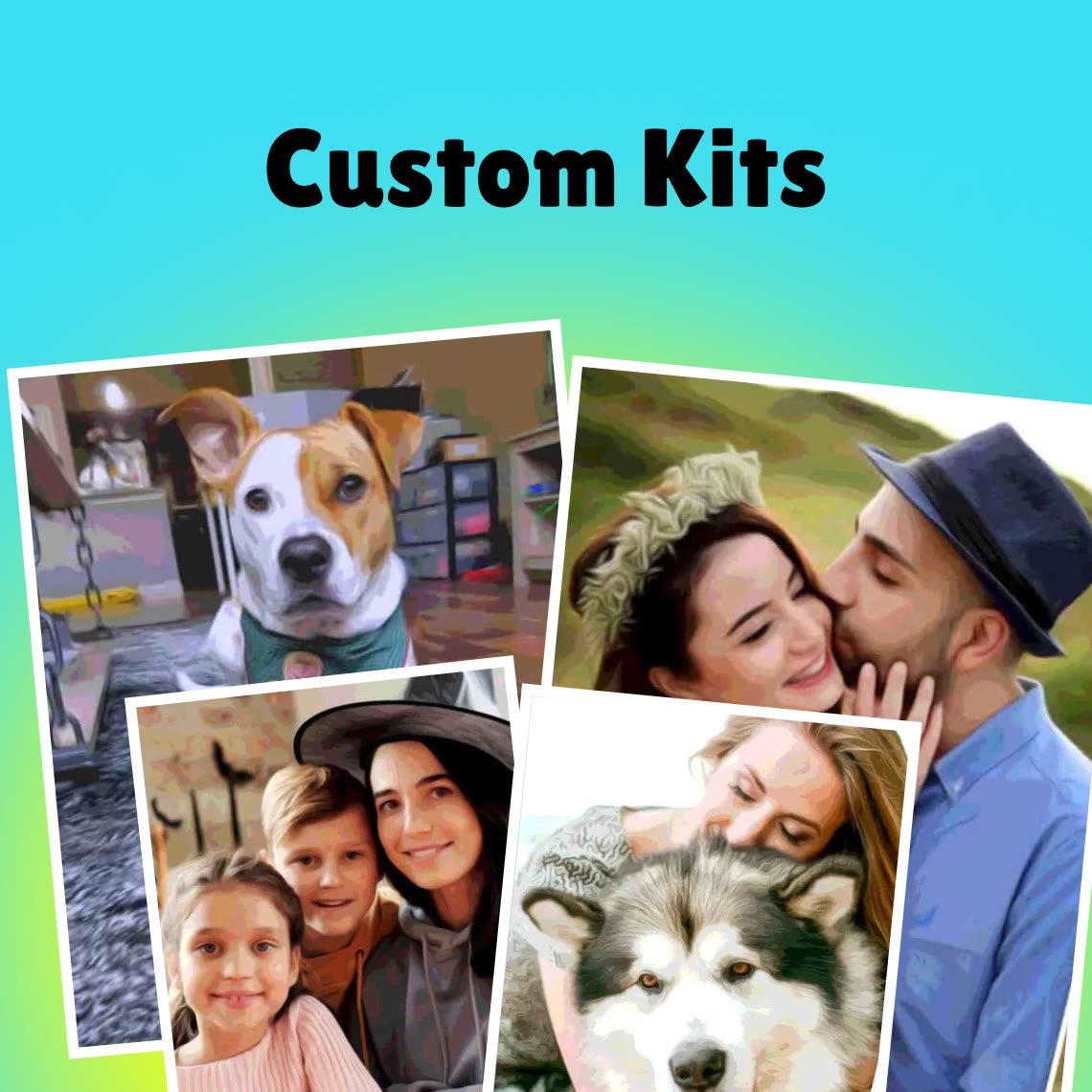
For a perfectly structured activity that combines mindfulness, creativity, and fine motor skill development, consider a custom kit from Custom Paint By Numbers. Transforming a cherished personal photograph into a guided painting project is a uniquely rewarding way to engage your mind and create a beautiful keepsake. Explore the possibilities at Custom Paint By Numbers to start your artistic journey.