
Anxiety can feel like a constant storm of racing thoughts and physical tension, making it difficult to find a moment of peace. While many strategies exist for managing this unease, art therapy provides a uniquely powerful path to relief. It bypasses the need for words, allowing you to engage your hands and mind in a focused, calming process. The goal isn't to create a masterpiece; it’s about the therapeutic act of creation itself. By focusing on colors, shapes, and textures, you can interrupt the cycle of worry and ground yourself firmly in the present moment.
This guide is designed to give you practical tools for just that. We will explore eight distinct art therapy activities for anxiety, each offering a structured yet flexible way to transform anxious energy into something tangible and healing. You'll learn how to express complex feelings through a collage, release physical tension with clay, and find meditative focus by drawing intricate patterns. These methods are not about artistic talent but about providing an outlet for your internal experiences. Whether you have five minutes or an entire afternoon, these accessible techniques are designed for anyone seeking a creative way to navigate stress and find a sense of calm.
1. Mandala Drawing and Coloring
Mandala creation is an ancient practice that involves drawing or coloring intricate, circular patterns that radiate from a central point. Rooted in spiritual traditions, Swiss psychiatrist Dr. Carl Jung introduced mandalas to Western psychology as a tool for self-exploration. Today, it stands as one of the most accessible and effective art therapy activities for anxiety.
The structured, repetitive nature of filling in a mandala provides a focal point, helping to quiet the mind and ground you in the present moment. This process encourages a state of mindfulness, gently pulling your attention away from anxious, spiraling thoughts and onto the simple, rhythmic task at hand.
How Mandala Creation Calms Anxiety
When you engage with a mandala, you are focusing on symmetry, pattern, and color. This structured activity occupies the brain’s prefrontal cortex, the area responsible for planning and decision-making, which can interrupt the amygdala's fear response. A 2005 study by researchers Nancy Curry and Tim Kasser famously found that coloring mandalas was significantly more effective at reducing anxiety than free-form drawing.
Key Insight: The predictable and contained structure of a mandala offers a sense of safety and order, which can be incredibly soothing when your internal world feels chaotic and unpredictable.
This powerful effect is why organizations from Johns Hopkins Medicine to corporate wellness programs at Google utilize mandala coloring to help manage stress and anxiety.
This infographic provides a quick overview of what to expect from a typical mandala session.
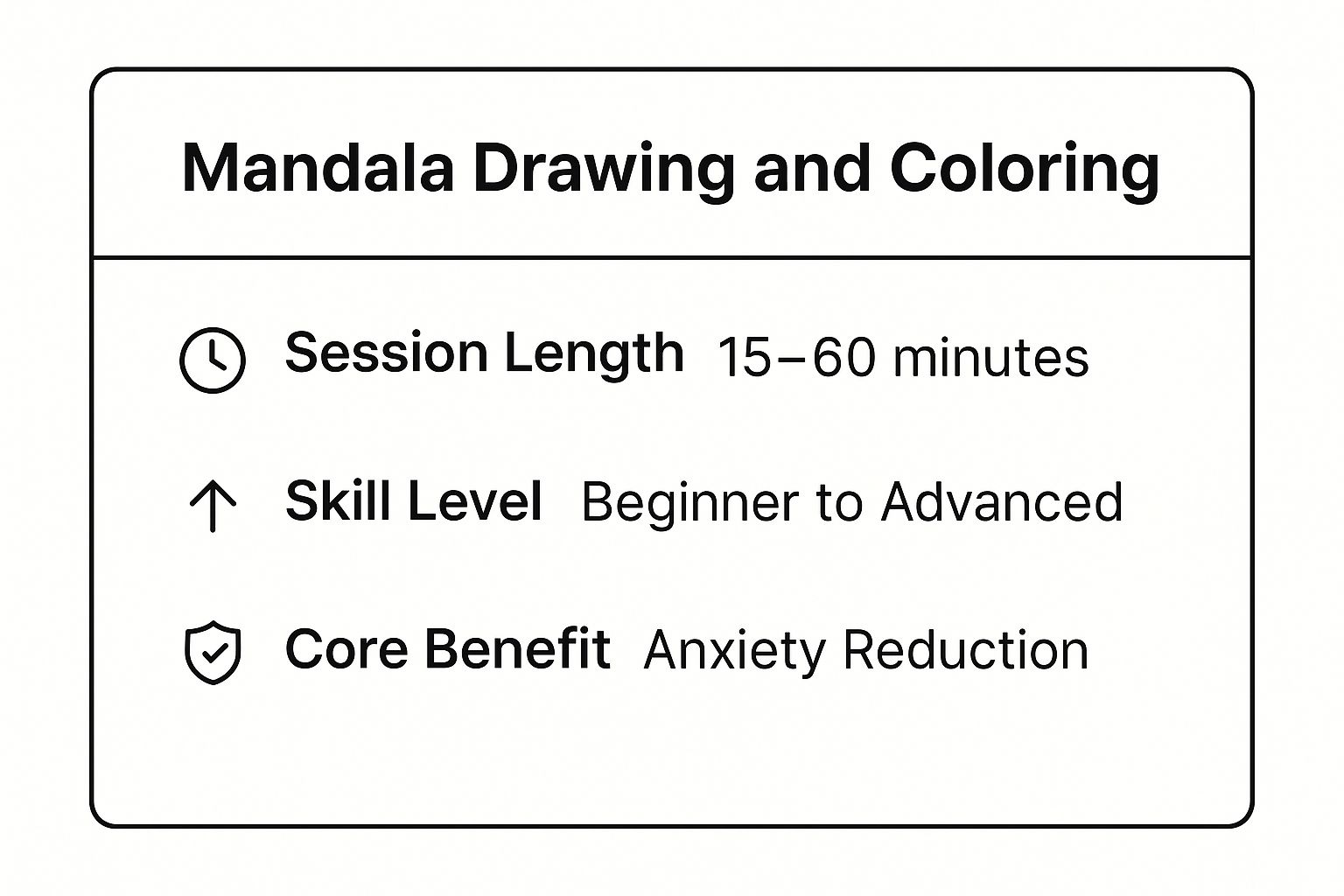
As the infographic highlights, mandala creation is a versatile activity that can be adapted to fit any schedule or skill level, making it a reliable tool for consistent anxiety management.
Tips for Getting Started
- Start with Templates: If drawing a mandala from scratch feels intimidating, begin with pre-printed mandala coloring books or online templates. Artist Johanna Basford's popular adult coloring books are a great starting point.
- Focus on Process, Not Perfection: The goal is not to create a masterpiece. The therapeutic benefit comes from the act of creation itself. Let go of judgment and enjoy the flow.
- Create a Routine: Set aside a specific time, even just 15-20 minutes a day, for your mandala practice. Consistency can enhance its calming effects.
- Use Both Hands: Try a technique called bilateral drawing, where you use both hands simultaneously to draw or color. This can help engage both hemispheres of the brain, promoting a deeper sense of calm.
2. Emotion Color Wheel Creation
The emotion color wheel is an activity where you create a visual map of your feelings using colors. It allows you to externalize and better understand complex emotional states that are often difficult to verbalize. By assigning specific colors to different emotions, you create a personalized chart that reflects your internal landscape, making it a powerful art therapy activity for anxiety.
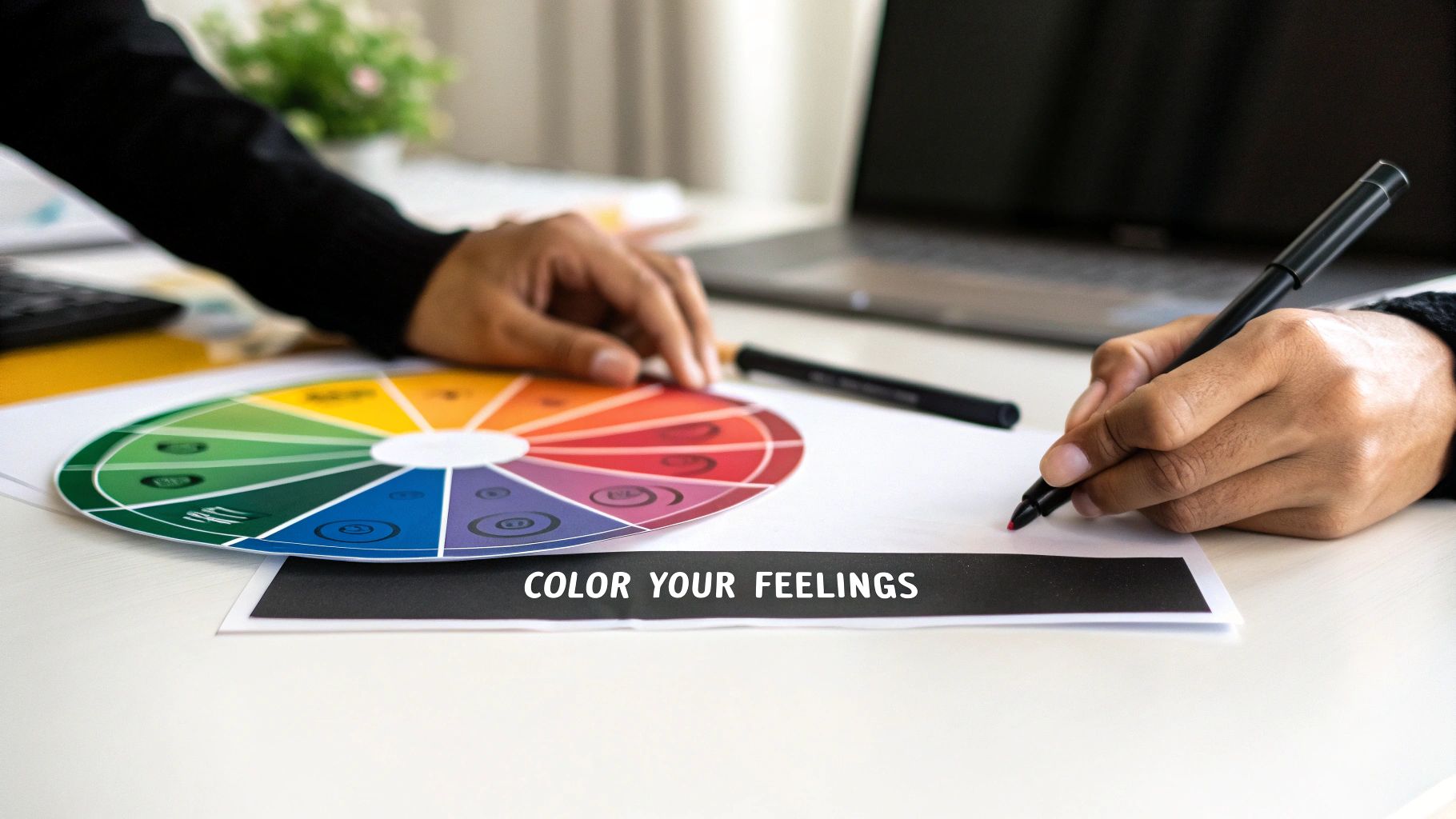
This process combines color theory with emotional intelligence, helping you recognize and name anxiety-related feelings. This simple act of identification creates distance from overwhelming emotions, allowing you to observe them without being consumed. The concept was famously advanced by psychologist Dr. Robert Plutchik, whose work demonstrated how visualizing emotions can improve regulation.
How an Emotion Wheel Calms Anxiety
Creating an emotion color wheel engages you in a process of self-reflection and categorization. This shifts your brain from a reactive, emotional state (driven by the amygdala) to a more analytical, observant one (engaging the prefrontal cortex). Labeling feelings like "dread" or "unease" with a color gives them a tangible form, reducing their abstract power and making them feel more manageable.
Key Insight: Giving a color and a name to a fleeting, anxious feeling transforms it from an overwhelming internal force into a single, definable piece of a larger picture, restoring a sense of control.
This technique is widely used in therapeutic settings. For instance, the Yale Center for Emotional Intelligence incorporates color-emotion mapping in its RULER approach to social-emotional learning, and Dialectical Behavior Therapy (DBT) programs adapt the activity to build emotion regulation skills.
Tips for Getting Started
- Brainstorm Your Emotions: Before starting, list all the feelings you've experienced recently, including subtle ones like "apprehension" or "restlessness."
- Trust Your Instincts: Don't overthink your color choices. Go with your first gut association for each emotion to create a more authentic wheel.
- Add Textures and Patterns: Use different textures, patterns, or line weights to represent the intensity of each feeling, adding another layer of expression.
- Create 'Current' vs. 'Desired' Wheels: Make one wheel for how you feel now and another for how you'd like to feel. This can help you identify and work toward your emotional goals.
3. Zentangle Method
The Zentangle Method is a structured, meditative art form where you create intricate abstract images from repetitive patterns, or 'tangles.' Developed in 2003 by Rick Roberts and Maria Thomas, it’s built on a foundation of specific principles: no mistakes (only opportunities), no erasers, and a focus on small, manageable sections. This makes it one of the most effective art therapy activities for anxiety.
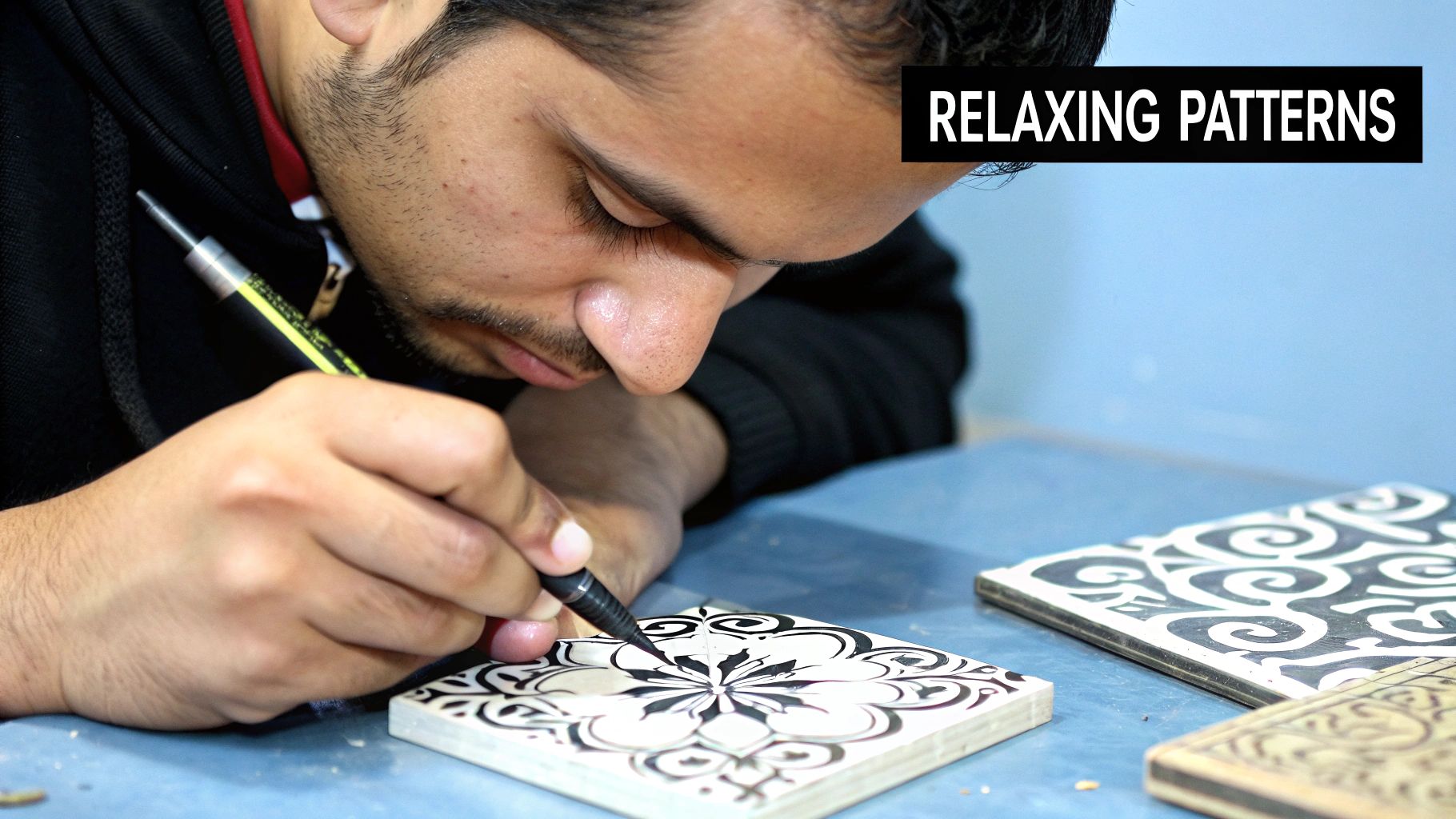
Unlike free-form drawing, the deliberate limitations of Zentangle, such as using a small 3.5-inch square paper tile, remove performance pressure and decision fatigue. The repetitive, predictable nature of drawing simple strokes one at a time creates a state of relaxed focus, pulling your attention away from anxious thoughts and grounding you in the creative process.
How The Zentangle Method Calms Anxiety
The Zentangle Method intentionally occupies the mind with simple, focused tasks, interrupting the cycle of rumination that fuels anxiety. By concentrating on one stroke at a time, you engage in a form of mindfulness that promotes a feeling of calm control and accomplishment. A 2014 study confirmed its benefits, showing that Zentangle significantly reduced test anxiety among college students.
Key Insight: The Zentangle philosophy of "no mistakes" is profoundly therapeutic. It reframes perceived errors as new opportunities, teaching you to embrace imperfection and reduce self-criticism, which is a common trigger for anxiety.
This powerful, process-oriented approach is why organizations from Kaiser Permanente to corporate wellness programs at Microsoft and IBM integrate Zentangle workshops to manage stress and anxiety. For an overview of how this and other structured art practices promote mental well-being, you can learn more about mindfulness activities for adults on paint-by-number.com.
Tips for Getting Started
- Start Simple: Begin with just four or five basic tangle patterns. Master them before expanding your repertoire to avoid feeling overwhelmed.
- Embrace the "No Mistakes" Mindset: When you make an unexpected stroke, intentionally incorporate it into your design. This practice helps build resilience and flexibility.
- Create a Go-To Kit: Assemble a small kit with a few tiles, a fine-tipped pen, and a pencil. Keep it in your bag for moments of anxiety in waiting rooms or during travel.
- Pair with Breathing: Synchronize your art with your breath. Try inhaling as you draw one stroke and exhaling on the next to deepen your state of relaxation.
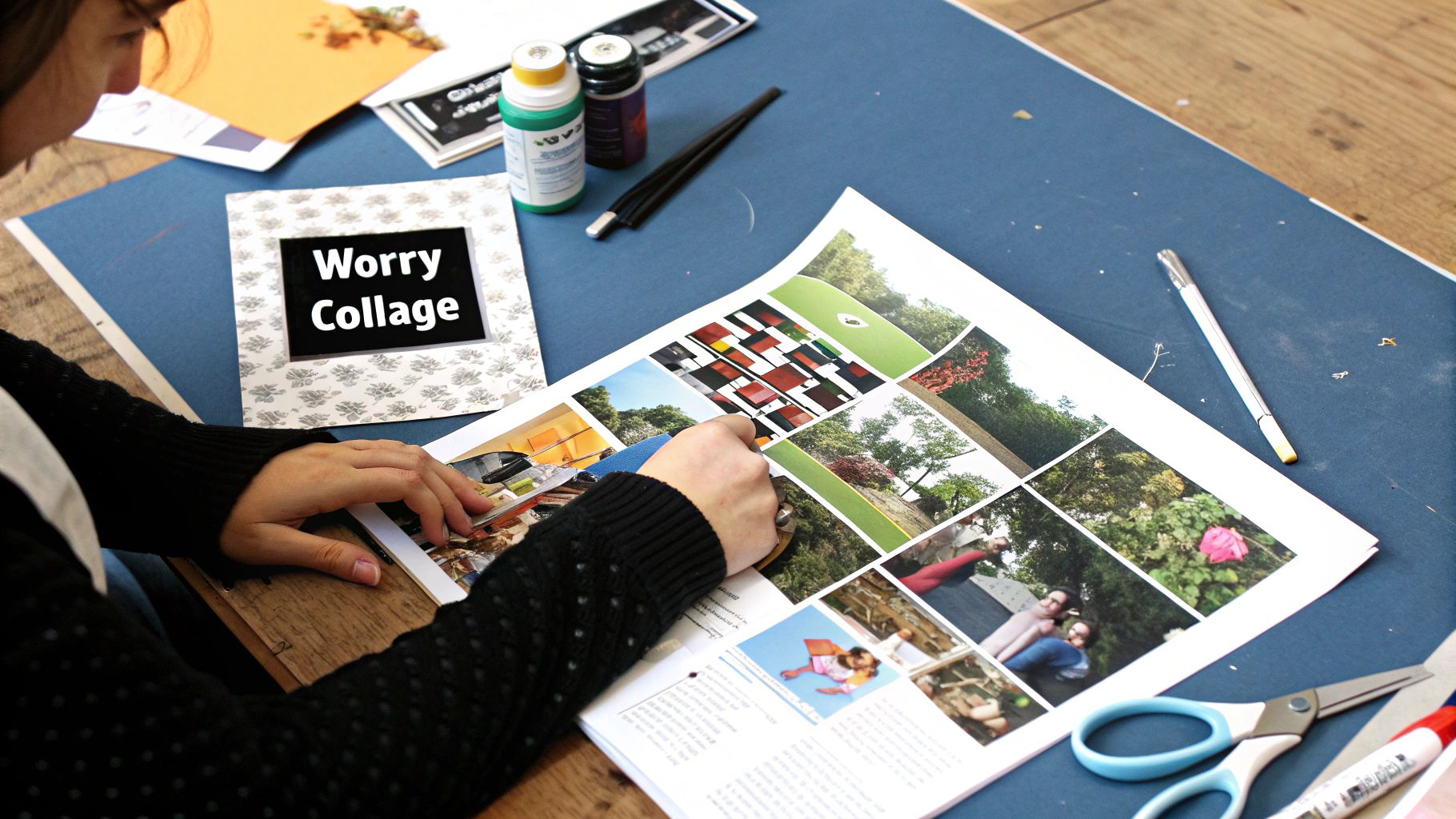
4. Collage Making for Worry Expression
Collage therapy is a powerful art therapy activity for anxiety that involves cutting, arranging, and pasting images, textures, and words to create a visual representation of your feelings. Pioneered by surrealist artists like Max Ernst, this method bypasses the need for traditional drawing skills, offering a tactile, hands-on experience that can ground you in the present moment. It allows you to express complex worries and fears without having to find the right words.
The process of searching for, selecting, and arranging materials gives your anxious mind a specific task to focus on. Instead of ruminating on abstract fears, you are making concrete decisions, which helps redirect and quiet racing thoughts. This technique externalizes internal struggles, making them feel more manageable and less overwhelming.
How Collage Making Calms Anxiety
Creating a collage acts as a form of non-verbal communication, giving a voice to anxieties that are difficult to articulate. The physical acts of cutting, ripping, and gluing can be incredibly cathartic, providing a safe outlet for frustration and tension. This externalization process helps you gain perspective on your worries, seeing them as separate from your core self.
Key Insight: A collage offers a tangible container for your worries. By placing an image representing a fear onto paper, you symbolically move it from your mind into the external world, reducing its power over you.
This is why organizations like the Anxiety and Depression Association of America and cancer support centers such as Gilda's Club utilize collage making. It provides a structured yet creative way to process and contain complex emotional states. Learn more about the art therapy benefits for mental health on paint-by-number.com.
Tips for Getting Started
- Create Themed Collages: Focus your collage on a specific theme. For example, create two pieces: one representing "what anxiety feels like" and another for "what calm feels like" to explore the contrast.
- Build a 'Safe Place': Design a collage that visually represents a place where you feel completely safe and relaxed. You can use this image as a visual anchor during moments of high anxiety or panic.
- Use Texture: Incorporate materials with different textures like fabric, sandpaper, or foil. Assigning textures to certain feelings can add another layer of sensory expression to your work.
- Trust Your Intuition: Don't overthink your image choices. Select pictures and words that resonate with you on an intuitive level, even if you don't immediately understand why. The meaning often becomes clear as you create.
5. Clay and Sculpting for Somatic Release
Working with clay or other sculpting materials is a deeply physical art therapy activity for anxiety that connects the mind and body. This hands-on process addresses anxiety through sensory engagement and physical manipulation, tapping into what is often called somatic release—the expression of emotions held within the body.
The bilateral, repetitive motions of kneading, rolling, and shaping clay help activate the parasympathetic nervous system, which is responsible for the body's rest-and-digest response. This tactile work provides immediate sensory feedback, allowing for a tangible release of physical tension and the creation of a three-dimensional representation of internal feelings.
How Clay Work Calms Anxiety
Engaging with a malleable material like clay shifts your focus from cyclical thoughts to the sensation in your hands. This physical grounding can interrupt the brain's anxiety loop by redirecting neural resources to sensory and motor processing. Pioneers in trauma treatment, like Dr. Bessel van der Kolk, emphasize somatic approaches like clay work because they allow individuals to process non-verbal, body-based memories and tensions associated with anxiety and trauma.
Key Insight: The malleable nature of clay provides a powerful metaphor for emotional regulation. It demonstrates that difficult feelings, like anxiety, are not fixed but can be reshaped, transformed, and contained.
This grounding power is why clay is used in settings from The Trauma Center at Justice Resource Institute to occupational therapy programs for managing anxiety-related motor tension.
This video demonstrates the therapeutic process of working with clay and its calming effects.
As shown, the process of transforming a simple lump of clay can be a powerful and meditative experience, offering a non-verbal outlet for complex emotions.
Tips for Getting Started
- Start with Kneading: Before trying to create anything, simply knead and squeeze the clay. Focus on the sensation and use it to release physical tension from your hands, shoulders, and jaw.
- Externalize Your Anxiety: Create an abstract representation of your anxiety, like a tight ball or a form with sharp points. Then, consciously transform that shape into something that feels calmer or more neutral.
- Create a 'Worry Stone': Sculpt a small, smooth, and comforting object that fits in your palm. You can carry this with you and hold it during moments of high anxiety as a grounding tool.
- Try Blind Sculpting: Work with the clay with your eyes closed. This technique helps quiet your inner critic and deepens your connection to the tactile experience, reducing performance pressure.
6. Anxiety Container or Box Creation
Creating an anxiety container involves decorating a physical box, jar, or vessel that serves as a symbolic holding place for worries and anxious thoughts. This tangible art therapy activity combines the creative process with the cognitive-behavioral technique of "worry postponement," offering a structured way to manage intrusive thoughts.
The process helps externalize anxiety by giving it a physical form and a designated place. Decorating the container's exterior to represent calm, safety, or strength transforms it into a personal sanctuary. Meanwhile, the interior becomes a repository for written worries or drawn fears, creating psychological distance and a profound sense of control.
How an Anxiety Container Calms Anxiety
This activity provides a concrete ritual for managing abstract fears. The physical act of writing down a worry and placing it inside the box offloads the mental burden, signaling to your brain that the concern is acknowledged and safely contained. This interrupts the rumination cycle, freeing up mental space and reducing the feeling of being overwhelmed.
Key Insight: An anxiety container works by separating you from your worries. It provides a tangible boundary, reinforcing the idea that you are not your anxiety; you are a person who experiences it and has a tool to manage it.
This powerful technique is widely used in various therapeutic settings. Child psychologist Dawn Huebner champions "worry boxes" in her books, and Cognitive Behavioral Therapy practitioners often incorporate them to help clients schedule "worry time" rather than letting anxiety dominate their day.
Tips for Getting Started
- Choose Your Container: Select a box, jar, or tin that feels substantial enough to hold your worries. The size and material are up to you; what matters is that it feels secure.
- Decorate with Intention: Use calming colors, affirmations, or images of strength and safety on the exterior. This visual cue reinforces the container's purpose as a safe space.
- Externalize Your Worries: Write or draw each specific anxiety on a small piece of paper. The act of putting it on paper is a key step. Fold it up and place it inside.
- Schedule "Worry Time": Set aside a specific, limited time each day (e.g., 15 minutes) to open the box and review its contents. This contains the act of worrying to a manageable window.
- Review and Release: Periodically go through old worries. You may find that many have resolved themselves or no longer feel important, which can build confidence in your ability to cope.
7. Breath Painting and Movement Art
Breath painting synchronizes artistic creation with the rhythm of your breath, establishing a biofeedback loop that directly calms the nervous system. This mindfulness-based technique involves creating abstract marks, lines, or flowing colors that correspond to your inhalations and exhalations. By physically linking your creative output to your breathing, you unite two powerful anxiety-reduction methods into a single, fluid practice.
The core of this activity is bringing non-judgmental awareness to your breath and allowing it to guide your hand. This process anchors you firmly in the present moment, making it difficult for anxious, future-oriented thoughts to take hold. The resulting artwork becomes a tangible record of your journey toward a calmer state.
How Breath Painting Calms Anxiety
When you consciously align your physical movements with your breath, you activate the parasympathetic nervous system, also known as the "rest and digest" system. This physiological shift counters the fight-or-flight response triggered by anxiety. The simple act of focusing on the repetitive in-and-out flow of breath provides a predictable anchor, while the creative expression offers an outlet for pent-up emotional energy.
Key Insight: Unlike other art forms, breath painting’s primary goal is not the final product, but the experience of somatic awareness. The art becomes a visual representation of your regulated breathing, reinforcing the mind-body connection.
This powerful combination is why pioneers in the field like Dr. Laury Rappaport integrated breathwork into Focusing-Oriented Art Therapy, and why many Mindfulness-Based Art Therapy (MBAT) programs use it as a core exercise.
Tips for Getting Started
- Try Box Breathing: Use the "box breathing" technique (inhale for 4 counts, hold for 4, exhale for 4, hold for 4) and make a corresponding mark or line for each count to create a visual square.
- Use Watercolors: Let the ratio of water to paint represent the depth of your breath. A deep, full inhale could be a diluted, flowing wash of color, while a shallow breath might be a more concentrated mark.
- Assign Colors to Breath: Experiment by using cool colors (blues, greens) for the coolness of an inhalation and warm colors (reds, oranges) for the warmth of an exhalation.
- Create a "Breath Landscape": Allow each complete breath cycle to create a new layer or element in your painting, building a visual landscape that documents your session of mindful breathing.
8. Nature Art and Outdoor Creating
Nature art therapy blends the proven calming effects of being outdoors with the expressive power of creation. Also known as eco-art therapy, this practice involves making art in nature using found materials like leaves, stones, twigs, and flowers. It harnesses the mental health benefits of nature exposure, such as reduced cortisol and lower heart rate, while providing a grounding creative outlet.
The core of this practice is its connection to the natural world. Engaging your senses outdoors and creating something from your surroundings helps anchor you firmly in the present moment. This process interrupts the cycle of anxious rumination by redirecting focus to tangible, sensory experiences like the texture of a leaf or the weight of a stone.
How Nature Art Calms Anxiety
Creating with natural materials is an inherently mindful activity that reduces stress by connecting you to the earth. This approach often emphasizes impermanence, such as building a temporary sand mandala or a leaf mosaic that the wind will eventually scatter. Acknowledging this transient nature can help cultivate acceptance, a powerful skill for managing anxiety. The work of environmental artist Andy Goldsworthy, known for his ephemeral sculptures, has heavily inspired these therapeutic approaches.
Key Insight: Engaging with the impermanence of nature art helps you practice letting go of control and finding beauty in the present, which directly counters the anxious need for certainty and permanence.
This powerful combination of nature and art is why wilderness therapy programs for adolescents and horticultural therapy programs in hospitals frequently integrate nature art as one of their primary therapeutic activities for mental health.
Tips for Getting Started
- Mindful Nature Walk: Begin by taking a walk and mindfully collecting materials. Pay attention to the colors, textures, and sounds around you, turning the gathering process into a meditative practice.
- Create a Temporary Mandala: Use flower petals, stones, or leaves to create a circular design on the ground. Focus on the pattern and symmetry, then leave it for nature to reclaim.
- Build a Nature Assemblage: On a piece of cardboard or a flat piece of bark, arrange your found items into a collage or sculpture that expresses your current feelings.
- Paint 'Worry Stones': Collect smooth, flat stones and paint them with calming symbols, patterns, or words. Carry one in your pocket to hold when you feel anxious.
Art Therapy Activities for Anxiety: 8-Item Comparison
| Method | Implementation Complexity 🔄 | Resource Requirements ⚡ | Expected Outcomes 📊 | Ideal Use Cases 💡 | Key Advantages ⭐ |
|---|---|---|---|---|---|
| Mandala Drawing and Coloring | Moderate – requires focus on symmetry | Minimal – paper, pencils, templates | Anxiety reduction via mindfulness and focus | Beginners to advanced, portable anxiety relief | Structured, mindfulness-promoting, research-backed |
| Emotion Color Wheel Creation | Moderate – conceptual mapping | Low – paper, colors, collage tools | Increased emotional awareness and regulation | Those who struggle to identify/express emotions | Builds emotional vocabulary, non-verbal expression |
| Zentangle Method | Moderate – learning specific strokes | Moderate – special tiles and pens | Relaxation, improved focus, reduced perfectionism | Short sessions, anxiety management, meditative art | No mistakes mindset, portable, scientifically supported |
| Collage Making for Worry Expression | Low to moderate – cutting/arranging | Moderate – magazines, scissors, glue | Externalization of worries, grounding, distraction | Those uncomfortable with drawing, group or solo use | Accessible, tactile, versatile, non-artistic friendly |
| Clay and Sculpting for Somatic Release | Moderate – tactile, requires setup | Moderate – clay materials, tools | Physical tension release, somatic calming | Trauma-related anxiety, sensory engagement | Physical outlet, sensory grounding, metaphor for change |
| Anxiety Container or Box Creation | Low – decorating & writing worries | Low – container, decorative supplies | Externalizes anxiety, promotes worry postponement | Rumination, intrusive thoughts, children to adults | Tangible control, customizable, CBT-based technique |
| Breath Painting and Movement Art | Moderate – synchronizing breath/art | Low – paints, paper | Parasympathetic activation, anxiety reduction | Panic disorder, generalized anxiety, stress relief | Combines breathwork and art, biofeedback effect |
| Nature Art and Outdoor Creating | Moderate – depends on outdoor access | Low – natural materials | Anxiety reduction via nature exposure and creativity | Nature-deficit anxiety, generalized anxiety | Combines nature therapy and art, grounding, sensory engagement |
Start Your Artistic Journey to a Calmer Mind
Embarking on a creative practice is not about becoming a professional artist overnight. It’s about giving yourself permission to explore, express, and heal. The collection of art therapy activities for anxiety we’ve explored, from the structured patterns of Mandalas and Zentangles to the free-form release of clay sculpting and breath painting, offers a rich toolkit for navigating the complexities of your inner world. Each activity serves as a unique doorway into mindfulness, providing a tangible way to process emotions that often feel abstract and overwhelming.
The core takeaway is that you are in control. You can build a personalized mental wellness routine that feels authentic to you. Whether it’s creating a collage to externalize your worries or designing an "anxiety container" to symbolically hold them, these practices shift your role from a passive recipient of anxious thoughts to an active participant in your own calm. The goal is not perfection, but presence. The value lies in the process, not the final product.
Key Insights to Carry Forward
Remember these crucial points as you begin to integrate these creative tools into your life:
- Process Over Product: The true therapeutic benefit comes from the act of creation itself. Let go of any pressure to create a masterpiece and focus instead on how the activity makes you feel in the moment.
- No "Right" Way: These activities are adaptable. Feel free to modify the steps, use different materials, or combine ideas. Your intuition is your best guide.
- Consistency is Key: A few minutes of creative engagement each day can be more impactful than a single, long session once a month. Build small, sustainable habits to create a lasting foundation for emotional regulation.
Your Actionable Next Steps
Feeling inspired but unsure where to start? Don't let indecision hold you back. The simplest way to begin is by choosing one activity from the list that sparked your curiosity the most. Gather just the basic materials needed and schedule a mere 15 minutes in your calendar this week to try it. Approach it as a low-stakes experiment, a moment of dedicated time just for you.
For those who appreciate structure and a clear path forward, an activity like guided painting can be an ideal entry point. It removes the intimidation of a blank canvas while providing the deep, meditative focus that quiets an anxious mind. This structured approach allows you to experience the soothing benefits of art therapy without the added stress of deciding what to create.
Ultimately, mastering these art therapy activities for anxiety means building a more compassionate and resilient relationship with yourself. It’s about learning to listen to your body, honor your feelings, and transform nervous energy into something beautiful, meaningful, and empowering. One brushstroke, one pencil line, one deliberate creative act at a time, you are reclaiming your peace.
Ready to experience the calming power of structured creativity? Turn a cherished memory into a therapeutic masterpiece with a kit from Custom Paint By Numbers. It’s a perfect, accessible way to practice mindfulness and create a beautiful piece of art that soothes your soul. Explore your personalized painting kit today at Custom Paint By Numbers.