
When you're starting a paint-by-number project, the best brushes you can grab are usually small, synthetic ones. A good set will have a mix of round, liner, and flat shapes. Honestly, upgrading from the brushes that come in the box to a dedicated set with sizes like a tiny 5/0 for details, a size 2 for most areas, and a size 4 for bigger blocks of color will make a world of difference in your control and how your painting turns out.
Why Better Brushes Transform Your Painting
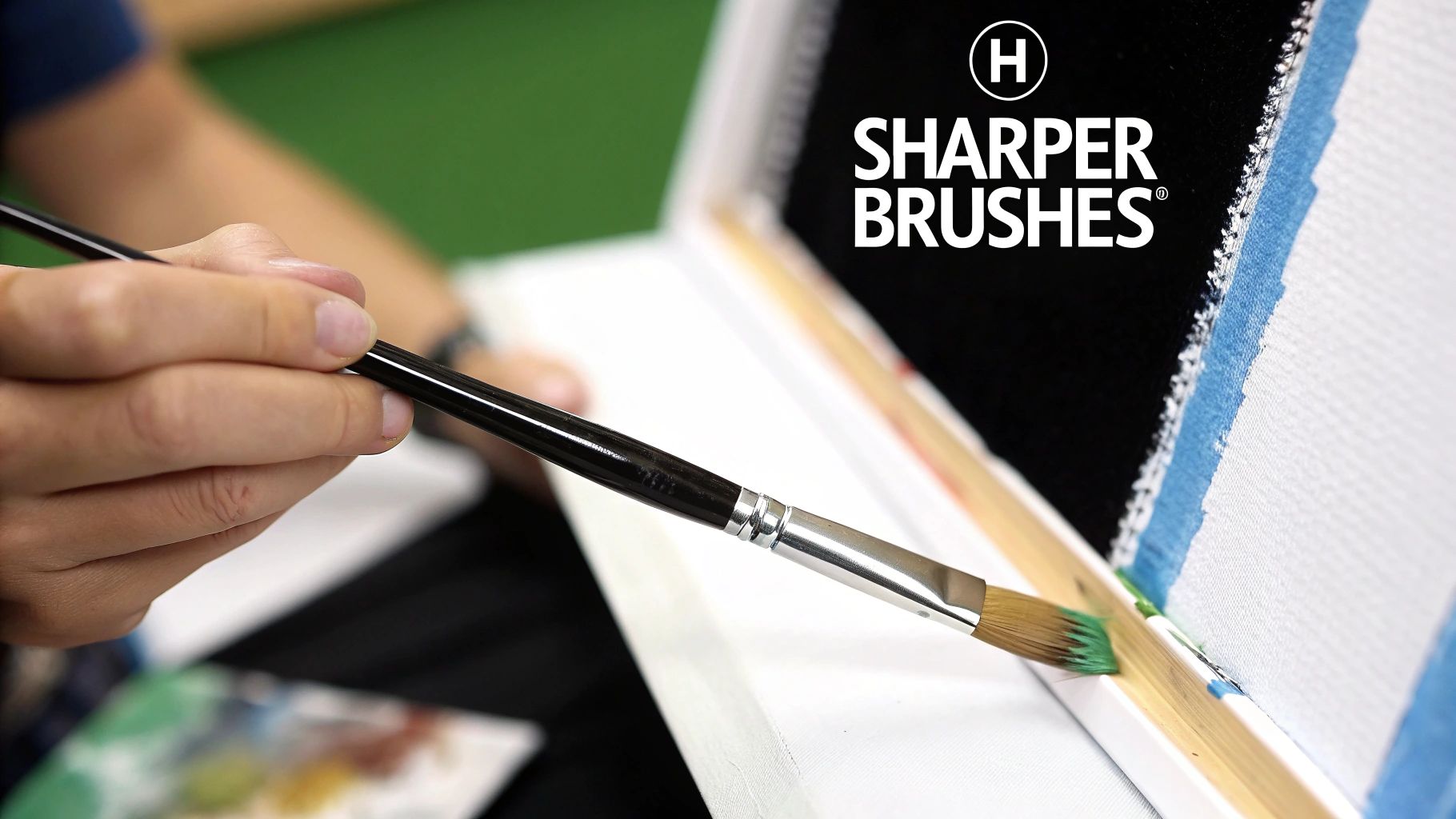
Ever feel like you're fighting with the little plastic brushes that come in a paint-by-number kit? You're not alone. They get the basic job done, sure, but swapping them out is probably the single best thing you can do to turn this from a simple craft into a genuinely creative and relaxing experience.
It’s a bit like trying to cook a fantastic meal. You could chop an onion with a butter knife, but it would be a frustrating mess. A proper chef’s knife, on the other hand, gives you precision and makes the whole process feel effortless and enjoyable. It's the exact same idea with brushes—the right tools get rid of the struggle and help you create the beautiful picture you have in your head.
The Power of Precision Tools
The moment you switch from a standard kit brush to a quality one, you feel the difference. Good brushes let you paint crisp, clean lines right up to the edge of each numbered section, and the paint goes on smoothly without leaving behind those annoying streaks. This level of control is what you need for those tiny, detailed spots that really make a painting pop.
To understand why this is so important, just think about the impact of quality and craftsmanship on anything we use. A well-made shirt feels better and lasts longer; a well-made brush just works better, holds its shape, and does what you tell it to do, every single time.
A good brush feels like an extension of your hand. It does exactly what you want it to, allowing you to focus on the art itself, not on fighting with your tools.
This guide will walk you through everything you need to know to pick the perfect brushes. We’ll break down the key things that make a brush great, starting from the ground up.
Here's what we'll cover:
- Brush Anatomy: Getting to know the handle, ferrule, and bristles.
- Brush Shapes: Figuring out which shape is best for sharp lines, tiny details, or filling in big spaces.
- Brush Sizes: Making sense of all the numbers so you can grab the right size for any section on your canvas.
Once you get these basics down, you'll be able to put together a small toolkit that can handle anything. And if you're looking for more ways to step up your game, check out these awesome paint by number tips and tricks to really perfect your technique.
Getting to Know Your Brushes: Materials and Anatomy
To find the right brushes for your paint-by-number project, it helps to know what you’re working with. A paintbrush is a simple tool, really, with just three parts designed to do one thing: get the paint exactly where you want it.
First, there’s the handle, which is pretty self-explanatory. Then you have the ferrule—that’s the little metal cuff that clamps the bristles to the handle. Its main job is to keep the bristles from falling out mid-stroke. Finally, you have the most important part for us: the bristles. These are the hairs that pick up the paint and lay it on your canvas.
The Great Bristle Debate: Synthetic vs. Natural
When it comes to bristles, there are two main camps: natural and synthetic. Natural bristles, often made from animal hair like sable or hog, are prized by oil and watercolor artists because they hold a ton of liquid.
But for the acrylic paints you find in every paint-by-number kit, synthetic bristles are the undisputed champion. These are typically made from man-made fibers like nylon or taklon.
For paint-by-number artists, synthetic brushes are the perfect match. They are designed to work seamlessly with acrylic paints, offering the durability and precision needed for detailed work without the high cost of natural hair brushes.
Here’s why they work so well. Synthetic bristles don't absorb water like natural ones do. This is a huge plus when using acrylics because it means the bristles stay firm and responsive, keeping a sharp point for all those tiny, numbered details. They’re also incredibly durable and way easier to clean, which is a big win for everyone.
Why Synthetics Are the Smart Choice
Honestly, going with synthetic brushes is a practical move that really pays off. As more and more people get into DIY hobbies, the quality and variety of synthetic brushes have gotten so much better and more affordable.
The global paint brush market is even projected to hit approximately US$6.48 billion by 2032, and a big chunk of that growth comes from hobbyists like us who need good, precise tools. You can find more details about this growing market on openpr.com.
So, what makes them the go-to choice?
- Precision and Control: They keep their shape beautifully, so you can paint crisp lines and fill in those tiny areas without the tip getting all frayed and messy.
- Durability: Synthetics can take a beating from thick acrylic paint and won't break down, even after a lot of vigorous cleaning sessions.
- Easy Maintenance: A little soap and water is all it takes to get acrylic paint out of synthetic bristles, preventing that crusty buildup that ruins brushes.
- Affordability: You can get a fantastic set of high-quality synthetic brushes for a fraction of what you'd pay for their natural-hair cousins.
When you choose a good set of synthetic brushes, you’re setting yourself up for success. To see what other tools can elevate your painting sessions, take a look at our guide on beginner acrylic painting supplies.
Choosing the Right Brush Shape for Each Area
Think of your paint brushes as a specialized toolkit. Just like you wouldn't use a sledgehammer to hang a tiny picture frame, you need the right brush for the right spot on your canvas. Different areas in your paint-by-number design call for different shapes to get those clean, crisp results we all want.
The good news? You don't need a massive collection to get started. A few key shapes will cover almost anything your kit can throw at you. For most projects, your go-to trio will be a round brush for details, a liner for the finest lines, and a flat brush for filling in larger sections. Get comfortable with these three, and you'll be painting like a pro in no time.
The All-Purpose Round Brush
The round brush is the absolute workhorse of any painter's collection. Its bristles form a full, round body that tapers down to a sharp point, which is what makes it so incredibly versatile. You can use that fine tip for sharp outlines and for filling in small, detailed shapes like the petals on a flower or distant little trees.
Then, by applying a bit more pressure, you can use the wider part—the "belly"—of the brush to make thicker strokes and fill in medium-sized areas. This flexibility is why you'll probably find yourself reaching for it more than any other brush.
The Precision Liner Brush
What about those super-fine details? I’m talking about an animal’s whiskers, delicate script, or the rigging on a tiny sailboat. That’s when you need to bring in the specialist: the liner brush.
This brush has very long, thin bristles that come to a needle-fine point. It’s specially designed to hold a surprising amount of thinned paint, which lets you draw out long, steady, unbroken lines without having to constantly dip back into your paint pot. It's the secret to making those tiny details look deliberate and elegant, not clunky.
The Efficient Flat Brush
For those big, open areas—a vast blue sky, a calm lake, or the side of a barn—the flat brush is your best friend. Its bristles are arranged in a wide, flat shape with a straight, squared-off edge. This design lets you lay down smooth, even coats of color over large sections way faster and more evenly than you ever could with a round brush.
Using a flat brush is the key to avoiding streaks and getting a beautiful, uniform finish on the bigger color blocks in your painting.
Choosing the right brush shape isn't just about making the process easier; it's about giving every part of your painting the clean edges and smooth coverage it deserves. Matching the tool to the task ensures your finished piece looks intentional and well-crafted.
Matching Brush Shapes to Paint-by-Number Tasks
To make it even clearer, here’s a quick-reference table. Think of it as a cheat sheet for grabbing the perfect brush for any situation you might encounter on your canvas.
| Brush Shape | Best Used For | Paint-by-Number Example |
|---|---|---|
| Round | Outlining, small-to-medium fills, versatile detail work. | Filling in flower petals, outlining a tree branch, painting a subject's eye. |
| Liner | Extremely fine lines, long continuous strokes, delicate details. | An animal's whiskers, blades of grass, tiny veins on a leaf. |
| Flat | Broad, even strokes over large areas. | Painting the sky, a body of water, the background wall of a room. |
With this guide, you can confidently pick the right tool from your kit and know you're set up for success before the first drop of paint even hits the canvas.
As more people discover the joy of creative hobbies, the demand for better tools is skyrocketing. In fact, the paint brush set market was valued at around USD 2.1 billion in 2023 and is expected to climb to USD 3.4 billion by 2032. This boom is fueled by a growing DIY culture and painters at all levels looking for better equipment, from ergonomic handles to advanced synthetic bristles. You can read the full research about the paint brush set market on dataintelo.com.
This infographic gives you a simple visual breakdown of a brush's anatomy.
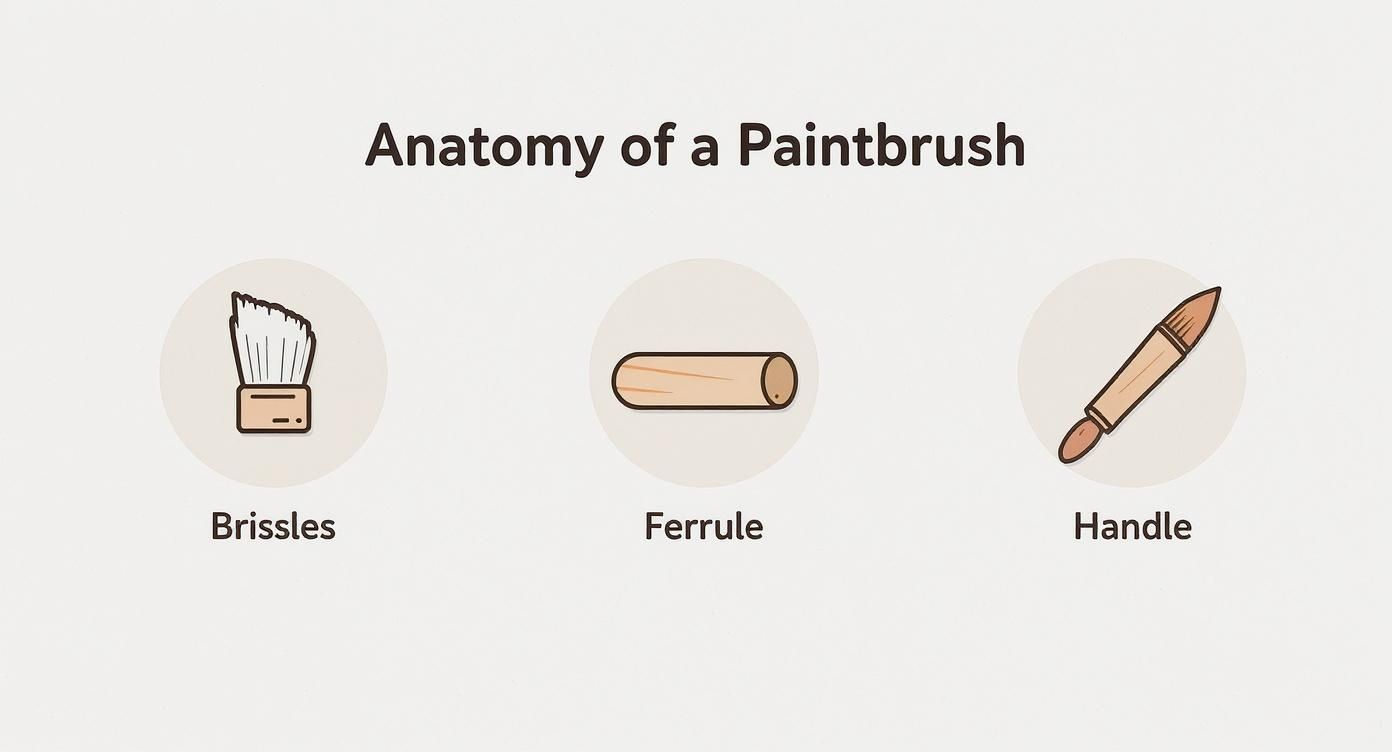
Understanding these three parts—the bristles, the metal ferrule that holds them, and the handle—helps you see how a well-made brush works as a single, cohesive tool to get the paint exactly where you want it to go.
How to Decode Brush Sizes for Ultimate Precision
Ever wonder about those little numbers printed on a brush handle? They aren't just for decoration. Think of them as your secret code for getting those crisp, clean lines that make a finished painting pop. Learning this simple sizing system is the key to matching the right tool to the right area on your canvas.
It's a lot like drawing. You wouldn't grab a thick permanent marker to sketch a tiny eyelash, right? And you wouldn't try to color a huge sky with a super-fine pen. Brushes follow the exact same logic—their size tells you what they're built for, from covering big areas to nailing the most delicate details.
Understanding the Numbering System
The sizing system for paint brushes is actually pretty easy once you crack the code. For most standard brushes, it’s a simple rule: the bigger the number, the bigger the brush. So, a size 10 brush is going to be way wider and hold a lot more paint than a tiny size 2.
But then you see those odd numbers like 2/0 or even 10/0. This is where it gets a little different. These are your detail brushes, the smallest of the small. With these, the logic flips—the higher the first number, the smaller and finer the brush tip.
A 10/0 brush is much smaller than a 2/0, which is itself smaller than a 0. These are the ultra-fine tools you'll grab for the most demanding, microscopic details in your painting.
This system gives you a whole range of tools to work with, so you can confidently pick the perfect brush for any section, no matter how big or small.
Essential Brush Sizes for Your Kit
While you could fill a jar with dozens of different brush sizes, you really only need a handful to tackle just about any paint-by-number kit out there. A small, well-chosen set means you're always prepared without being bogged down by too many options.
Here are the core sizes that will become the workhorses of your painting toolkit:
- Size 4 or 6: This is your big-area brush. Perfect for filling in skies, water, and large background sections. A flat brush in this size is especially great for getting smooth, even coverage without a lot of streaks.
- Size 2: This is the MVP of your collection. A round brush in this size is incredibly versatile, handling all the medium-sized spots and even some of the simpler detail work. You'll probably find yourself reaching for this one more than any other.
- Size 0 or 1: When you need to tighten things up a bit, this is your guy. It's ideal for creating sharp outlines and filling in those smaller, more defined shapes.
- Size 5/0 (or even 10/0): Welcome to the specialist. This is the brush you pull out for extreme detail—think of an animal's whiskers, tiny specks of light in an eye, or the delicate veins on a flower petal.
Armed with just these four brushes, you'll be ready for anything the canvas throws at you, moving like a pro from the big, sweeping areas down to the tiniest numbered dot.
Top Brush Sets for Every Paint by Number Artist
Alright, now that we’ve covered what makes a brush tick, let's get down to finding the right set for you. Choosing the best paint brushes for paint by number isn't about grabbing the most expensive set off the shelf. It’s about finding tools that match how you like to paint.
Everyone has their own style. Maybe you’re just dipping your toes in, or perhaps you’re the type who lives for those tiny, intricate details. Some of us just want to relax for hours on end. Whatever your approach, there's a brush kit made for you.
Let's look at some of my favorite types of sets, broken down by painting style.
The Best Budget Starter Set
Ready to level up from the basic brushes that came with your kit? A budget starter set is the smartest first move you can make. You'll get a massive jump in quality and control without having to break the bank.
What you're looking for is a good mix of shapes and sizes that can handle anything a typical canvas throws at you. A solid starter pack should have:
- Round Brushes (Sizes 1, 2, 4): This gives you a small one for details, a medium workhorse for most spots, and a slightly larger one for bigger areas.
- Flat Brush (Size 6): This is your go-to for covering those large background sections smoothly and without annoying streaks.
- Liner Brush (Size 2/0): Perfect for nailing those super-fine lines and sharp edges that really make a painting pop.
With just these few brushes, you'll be able to tackle almost any paint-by-number project with so much more confidence and precision.
The Ultimate Detailer's Kit
Are you the kind of painter who gets excited by the tiniest, most complex parts of a design? If you live for canvases packed with intricate patterns and microscopic cells, a standard brush set just won’t do the job. You need a dedicated detailer's kit.
These are specialized tools built for one thing: extreme precision. They’re packed with ultra-fine brushes that give you absolute pinpoint control.
For a detail-oriented artist, a brush needs to feel like an extension of your hand—steady, sharp, and capable of the most delicate work. A good detailer’s kit delivers exactly that.
A great detailer’s set will usually contain:
- Multiple Liner Brushes: Look for a range from 5/0 to a minuscule 10/0 to create lines as thin as a hair.
- Spotter Brushes: These have super short, fine bristles, perfect for making tiny, perfect dots, like the glint in an eye.
- Miniature Round Brushes: Sizes like 0, 2/0, and 3/0 are absolutely essential for filling in those teeny-tiny numbered areas without going over the lines.
Getting a set like this will completely change how you approach complex paintings.
The Marathon Painter’s Comfort Grip Set
If you're someone who can get lost in a painting for hours at a time, comfort becomes just as critical as precision. Hand cramps and fatigue are real, and they can ruin a long, relaxing session. That’s where ergonomic brushes come in.
Comfort grip sets are designed with handles that help reduce strain on your hand. They might have a triangular shape or a soft, cushioned barrel that just feels better to hold. This lets you paint for longer stretches without your hand getting tired, which means your strokes stay steady from the first number to the last.
It’s clear that hobbyists are looking for better tools. The global acrylic paintbrush market was valued at around USD 500 million in 2025 and is expected to grow by about 7% each year. This growth is largely driven by people like us seeking more comfortable and effective tools. You can read more about this expanding market and its innovations on archivemarketresearch.com.
How to Clean and Care for Your Brushes
Finding the perfect paint brushes is one thing, but making them last is another story. The number one enemy of a good paint-by-number brush is dried acrylic paint. It can turn those soft, flexible bristles into a stiff, useless clump in no time.
The good news? Cleaning them is a breeze, and it only takes a few minutes after you’re done painting. A solid cleaning habit will keep your tools in prime condition, so your tenth painting looks just as sharp as your first.
Simple Steps for Brush Cleaning
With acrylics, there's one golden rule: never let the paint dry on the brush. Once it hardens, getting it out without wrecking the bristles is a real challenge.
Just follow these simple steps right after you finish a painting session:
- Wipe Off Excess Paint: First things first, gently pinch the bristles with a paper towel or a rag to get rid of any leftover paint.
- Rinse with Lukewarm Water: Swirl the brush tip around in a cup of lukewarm water. Stay away from hot water! It can actually melt the glue that holds the bristles together inside the metal ferrule.
- Lather with Mild Soap: Put a tiny drop of gentle soap, like dish soap, into the palm of your hand. Swirl the brush into the soap to create a light lather, which helps break down any stubborn paint residue.
- Rinse Until Clear: Hold the brush under cool, running water and keep rinsing until the water runs completely clear. No more color!
- Reshape and Dry: Squeeze out the extra water, carefully reshape the bristles back to their original point or flat edge, and then lay them flat to dry. You can also hang them with the bristles pointing down.
Never, ever leave your brushes sitting bristle-down in a jar of water. It's the fastest way to bend the bristles, and you’ll lose that perfect, sharp tip for good.
A little maintenance goes a long way. If you want to dive deeper into the best techniques, check out our full guide on how to clean paint brushes for more tips and tricks.
Frequently Asked Questions About Paint Brushes
It's totally normal to have a few questions when you're staring at a wall of different paint brushes. Let's clear up some of the most common ones I hear from fellow paint-by-number artists so you can get back to your canvas with confidence.
How Many Brushes Do I Really Need to Get Started?
You definitely don't need a giant collection to make something beautiful. Honestly, a small, well-chosen set of three to five brushes will cover almost everything you need.
Make sure your starter kit includes these essentials:
- A fine liner (something like a 5/0) for those super tiny, intricate details.
- A medium round brush (around a size 2) for your general painting work.
- A small flat brush (maybe a size 4 or 6) for smoothly filling in the larger blocks of color.
Can I Use Watercolor Brushes for Acrylic Paint?
You can, but I wouldn't recommend it. Watercolor brushes are built differently; they're much softer because they're designed to hold a lot of water.
Acrylic paint is thicker and heavier, and it really needs a firmer, more durable bristle to push it around. Using a delicate watercolor brush with acrylics will not only wear it out fast, but you also won't get that crisp, clean control you need for sharp lines. It’s best to stick with synthetic brushes specifically made for acrylics.
Think of it like trying to spread cold butter on soft bread with a flimsy napkin. You need a sturdy knife! The stiffness of an acrylic brush gives you the control you need to guide that thicker paint exactly where it needs to go.
Why Is My New Brush Tip Splitting?
Ah, the dreaded frayed brush tip. This almost always comes down to one of two culprits: either there's dried paint stuck deep down in the bristles, or the brush was stored incorrectly.
To fix it, give your brush a good, gentle cleaning with some mild soap and lukewarm water. Once it's clean, use your fingers to carefully coax the bristles back into a sharp point. Then, just lay it flat and let it dry completely.
Ready to find the perfect tools to bring your next masterpiece to life? You can explore the high-quality kits at Custom Paint By Numbers, where every box comes with the essential brushes you need to start painting right away. Turn your favorite memories into art today at https://paint-by-number.com.