
Think of an easel as more than just a place to prop up your canvas. It’s a game-changer. A good easel holds your artwork upright, which does wonders for your posture, perspective, and how you handle the brush. It completely transforms your painting experience, letting you work comfortably for hours and see your piece as it’s meant to be seen.
Your Easel Is More Than a Canvas Holder
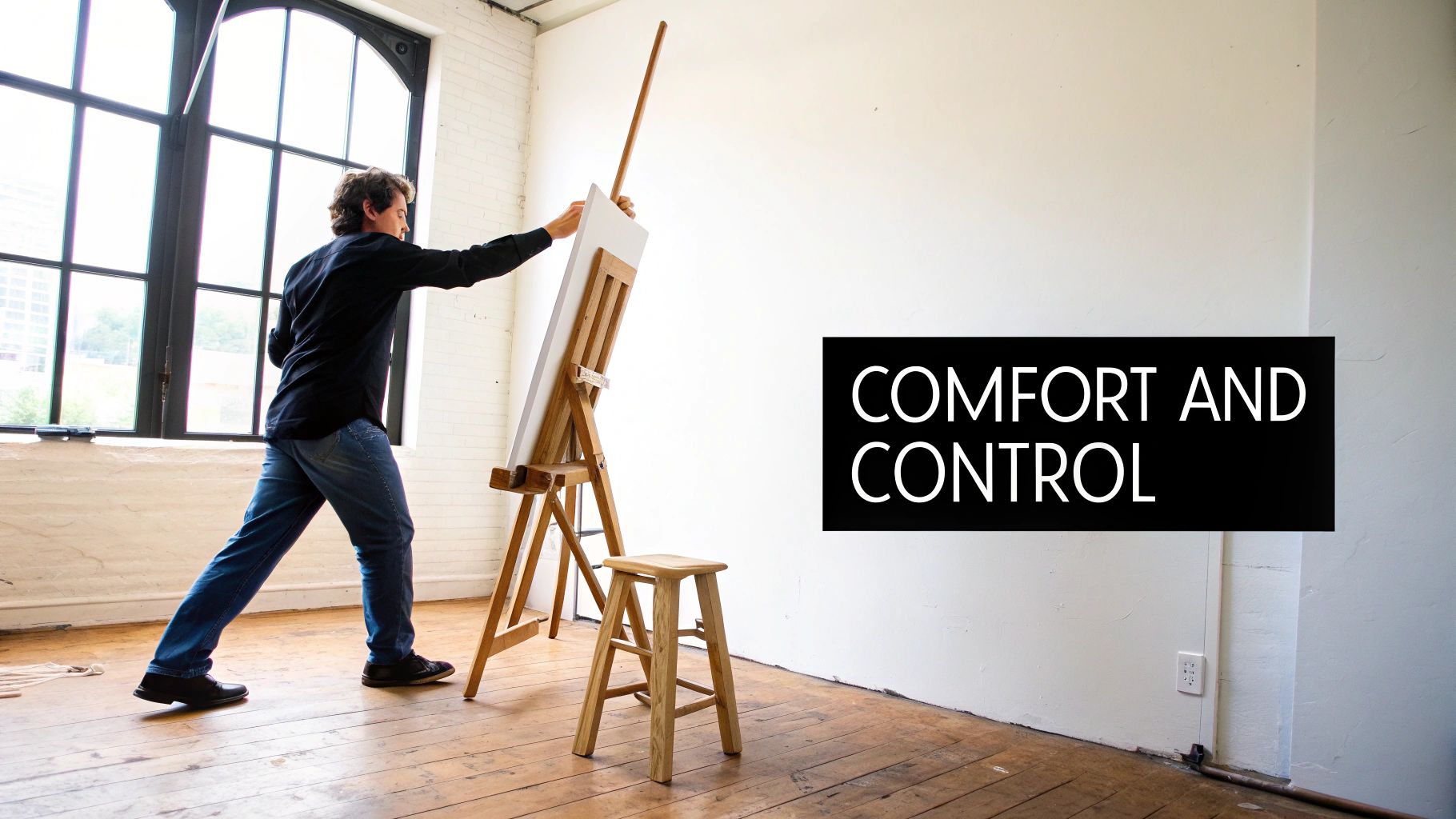
Let's be honest, buying an easel seems straightforward enough. But picking the right one can make a huge difference, turning your painting from a casual hobby into a more focused, rewarding practice. It’s the unsung hero of the art space, quietly influencing everything from your comfort to the final quality of your work.
We’re going to look past the obvious and really dig into the impact an easel can have. This is about more than just holding a canvas—it's about setting yourself up for a better creative process from the get-go.
Unlocking Better Technique and Comfort
Painting upright saves you from that nagging back and neck pain that always seems to show up during long sessions. When you’re not constantly shifting around trying to get comfortable, you can stay lost in the creative flow.
Even more crucial is the viewing angle. Painting on a flat table skews your perspective, leading to subtle distortions in your work that you might not notice until it’s too late. An easel fixes that. Suddenly, you're seeing your painting with fresh eyes, which is vital for getting proportions and composition just right.
A properly set up easel for painting canvas also gives you:
- Improved Brush Control: With your arm free to move, your brushstrokes become more natural and expressive.
- Better Compositional Awareness: It's so much easier to step back and take in the whole picture. This is a non-negotiable habit for checking your painting's balance, color harmony, and overall feel.
- A Professional Workflow: It just feels different. Moving from the kitchen table to an easel elevates the entire experience, making it feel less like a craft and more like a true artistic practice.
An easel is an artist’s silent partner. It provides the stability and perspective necessary to translate the vision in your mind onto the canvas without physical strain or visual distortion getting in the way.
A Growing Trend for New Artists
It’s not just seasoned pros who understand the value of a good easel anymore. The biggest and fastest-growing group of easel buyers is actually students and beginners.
In fact, the market for easels designed for new artists was valued at over USD 1 billion in 2024. What’s really interesting is that over 60% of those sales were tied to people taking online art courses. You can dig into more of these easel market trends over at MarketReportAnalytics.com.
This isn't just about buying another piece of equipment. It’s an investment in creating better art and making your creative time more enjoyable.
Finding the Right Easel for Your Art Style
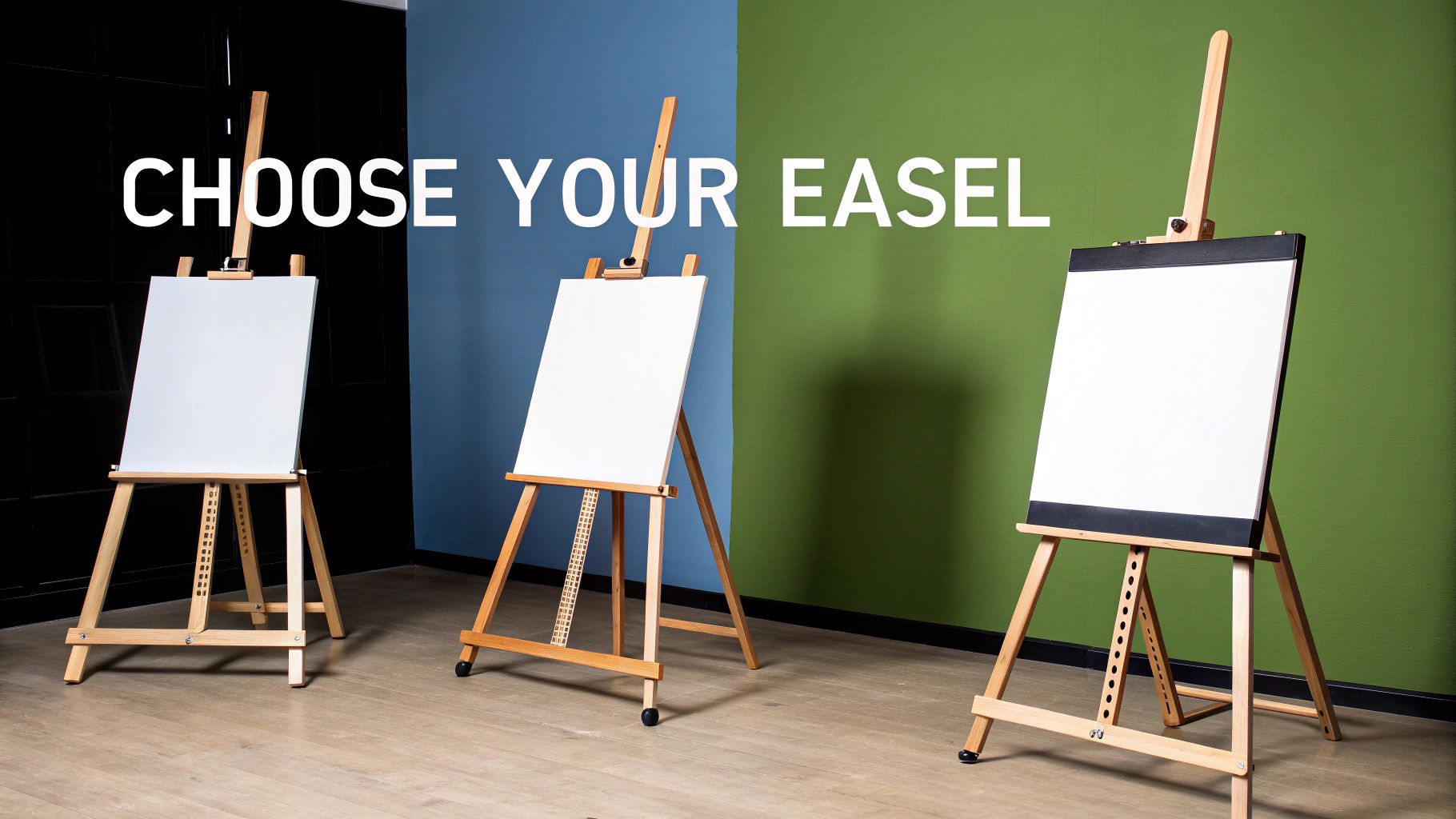
Choosing an easel for painting canvas can feel a bit daunting, but it really just boils down to your space, your canvases, and how you like to paint. Think of it less as a purchase and more like finding the right partner for your creative sessions.
This isn’t just about propping up a canvas; it’s about investing in your comfort and creativity. In fact, artists are increasingly seeking out better gear. In 2024, the global artist easel market was valued at over USD 450 million, with sales growing around 7% annually in North America and Europe. This jump shows that more of us are looking for durable, ergonomic options that make painting a better experience. You can read more about this trend toward premium easels on Accio.com.
Let’s walk through the most common types so you can figure out which one fits you best.
The Studio Workhorse: H-Frame Easel
If you have a dedicated corner for your art and plan to work on larger canvases, the H-Frame easel is your best friend. Its sturdy, square base and parallel posts make it incredibly stable. You won’t get any wobble, even with a big, heavy canvas.
- Best For: Serious hobbyists or professionals with a dedicated studio space.
- Pros: Rock-solid stability, can handle enormous canvases, and often comes with handy trays for your brushes and paints.
- Cons: These are heavy, take up a lot of room, and are usually the most expensive option.
The Versatile A-Frame or Lyre Easel
This is probably the most popular choice for home artists, and for good reason. The A-Frame (sometimes called a Lyre easel because of its shape) hits that sweet spot between stability and a smaller footprint. Its three-legged design is also easy to fold up and tuck away when you’re done painting.
For those exploring more expressive styles, like an abstract acrylic on canvas artwork, an A-Frame gives you the support you need without getting in the way.
The Portable Studio: French Easels and Pochade Boxes
Ever dreamed of painting outdoors or taking your kit to a friend’s house? That’s where these come in. A French Easel is a classic for plein air painting because it’s a tripod, easel, and supply box all rolled into one. It folds down into a surprisingly compact little suitcase.
For something even more minimal, a Pochade Box is a fantastic little gadget. It’s a small, hinged box designed to be held on your lap or mounted on a camera tripod—perfect for quick studies on the go.
A portable easel doesn't just let you paint anywhere; it changes how you see the world. Suddenly, every park bench and scenic overlook becomes a potential studio, encouraging a more spontaneous and observant approach to your art.
The Space-Saving Tabletop Easel
If you’re working in a small apartment, a dorm room, or just prefer painting while sitting at a desk, a tabletop easel is the perfect solution. It’s an excellent, budget-friendly choice that gives you the proper upright angle for your canvas without taking up any precious floor space.
This is an ideal starting point for anyone new to paint-by-numbers, helping you build good habits from the get-go. If you're looking to brush up on the basics, our guide on acrylic painting techniques for beginners is a great place to start.
Easel Type Comparison for Your Painting Needs
Still on the fence? This quick comparison should help you weigh the options and find the best fit for your space, canvas size, and artistic goals.
| Easel Type | Best For | Max Canvas Size | Portability | Stability |
|---|---|---|---|---|
| H-Frame | Dedicated studio spaces, large-scale projects | Very Large | Low | Excellent |
| A-Frame | Home studios, medium to large canvases, versatility | Large | Medium | Good |
| French | Outdoor (plein air) painting, artists on the move | Medium | Excellent | Good |
| Tabletop | Small spaces, small canvases, seated painting | Small | Excellent | Fair |
Ultimately, the best easel is the one that removes barriers and makes you excited to pick up a brush. Whether it's a huge H-Frame for your masterpiece or a tiny tabletop easel for your kitchen counter, choose the one that gets you painting.
Matching an Easel to Your Space and Canvas
Finding the perfect easel for painting canvas is all about what fits your artwork and your life. It’s easy to get swept up by a big, professional-looking easel, but if it doesn't work with your canvas or your room, it just becomes a fancy, frustrating dust collector. Let’s make sure that doesn’t happen to you.
First up, your canvas. Every easel is designed to hold a canvas up to a certain maximum height, and you’ll usually find this info listed right in the product specs. If you’re excited to start a 24x36 inch paint-by-number, that little tabletop easel rated for 20-inch canvases just isn't going to cut it. The whole thing will be top-heavy and wobbly—a surefire way to ruin your flow.
Thinking Beyond Canvas Height
But it’s not just about height. I’ve seen painters forget to consider canvas weight, and it can be a real problem. A lightweight aluminum A-frame might be perfect for a standard stretched linen canvas, but it could seriously struggle with a heavy, cradled wood panel of the exact same dimensions. That extra weight can make a flimsy easel bow or, even worse, tip over completely.
Before you click "buy," think about the heaviest type of canvas you see yourself using. Make sure the easel you’re eyeing is built to handle that load. Trust me, it’ll save you from that heart-stopping moment when you realize your masterpiece is too much for its support.
It's clear artists are taking their gear seriously. The global market for easels was valued at roughly USD 1.42 billion in 2024. With North America and Europe leading the charge—at over USD 600 million and USD 550 million respectively—it shows a strong demand for reliable equipment. You can see more on this trend over at Prof-Research.com.
Assess Your Creative Workspace
Okay, now let’s talk about your actual painting space. That gorgeous, towering H-Frame easel looks incredible online, but will it even fit under your 8-foot ceiling? You have to measure your ceiling height before you commit to a big studio easel. Don't forget to account for the upper mast, which often slides up several inches higher than the top of your canvas.
Your studio space dictates your easel choice just as much as your artistic ambition. Don't fight your environment; choose an easel that works in harmony with it. A well-chosen tabletop easel in a small corner is far more useful than a giant H-Frame crammed into a space it was never meant for.
If you’re short on floor space, don't worry. A-Frame easels have a much smaller footprint and fold up nicely to tuck away in a closet. Tabletop models are even better, turning any desk or sturdy table into an instant studio. This is particularly useful if you're experimenting with different artwork sizes. For more on that, take a look at our guide on choosing a custom canvas size to find the perfect dimensions for your next project.
Ultimately, making a smart, practical choice means you’ll end up with an easel you truly love to use, not just one that gets in the way.
Getting Your Easel Set Up Just Right
Unpacking a brand new easel for painting canvas is always a great feeling. But getting it set up correctly is what really makes the magic happen. A good setup means you can paint comfortably for hours, avoiding weird backaches or annoying glare. Let's get your new easel dialed in and ready for your first brushstroke.
First things first, let’s get that canvas locked in. Your easel probably has either a sliding clamp on top or a couple of grips on the side. The key is to make it snug and secure without crushing the canvas frame. You want it tight enough that the canvas doesn’t wobble if you give it a gentle nudge, but not so tight that you leave dents in the wood.
This diagram hits on the three big things to think about before you even start tightening knobs: your canvas, its weight, and your painting space.
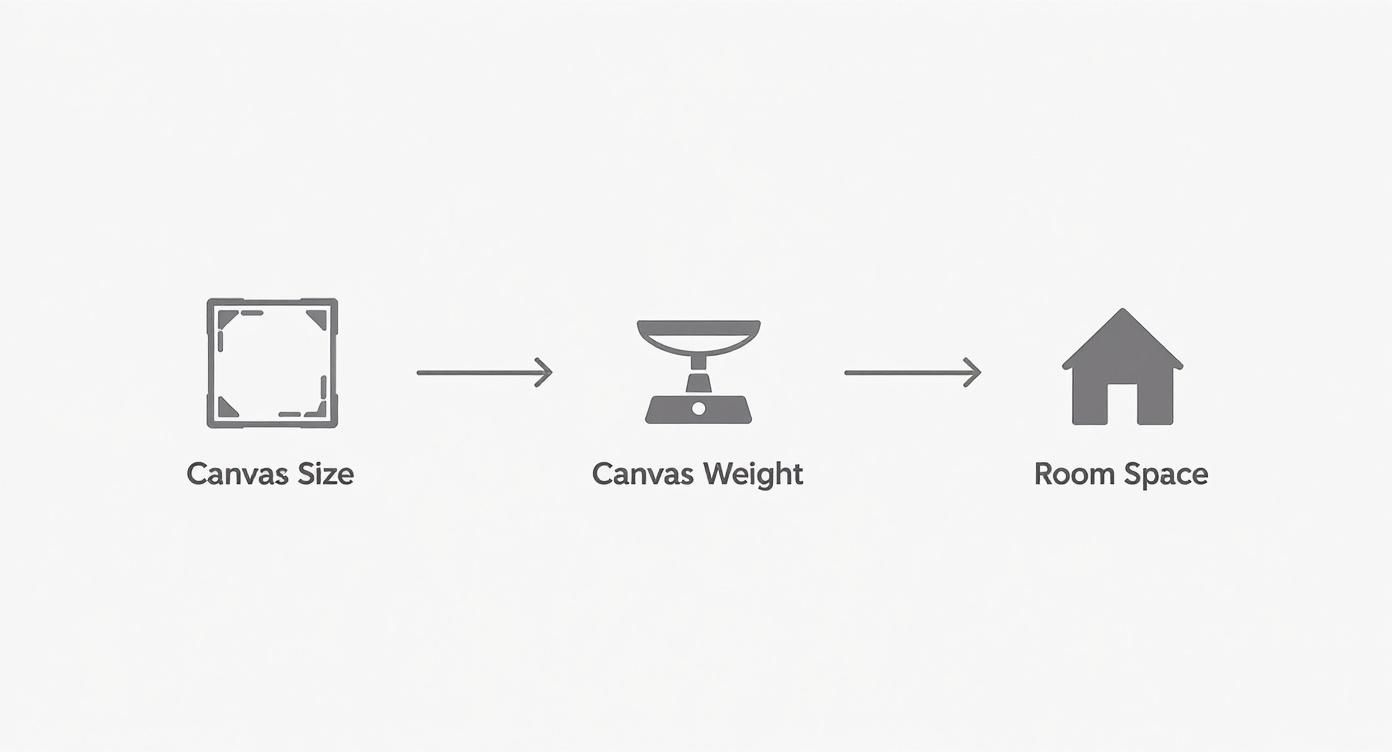
As you can see, these elements are all connected. A big, heavy canvas needs a sturdy easel and enough room to work, so getting the balance right from the start saves a lot of headaches.
Nailing the Height for Comfort and a Better View
With the canvas secure, it's time to adjust the height. This is probably the most important step for avoiding neck and shoulder pain later. You want the middle of your painting to be right at eye level.
- If you paint standing up: Raise or lower the easel so you can comfortably reach the heart of the canvas without slouching or stretching.
- If you prefer to sit: Get settled in your chair and then adjust the easel down so the canvas's center meets your gaze.
The goal is to be able to move your arm freely and naturally. Don't hesitate to tweak the height as you move around the canvas. The perfect position for the top corner might not feel so great when you’re working on the bottom edge.
The Secret to a Glare-Free Painting Session: Adjusting the Tilt
This is the adjustment most people miss, and it’s a game-changer. The angle of your canvas is your best weapon against glare from lights or a bright window. All it usually takes is a slight forward tilt.
Start with the canvas sitting perfectly vertical. Then, begin to angle the top forward just a little at a time. Step back to where you'll be painting and see how it looks. You're hunting for that sweet spot where the reflections vanish, giving you a true, clear view of your colors. As a bonus, this angle is often much more comfortable for your wrist and arm.
My Go-To Trick: I always keep a small bubble level handy. Once I think I have the easel set up perfectly, I place the level on the bottom tray holding the canvas. It's a quick, foolproof way to ensure everything is level and stable, which helps prevent any subtle distortions while you're painting.
Before you pick up a brush, do one last walk-around and give every knob and clamp a final tightening. It only takes one loose screw for your canvas to slip mid-stroke. Taking a minute to double-check that everything is solid is the best way to protect your hard work and keep your creative focus locked in.
Real-World Tips for Maintenance and Stability
https://www.youtube.com/embed/FCOZ5wzRulo
Buying an easel for painting canvas is the first step, but keeping it sturdy and reliable for years of painting is what really matters. I've picked up a few tricks over the years to handle those common annoyances, so your focus stays on the canvas, not on a wobbly setup.
Nothing kills the creative mood faster than an unsteady easel. If you’ve set up on a slightly uneven floor, don't get frustrated. Just slide a small piece of wood or even some folded cardboard under the shorter leg to act as a shim. It’s a simple fix that works wonders.
Lightweight A-frame easels can sometimes feel a bit precarious with a bigger canvas. An easy solution is to weigh down the base. A small sandbag or a couple of heavy books set on the lower part of the back leg adds just the right amount of ballast to keep it firmly planted.
Creating the Perfect Painting Environment
Where you place your easel and how you light your space are just as important as the easel itself. Glare bouncing off wet paint can throw your color perception way off, and your own shadow falling across the canvas can be a real headache.
The trick is to position your easel so the main light source, like a window or lamp, hits the canvas from the side and slightly above.
- If you're right-handed: Your light should come from the left.
- If you're left-handed: Set up your light on your right side.
This simple arrangement stops your painting arm from casting a shadow right where you need to see. You’ll be surprised at what a huge difference it makes, especially when you're working on tiny, detailed sections.
The goal is to illuminate the canvas, not your back. Think of your easel and light source as a team working together to give you the clearest, most accurate view of your masterpiece in progress.
Simple Maintenance for a Long-Lasting Easel
A little bit of upkeep goes a long way. Dried paint splatters are just part of the process, but they don't have to be a permanent feature. If you get acrylic paint on a wooden easel, you can usually scrape the thickest spots off gently with a palette knife once they're dry. A cloth with some warm, soapy water will take care of the rest.
Every so often, take a minute to check and tighten all the nuts, bolts, and knobs. Wood can expand and contract with changes in temperature and humidity, which can loosen the hardware over time. A quick tighten-up every few months will prevent that dreaded mid-painting slip.
Keeping your canvas stable is also key if you want to frame your finished work later. For more on that final step, check out our guide on how to stretch a painted canvas once it’s fully dry.
Still Have Questions About Easels?
I get it. Even after you’ve browsed all the options, a few questions always seem to pop up right when you’re ready to pull the trigger. Getting those final details ironed out is the key to choosing an easel you’ll actually enjoy using for years to come.
So, let's tackle some of the most common questions I hear from painters of all stripes—from total beginners to seasoned artists looking to refine their setup.
What’s the Best Easel for a Beginner?
For anyone just starting out, my go-to recommendation is a lightweight A-Frame easel (sometimes called a Lyre easel). It really hits the sweet spot between stability and price, and it won't take over your entire room. This type can easily handle the small to medium canvases you'll find in most paint-by-number kits.
They’re also a breeze to set up and fold down when you need to reclaim your space. Now, if you're really tight on room or just prefer painting at a desk, a solid Tabletop easel is another fantastic, budget-friendly choice. Either one will help you develop good posture and painting habits without the hefty price tag of a big H-Frame studio easel.
Can I Use One Easel for All Kinds of Paint?
Mostly, yes—but there’s a catch. Your standard standing easels, like A-Frames and H-Frames, are perfect for acrylics and oils. With those paints, you typically want your canvas sitting vertically or at a slight angle.
Watercolors, however, are a different beast. They often require a completely flat surface to keep the watery pigments from running where you don't want them. If you’re planning to dabble in watercolors, you'll need a convertible or multi-angle easel that can lay flat. French easels and some specialized studio models have this feature, making them a great all-arounder if you’re the type who likes to experiment.
The best easel is one that grows with your curiosity. If you think you might explore different paints down the road, picking a versatile, multi-angle easel from the start is a smart move.
My Big Canvas Keeps Wobbling. How Do I Fix It?
Ah, the dreaded canvas wobble—it’s incredibly distracting! The first thing to do is a quick check of all the knobs and bolts on your easel. Make sure everything is cranked down tight. Also, double-check that the bottom canvas support is securely cradling the frame and the top clamp is holding it firmly.
If the whole easel feels shaky, be sure it’s on a level, solid floor. A little trick for A-Frame easels is to place a small weight, like a sandbag or even a heavy book, on the back leg’s crossbar for extra stability. But if you find yourself regularly painting on larger canvases (anything over 36 inches), the real solution is to upgrade to a sturdy H-Frame easel. They’re built like tanks specifically to handle that size and weight without a hint of wobble.
How Do I Clean Old Paint Off My Wooden Easel?
Keeping your wooden easel clean is pretty simple and will help it last a lifetime. The trick is to use the right method for the type of paint.
- Fresh Acrylics: Just wipe it off with a damp cloth. Easy.
- Dried Acrylics: Gently use a palette knife to flake off the bigger chunks. Then, a little warm, soapy water on a cloth should take care of the rest.
- Oils: For wet oil paint, a cloth with a bit of odorless mineral spirits does the trick. Dried oil paint might require some careful scraping.
Here’s a pro tip: when you get a new wooden easel, rub it down with a coat of linseed oil or apply a clear varnish. This seals the wood, so future paint drips won’t soak in and can be wiped away in seconds.
Ready to turn a cherished photo into a work of art? At Custom Paint By Numbers, we'll help you create a personalized kit that will look fantastic on your new easel.
Start your custom painting journey today!