
Have you ever wanted to create art but felt unsure where to begin? The world of art can seem intimidating, filled with complex techniques and expensive materials. But the truth is, everyone has a creative spark waiting to be ignited. This guide is designed to demystify the process and introduce you to seven engaging and accessible art projects for beginners. Each project has been selected for its simplicity, low barrier to entry, and potential for beautiful results, regardless of your prior experience.
We will explore everything from the fluid beauty of watercolors to the tactile satisfaction of clay modeling, providing you with the exact materials, steps, and tips needed to build your confidence. These projects are perfect for anyone looking to start a new hobby, find a way to de-stress, or simply have fun making something unique. You will learn practical skills in drawing, painting, and sculpting that serve as a fantastic foundation for your artistic journey. For those looking for even more straightforward creative activities, especially with family, you can explore these easy and fun crafting ideas for children for additional inspiration.
Prepare to discover a new passion and prove to yourself that art is for everyone.
1. Watercolor Landscape Painting
Watercolor landscape painting is a fantastic entry point into the world of art for beginners. The medium uses water-based paints that blend beautifully, creating soft, ethereal effects that are perfect for capturing natural scenes. It’s an accessible way to learn fundamental concepts like color theory, composition, and how light and shadow interact, all while being remarkably forgiving.
Unlike thicker paints like acrylics or oils, watercolors allow you to build up color in transparent layers, a technique called glazing. This process makes it easier to control color intensity and correct mistakes. Simple subjects are often the most rewarding for newcomers.
Project Ideas for Your First Landscape
- Mountain Silhouettes: Paint a simple gradient sky and then add a dark, solid mountain range in the foreground.
- Beach Scenes: Capture the look of wet sand reflections with a wet-on-wet technique.
- Forest Paths: Use a dry brush to create textured bark and dappled sunlight filtering through leaves.
- Abstract Sunsets: Don't worry about realism; just blend vibrant reds, oranges, and purples to capture the feeling of a sunset.
This infographic summarizes the core benefits that make watercolor an ideal starting point for many art projects for beginners.
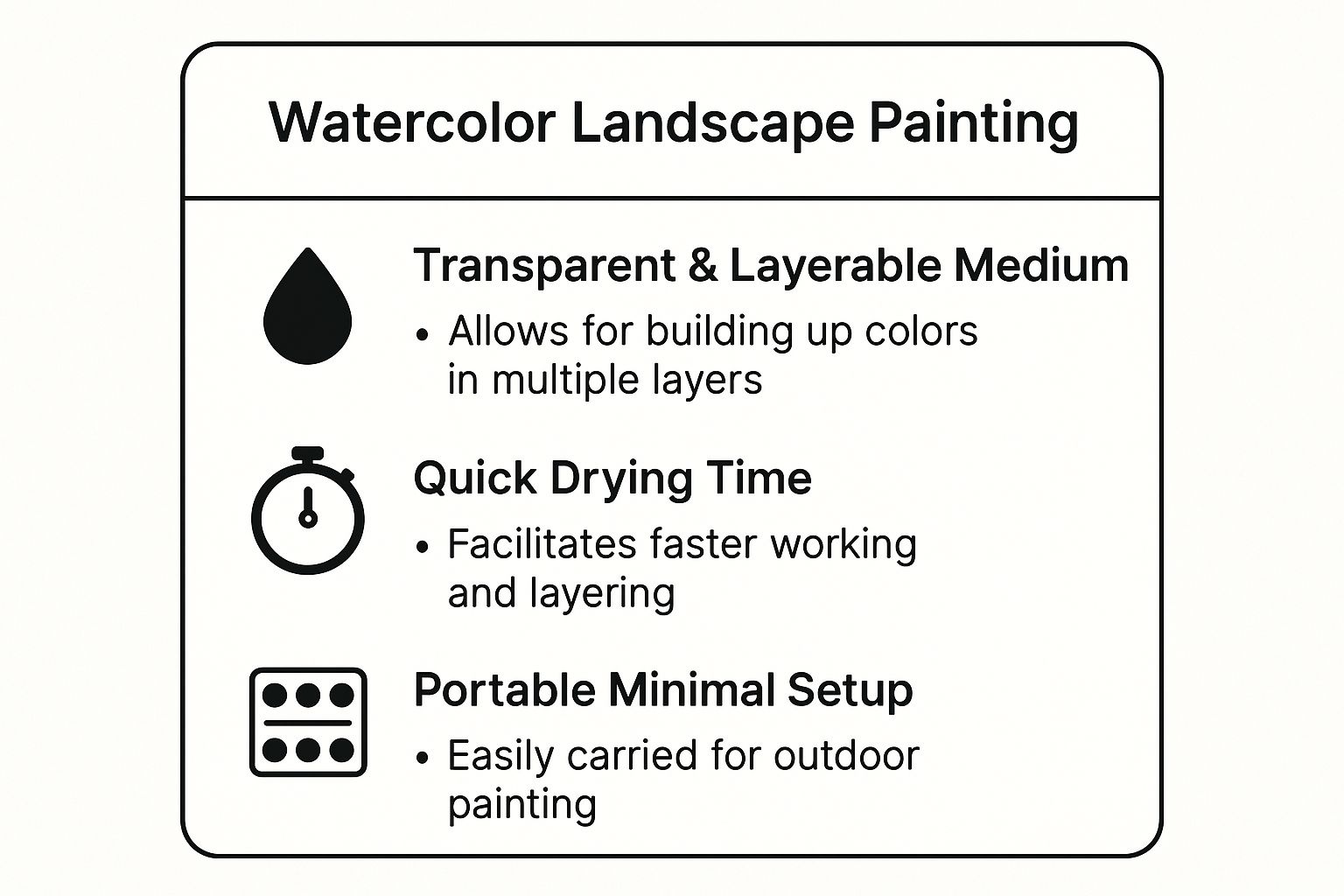
As the infographic highlights, the combination of transparency, fast drying time, and portability makes watercolor painting an excellent and low-barrier art project. This means you can easily practice indoors or take your supplies outside to paint a real scene. If you're looking for a more structured approach, you might also find paint-by-number kits helpful. You can learn how to make your own custom kit to turn a favorite photo into a guided painting experience.
Quick Tips for Success
Pro Tip: Always work from light to dark. It's easy to add more pigment to darken an area, but it's very difficult to lighten a watercolor wash once it's on the paper.
For a visual guide, this tutorial breaks down the basics of painting a simple watercolor landscape, perfect for your first attempt.
2. Pencil Portrait Drawing
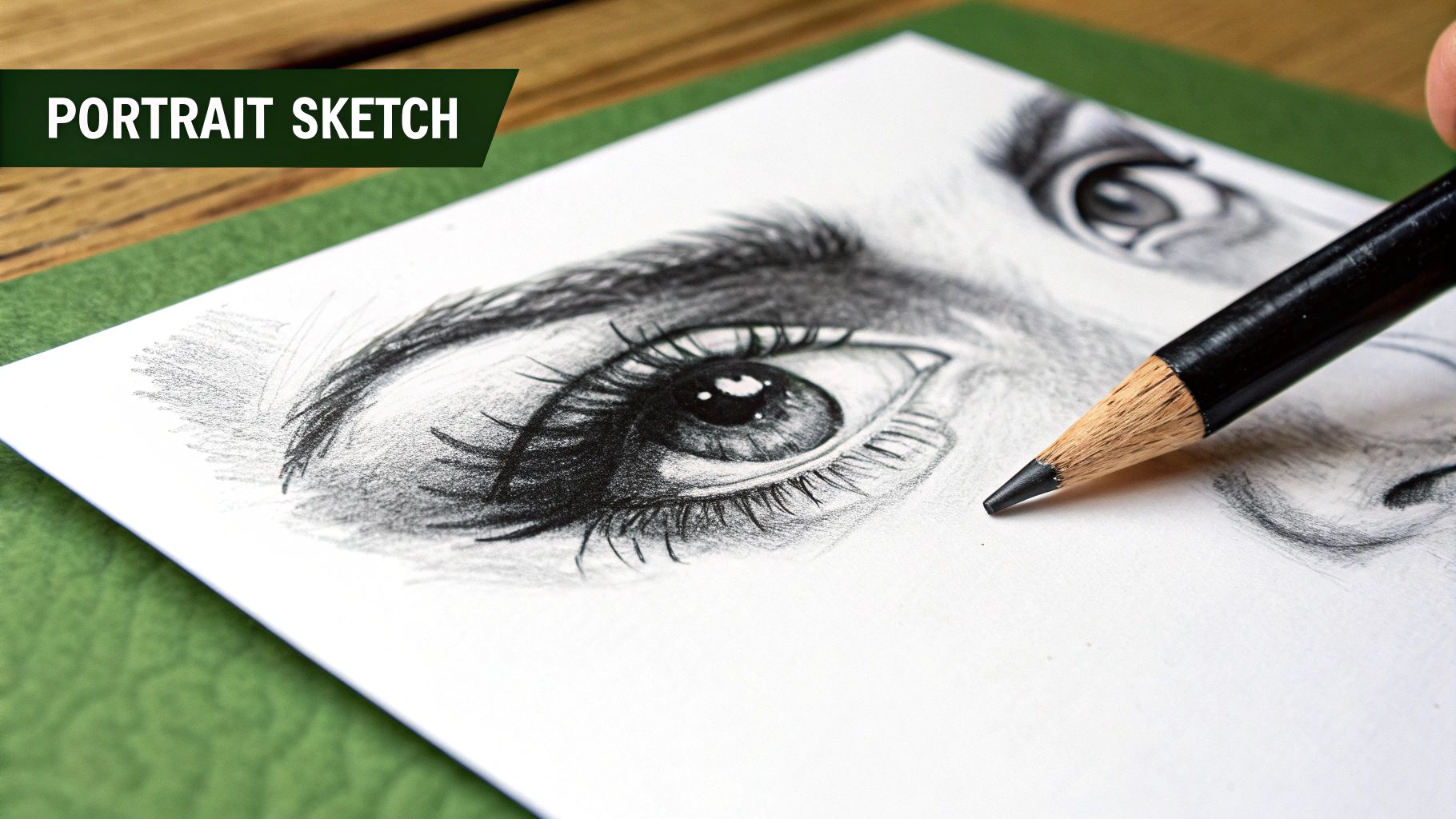
Pencil portrait drawing is one of the most classic and rewarding art projects for beginners. It focuses on capturing a person's likeness using simple graphite pencils. This foundational art form is an exceptional way to master essential skills like proportion, shading, and observation, all while requiring only basic and affordable materials. It directly trains your hand-eye coordination and builds an intuitive understanding of facial structure.
Unlike painting, which involves mixing colors and managing drying times, pencil drawing offers immediate results and precise control. The process of building up tones from light to dark with different pencil grades (from hard, light 'H' pencils to soft, dark 'B' pencils) is a core skill that translates to nearly every other visual art medium.
This direct approach makes it an excellent choice for anyone wanting to develop a strong artistic foundation. The skills you learn by observing and rendering a face are universally applicable, making this one of the most valuable art projects for beginners. For those who love the idea of portraits but prefer a more colorful or guided approach, you can also explore how to turn a photo into a painting project for a different kind of creative experience.
Project Ideas for Your First Portrait
- Self-Portrait: Use a mirror or a clear photograph of yourself to practice. You are your most available model!
- Pet Portraits: Work from a photograph of your furry friend to capture their unique personality and features.
- Celebrity Sketches: Find high-quality reference photos online of a favorite actor or musician to practice capturing recognizable features.
- Family Member Drawings: Ask a family member to pose for you or use a favorite photo to create a heartfelt gift.
Quick Tips for Success
Pro Tip: Use a grid method to start. Lightly draw a grid over your reference photo and a corresponding, scaled grid on your drawing paper. This helps you place features accurately and maintain correct proportions, removing much of the initial intimidation.
For a visual guide, this tutorial from Proko, a renowned online art instructor, breaks down the fundamentals of drawing a realistic head, which is perfect for your first attempt at portraiture.
3. Abstract Acrylic Canvas Painting
Abstract acrylic canvas painting is one of the most liberating art projects for beginners. It removes the pressure to create a realistic image and instead focuses on exploring color, texture, and emotion. Using fast-drying acrylic paints, you can freely experiment with composition and technique, making it a powerful way to learn the fundamentals of painting without the constraints of realism.
This approach, pioneered by artists like Wassily Kandinsky and Mark Rothko, is all about personal expression. You can layer colors, scrape paint with a palette knife, or create bold, expressive marks. Because acrylics dry quickly, you can build up complex surfaces and make changes without a long wait time, which encourages a more intuitive and spontaneous creative process.
Project Ideas for Your First Abstract
- Color Field Painting: Inspired by Rothko, create large, solid blocks of color that blend into one another to evoke a specific mood or feeling.
- Geometric Compositions: Use painter's tape to create sharp lines and shapes. Fill them in with contrasting or complementary colors for a clean, modern look.
- Expressionist Brush Strokes: Channel Jackson Pollock's energy by using bold, dynamic brush strokes, drips, and splatters to convey movement and raw emotion.
- Textural Abstracts: Mix a texturizing medium into your paint or use a palette knife to apply thick layers, creating a three-dimensional surface you can almost feel with your eyes.
This style of painting is an excellent, low-stress activity that promotes mindfulness and self-expression. The focus on process over a perfect outcome makes it a popular choice for artists of all ages and abilities. For those seeking a creative outlet later in life, you can explore the benefits of paint by numbers for seniors, which can also offer a structured path into abstract concepts.
Quick Tips for Success
Pro Tip: Start with a limited color palette of just three or four colors (plus black and white). This helps you learn color mixing and prevents your painting from becoming a muddy, chaotic mess.
For a visual guide on how to approach your first abstract piece, this tutorial offers simple, effective techniques to get you started.
4. Paper Collage Art
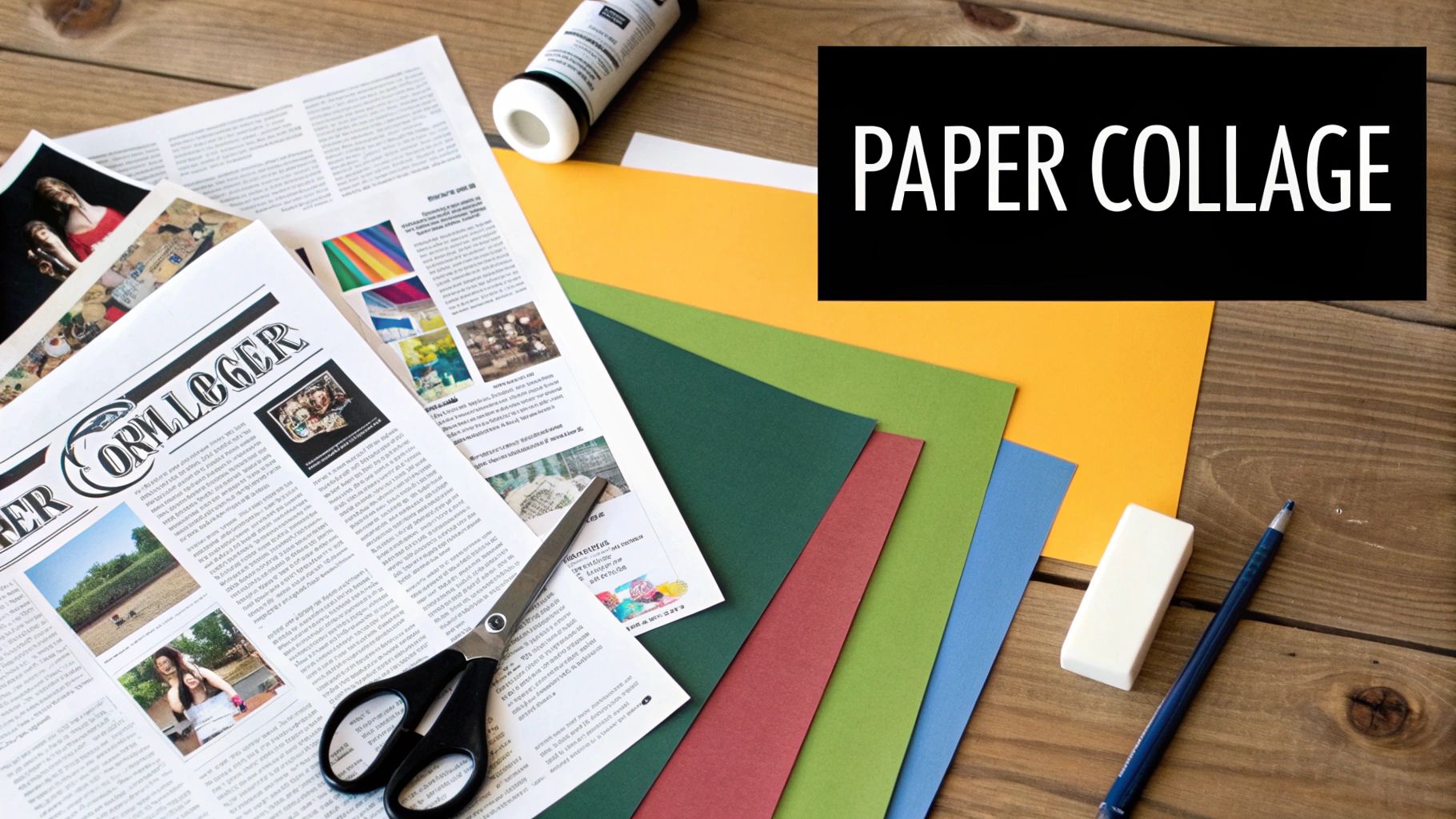
Paper collage is an wonderfully accessible art project for beginners, involving arranging and gluing various paper materials onto a surface to create a new, unified piece. It's a fantastic way to explore core artistic principles like composition, color theory, and texture without the pressure of drawing or painting from scratch. This makes it an incredibly freeing and low-stakes entry into creative expression.
Because it relies on found or prepared materials, collage encourages resourcefulness and helps develop a keen eye for how different visual elements can work together. You can use anything from magazines and newspapers to colored construction paper and old photographs.
This art form, popularized by artists like Pablo Picasso and Hannah Höch, is perfect for those who enjoy a more tactile, hands-on process. It’s less about perfect rendering and more about storytelling through assembled pieces.
Project Ideas for Your First Collage
- Portrait from Magazines: Use cutouts of different colors and textures from magazines to build the features of a face.
- Torn Paper Landscape: Create a mountain or coastal scene by tearing, not cutting, colored paper to achieve soft, organic edges.
- Abstract Color Study: Focus solely on arranging shapes of different colors to explore mood and balance, without representing a specific object.
- Mixed Media Creation: Combine your paper collage with other simple art projects for beginners, like adding details with ink pens or a light watercolor wash in the background.
Quick Tips for Success
Pro Tip: Before you glue anything down, do a "dry run." Arrange all your pieces on the background surface and move them around until you are happy with the composition. Take a quick photo with your phone so you can remember the placement.
For a visual guide on creating a simple yet beautiful torn paper landscape, this tutorial is a great place to start.
5. Simple Pottery and Clay Modeling
Simple pottery and clay modeling offers a tactile, three-dimensional introduction to art-making that is deeply satisfying. It connects beginners with one of humanity's oldest art forms, allowing you to create functional and decorative objects with just your hands and a few basic tools. This medium is excellent for developing spatial awareness, hand-eye coordination, and a feel for form and volume.
Air-dry clay is a perfect starting point as it requires no special kiln for firing, making it one of the most accessible art projects for beginners. You can use basic hand-building techniques like pinching, coiling, and slab construction to bring your ideas to life, transforming a simple block of clay into a unique creation.
Project Ideas for Your First Clay Creation
- Pinch Pots: Create small bowls perfect for holding jewelry, keys, or salt by simply pinching and rotating a ball of clay.
- Coil-Built Vessels: Roll out long ropes of clay and stack them to build vases, mugs, or decorative pots with interesting textures.
- Slab-Constructed Tiles: Roll clay flat and cut it into shapes to make decorative tiles, wall hangings, or small trays.
- Simple Sculptural Figures: Model small, abstract animals or figures, focusing on form and expression rather than perfect realism.
For a deeper dive into these techniques, you can explore the rich history of studio pottery, influenced by pioneers like Bernard Leach and Shoji Hamada. Their focus on simple, functional forms provides great inspiration. Learning from their approach can help you appreciate the beauty in handmade imperfections.
Quick Tips for Success
Pro Tip: To securely join two pieces of clay, use the "score and slip" method. Scratch a cross-hatch pattern onto both surfaces you want to connect, then brush on a bit of watery clay (slip) to act as glue. This creates a strong, lasting bond.
To see how these fundamental techniques work in practice, check out this video that demonstrates how to make a simple coil pot from start to finish.
6. Digital Art Using Free Software
Creating digital art is a modern and highly versatile entry point for artistic expression. Using powerful and free software like Krita, GIMP, or Medibang Paint, beginners can explore the principles of drawing, painting, and design without investing in physical materials. This medium combines the feel of traditional art with the incredible power of digital tools, offering features like an "undo" button, layers, and a vast array of brushes that make experimentation easy and fun.
The beauty of digital art lies in its accessibility and forgiveness. You can correct mistakes with a single click and experiment with colors and compositions without wasting paint or paper. This freedom encourages a more playful and less intimidating approach, making it one of the most dynamic art projects for beginners looking to build foundational skills that are relevant in today's digital world.
Project Ideas for Your First Digital Artwork
- Character Design: Sketch a simple character, then use layers to add line art, base colors, and shading separately.
- Stylized Portraits: Trace over a photograph on a lower layer to understand proportions, then create a stylized illustration on a new layer above it.
- Vector Illustrations: Practice using pen tools to create clean, scalable logos or icons with solid colors and gradients.
- Digital Paintings: Mimic traditional media by experimenting with textured brushes that simulate watercolor, oil, or charcoal effects.
For those exploring the possibilities of digital creation, you can also leverage other tools to spark inspiration. For instance, consider using Richly AI, a powerful content and image generator to generate concepts or reference images that can kickstart your creative visions.
Quick Tips for Success
Pro Tip: Learn to love layers. By keeping different elements of your artwork on separate layers (e.g., background, line art, color, shadows), you can edit each part independently without affecting the rest of your image. This is a non-destructive workflow that saves a lot of time and frustration.
This tutorial provides an excellent introduction to Krita, one of the most popular free digital painting programs, guiding you through the essential tools and functions to get started.
7. Alcohol Ink Art
Alcohol ink art is a vibrant and unpredictable medium that is exceptionally well-suited for beginners. It involves using highly pigmented, fast-drying alcohol-based inks on non-porous surfaces like synthetic paper, ceramic, or glass. The inks flow, mix, and spread with an organic quality, creating mesmerizing fluid patterns that often look like natural formations. It's a fantastic art project for beginners because the process is more about guiding the medium than controlling it, leading to stunning results without needing precise drawing skills.
The beauty of alcohol ink lies in its spontaneous nature. By adding isopropyl alcohol or a blending solution, you can re-wet the ink, creating beautiful blooms, fades, and textures. This makes it a very forgiving and playful way to explore color interactions and abstract composition.
Project Ideas for Your First Alcohol Ink Piece
- Abstract Coaster Sets: Drip a few complementary colors onto ceramic tiles and tilt them to create a marbled effect.
- Vibrant Bookmarks: Use synthetic Yupo paper cut into strips to create small, colorful pieces of functional art.
- Decorated Ornaments: Apply inks to clear glass or plastic ornaments for a beautiful stained-glass appearance.
- Galaxy-Inspired Art: Use dark blues, purples, and blacks, then spatter with white or metallic ink to create a starfield.
Many contemporary artists, such as Anna Bulbrook and Cathy Taylor, have popularized alcohol ink through workshops and online tutorials, making it more accessible than ever. The vibrant results and fluid process make it a highly rewarding experience.
Quick Tips for Success
Pro Tip: Always seal your finished, dried artwork with a UV-resistant varnish. Alcohol inks are not lightfast and can fade over time with exposure to direct sunlight. Sealing protects the vibrancy of your colors.
For a visual demonstration, this tutorial from artist Alexis Bonavitacola shows how to get started with basic techniques, perfect for anyone new to the medium.
Beginner Art Projects Comparison Guide
| Art Form | Implementation Complexity 🔄 | Resource Requirements ⚡ | Expected Outcomes 📊 | Ideal Use Cases 💡 | Key Advantages ⭐ |
|---|---|---|---|---|---|
| Watercolor Landscape Painting | Moderate 🔄 - layering, control needed | Low ⚡ - minimal supplies, quality paper recommended | Soft, natural landscapes with color blending 📊 | Beginners learning color theory and composition 💡 | Transparent medium; quick drying; portable ⭐ |
| Pencil Portrait Drawing | Moderate to High 🔄 - precision & shading | Very Low ⚡ - pencils and erasers only | Realistic human likeness and detailed portraits 📊 | Developing drawing fundamentals and anatomy 💡 | Easy corrections; builds foundational skills ⭐ |
| Abstract Acrylic Painting | Low to Moderate 🔄 - freeform, experimental | Moderate ⚡ - acrylic paint, canvas needed | Unique, expressive abstract compositions 📊 | Exploring color, texture, and personal expression 💡 | Fast drying; forgiving; encourages creativity ⭐ |
| Paper Collage Art | Low 🔄 - arranging and gluing | Very Low ⚡ - recycled paper and glue | Colorful, textured compositions without drawing skills 📊 | Beginners focusing on composition and design 💡 | Low cost; eco-friendly; no drawing required ⭐ |
| Simple Pottery & Clay Modeling | Moderate to High 🔄 - hand-building, drying/firing | Moderate to High ⚡ - clay, kiln access needed | Functional and decorative 3D ceramic pieces 📊 | Tactile art with historical and cultural relevance 💡 | Therapeutic; develops motor skills; reusable mistakes ⭐ |
| Digital Art (Free Software) | Moderate 🔄 - learning interfaces and tools | Low after setup ⚡ - computer/tablet needed | Versatile, editable digital artwork 📊 | Modern art creation with easy corrections & sharing 💡 | Unlimited tools; easy undo; no physical storage ⭐ |
| Alcohol Ink Art | Low 🔄 - flowing medium, unpredictable | Low to Moderate ⚡ - inks, alcohol, ventilation | Vibrant, organic abstract patterns 📊 | Stress relief, meditation, and spontaneous art 💡 | Stunning results with minimal skill; fast drying ⭐ |
What Will You Create First?
The journey into art doesn't start with a masterpiece; it begins with a single, simple decision to create. Throughout this guide, we've explored a diverse collection of art projects for beginners, each designed to be an accessible entry point into your creative expression. From the fluid, gentle washes of watercolor landscapes to the precise, thoughtful lines of a pencil portrait, you now have a map to guide your initial steps.
We uncovered the liberating joy of abstract acrylics, where emotion takes precedence over realism. We saw how everyday materials could be transformed into stunning paper collages, and how the tactile experience of shaping clay can be both meditative and rewarding. For those drawn to the digital realm, we learned that powerful creative tools are available for free, while alcohol inks offer a vibrant, unpredictable, and exciting medium to explore. The most crucial takeaway is that there is no single "right" way to be an artist. Your path is yours alone to forge.
Your Artistic Journey Starts Now
The most significant barrier for any aspiring artist isn't a lack of talent; it's the fear of the blank page. The projects we've detailed are specifically designed to dismantle that fear. They provide structure without being restrictive, offering a clear process you can follow while leaving ample room for your unique voice to shine through.
Think about what truly excites you.
- Do you love precision and detail? Start with pencil portrait drawing.
- Are you drawn to color and expressive freedom? Abstract acrylics or alcohol inks are calling your name.
- Do you enjoy a hands-on, tactile process? Simple pottery is the perfect place to begin.
The value in mastering these foundational projects isn't just about the finished piece you hang on your wall. It's about building creative confidence. Each completed project, no matter how small, is proof that you can turn an idea into a tangible reality. This process nurtures problem-solving skills, enhances mindfulness, and provides a powerful outlet for stress relief and self-discovery.
Embracing the Process Over Perfection
Remember, the goal of these beginner projects isn't to create a flawless work of art on your first try. The true objective is to engage with the materials, learn their properties, and enjoy the act of creation itself. Don't be discouraged by a crooked line or a color that didn't turn out as expected. These are not mistakes; they are learning opportunities.
Every artist was first an amateur. The only difference between them is persistence and a willingness to embrace the learning curve. Your artistic adventure is just beginning, and the most beautiful creations lie ahead.
Pick the one project from our list that sparked the most curiosity. Gather your few essential supplies, clear a small space, and dedicate an hour to just playing. Give yourself permission to experiment without pressure. You have the tools, the knowledge, and the inspiration. The only thing left to do is begin.
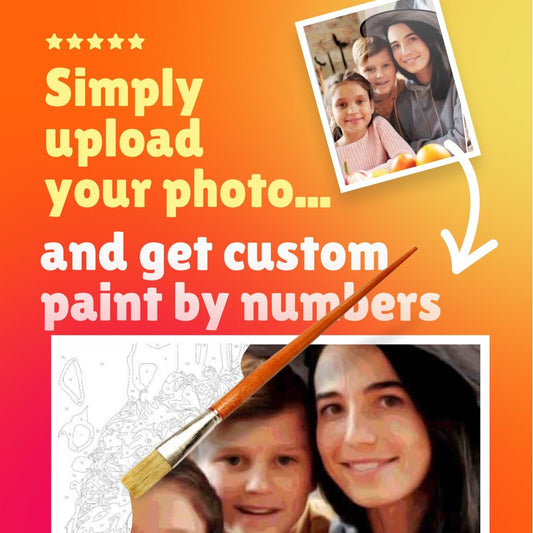
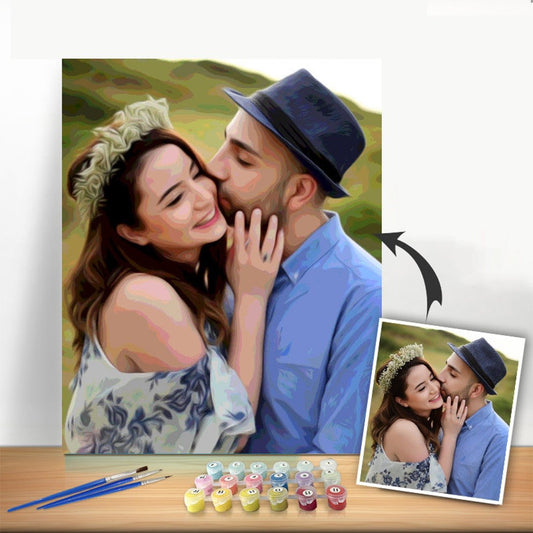
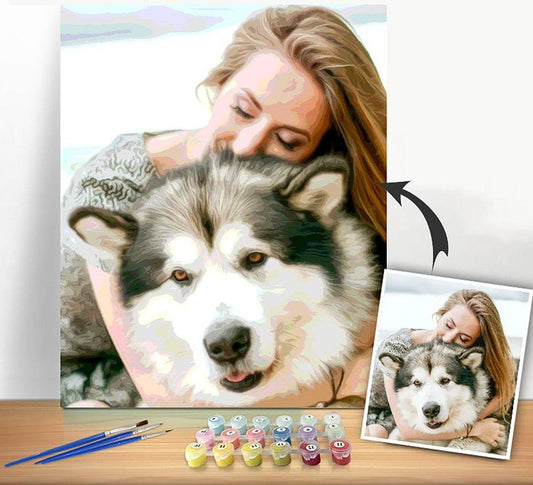
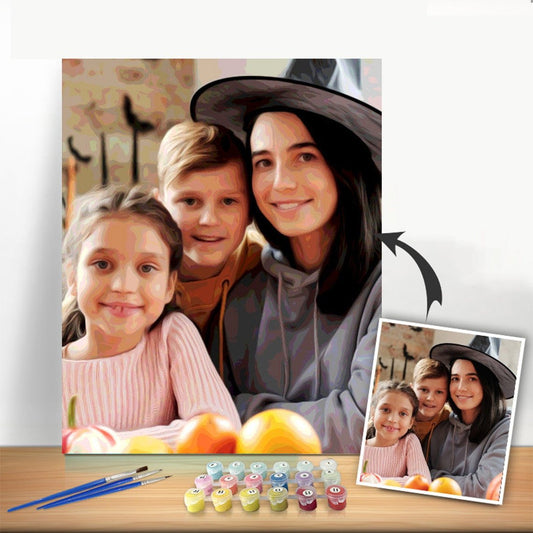
Ready to paint something meaningful but want a little extra guidance? A Custom Paint By Numbers kit is one of the best art projects for beginners, turning your favorite photo into an easy-to-follow painting canvas. Visit Custom Paint By Numbers to create a personalized kit and start your painting journey with confidence today.