
Think of your brain as having a built-in GPS and 3D modeling system. That, in a nutshell, is your visual-spatial skill. It's the powerful ability to understand where things are in space, how they relate to each other, and how to mentally manipulate them. This skill is what helps you navigate a new city just as much as it helps you assemble furniture using a diagram.
Decoding Your Internal GPS and 3D Map
At its heart, visual-spatial skill is the mental superpower that lets us see and process the world in three dimensions. It’s not just about what our eyes see, but how our brain interprets that information to make sense of distance, shape, position, and movement. This cognitive ability is the silent partner behind so many of our daily actions.
Ever tried to parallel park? You have to instantly judge the distance to the curb, the gap between the other cars, and your own car's position in relation to everything else. That entire complex calculation happens in a flash, and it's all powered by your visual-spatial skills.
The Building Blocks of Spatial Awareness
This powerful skill isn't just one thing; it's a team of different cognitive functions all working together. We can break it down into a few core components that make up what we call visual-spatial intelligence.
The table below gives you a quick summary of these key abilities, what they mean, and where you see them in action every day.
Core Components of Visual Spatial Skills
| Skill Component | What It Means | Everyday Example |
|---|---|---|
| Spatial Perception | Understanding your body's position in relation to other objects. | Weaving through a crowded room without bumping into anyone. |
| Mental Rotation | The ability to imagine what an object would look like from a different angle. | Figuring out if a sofa will fit through a doorway before you move it. |
| Spatial Visualization | Mentally creating and manipulating shapes and patterns. | Putting together a puzzle or building with LEGO bricks. |
| Visual Memory | Recalling the layout of a space or the location of objects. | Remembering exactly where you left your keys this morning. |
Each of these components plays a crucial role, allowing us to move through and interact with our environment smoothly and effectively.
The image below shows how these skills come together in some very common, real-world tasks.
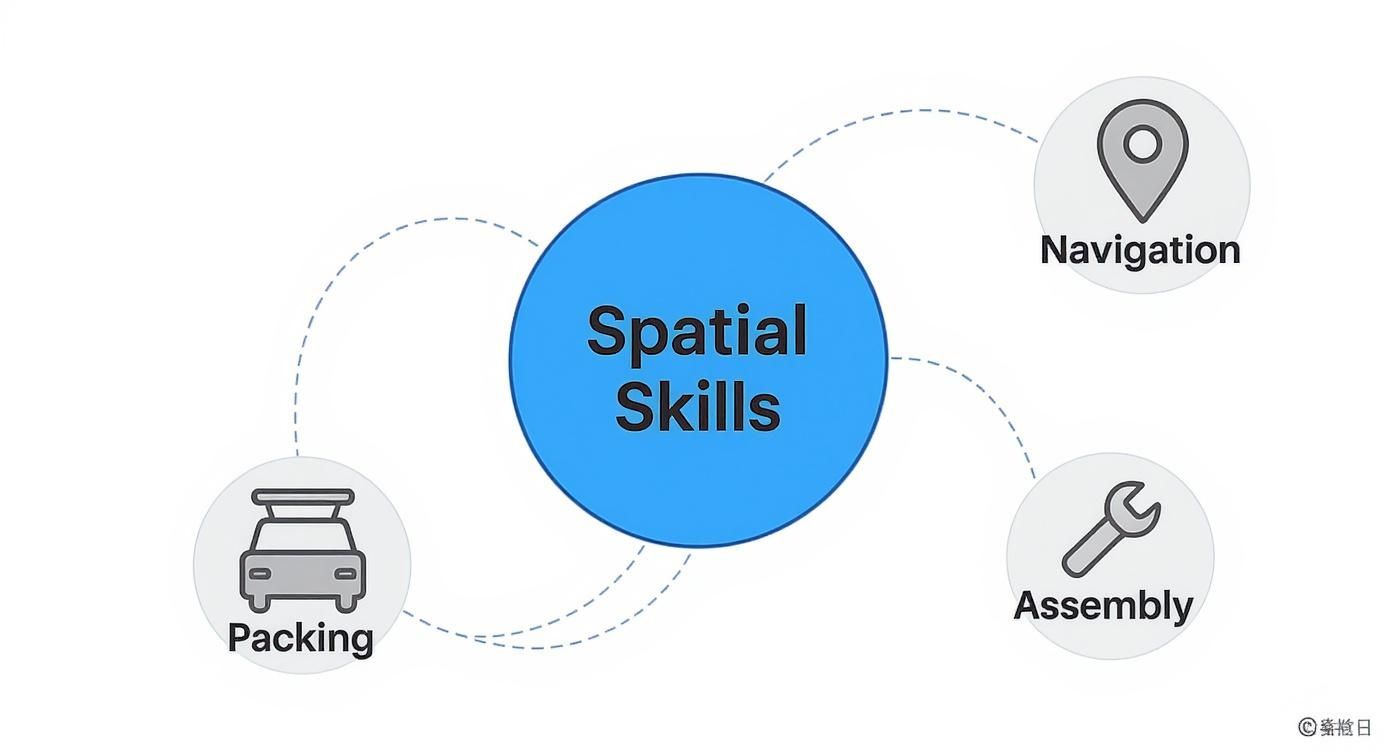
As you can see, whether you're strategically packing a suitcase to maximize space, following a map, or building a model airplane, you’re actively flexing these cognitive muscles.
In essence, visual-spatial skill is the bridge between seeing and doing. It turns raw visual data into actionable understanding, letting us interact effectively with the world around us.
These skills start developing from a very young age and form the foundation for learning in subjects like math and science. For instance, understanding geometry or picturing molecular structures in chemistry relies heavily on a well-developed spatial sense. It's a fundamental part of human intelligence that impacts everything from our simplest chores to our most complex problem-solving.
Why Strong Spatial Skills Matter for Success
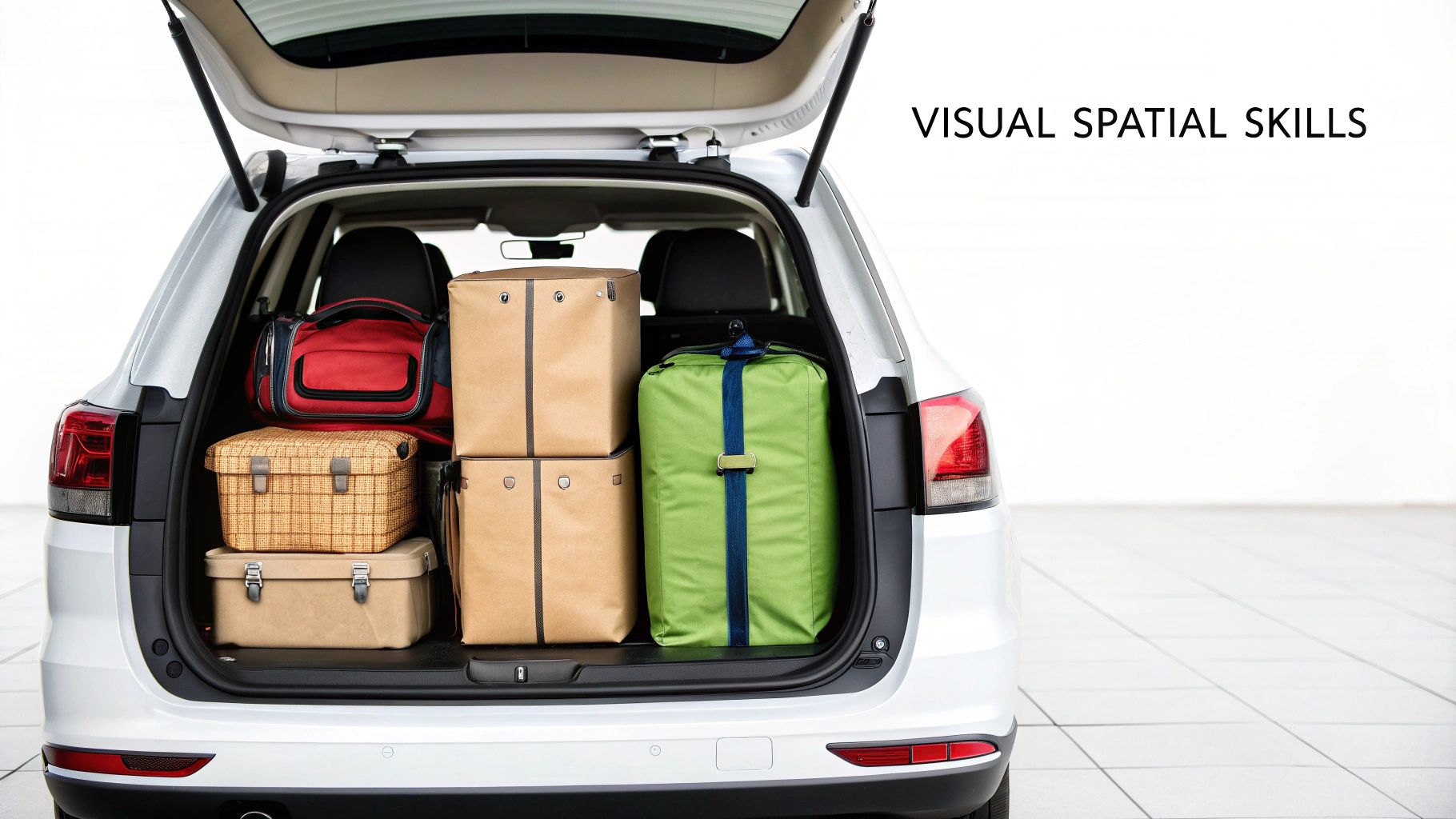
Sure, visual-spatial skills help you nail a parallel park or pack the trunk for a road trip. But their true power goes way beyond these daily wins. Think of these skills as a secret weapon for success, giving people a serious edge in both school and their careers.
Strong spatial reasoning is the mental machinery behind so much innovation and complex problem-solving. It's what allows a surgeon to mentally map out the complex web of veins and arteries before ever making an incision. It’s the same skill an engineer uses to see how all the individual parts of a new engine will fit and work together long before a prototype is built.
The Bridge Between Play and Profession
It’s amazing how often childhood playtime connects directly to a future career, especially when you look at it through the lens of spatial skills. That kid who spends hours building intricate LEGO castles isn't just goofing off; they're laying the groundwork for a future in architecture, engineering, or product design.
Likewise, a teenager glued to a 3D video game is actually sharpening their ability to track multiple objects moving through a dynamic space. This is the same mental muscle an air traffic controller or a robotics expert needs to do their job. Even software developers rely on it to visualize how complex systems interact.
These aren't just hobbies. They're fundamental training for high-level thinking.
Nurturing spatial intelligence is a critical investment in future innovation. It equips individuals with the mental flexibility to see problems from multiple angles and envision solutions that don't yet exist.
A Strong Predictor of STEM Success
The connection between spatial skills and achievement in science, technology, engineering, and mathematics (STEM) is undeniable. These fields demand that you think in abstract, multi-dimensional ways, whether you're picturing molecular bonds in a chemistry lab or understanding the physics behind a suspension bridge.
Time and again, research shows that spatial ability is a key ingredient for success here. A massive study that tracked over 400,000 high school students found a powerful link. It revealed that students with high spatial ability were nearly three times more likely to earn a STEM PhD than those with lower ability.
Interestingly, this research pointed out that spatial skill was a better predictor of future STEM success than math or verbal scores alone. You can dig into the full research on spatial ability and STEM careers to see the data for yourself.
The evidence is clear. Developing visual-spatial skills isn’t just a nice-to-have; it's a crucial stepping stone to success in some of the world's most important and fastest-growing professions.
How to Spot Strengths and Weaknesses in Spatial Skills
https://www.youtube.com/embed/XtYzuhNUmhs
Visual-spatial skills can sound a bit academic, but seeing them in action is actually pretty simple. Think of it this way: some people are born runners, while others are naturally gifted at seeing and moving through the world. The first step to getting better is learning to spot these traits, whether in yourself or in your kids.
Remember, these abilities aren’t set in stone. They exist on a spectrum, and just about anyone can improve with a little practice. These signs aren't labels—they're just clues that can help you find the right activities to build skills and boost confidence.
Common Signs of Strong Spatial Skills
People with well-developed spatial skills often just get how things fit together. They can process what they see quickly and can easily imagine turning objects around in their minds.
Here are a few positive signs you might notice:
- A Love for Puzzles and Building: They're the ones who dive into a jigsaw puzzle, a LEGO set, or a model airplane and finish it in record time.
- An Excellent Sense of Direction: This is the person who never seems to get lost. They can glance at a map and instantly know which way to go, often remembering a route after driving it only once.
- A Knack for Geometry: They seem to intuitively understand shapes, angles, and dimensions without needing long explanations.
- Artistic or Mechanical Talent: You might see them sketching, drawing, or taking apart a gadget just to figure out how it works.
Challenges That Signal Room for Growth
On the flip side, weaknesses in this area can make everyday tasks feel frustrating. This isn't about intelligence—it’s more like the brain’s internal GPS just needs a little fine-tuning. It's also worth noting that struggles with spatial reasoning can sometimes go hand-in-hand with challenges in fine motor control. You can explore this connection further in our guide on what are fine motor skills.
Keep an eye out for these common hurdles:
- Trouble with Assembly: If following the instructions for IKEA furniture or a new toy feels impossible, that’s a classic sign.
- Poor Sense of Personal Space: Frequently bumping into furniture, door frames, or other people can point to a weak spot in spatial awareness.
- Messy Handwriting and Organization: Difficulty lining up numbers in a math column or keeping handwriting on the line can be tied to spatial processing.
- Getting Lost Easily: Consistently losing your way in familiar neighborhoods or struggling to follow verbal directions are big clues.
Professionals often use specific tools like the Purdue Spatial Visualization Test to measure these skills. A fascinating study showed just how predictive these tests can be: engineering students scoring in the top 75% passed their graphics course at a 92% rate. For students in the bottom 25%, the pass rate was only 58%. You can dig into the study’s findings on spatial tests to see the data for yourself.
Engaging Activities to Improve Spatial Skills
Knowing what visual-spatial skills are is one thing, but actually strengthening them is where the real fun starts. The best part? You don’t need any fancy training programs or expensive gadgets. Many of the most effective activities are timeless classics that feel more like play than practice, fitting easily into everyday life for kids and adults alike.
The secret is hands-on engagement. When you physically interact with objects—stacking them, fitting them together, or drawing them—your brain gets a fantastic workout. This process builds stronger neural pathways for spatial reasoning by turning abstract ideas into something you can actually see and touch.
Foundational Fun for Young Children
For little ones, building a strong spatial foundation is a huge piece of their development. Simple, playful activities can make a world of difference, encouraging them to explore, solve problems, and connect what they see with what they do.
You can't go wrong with the classics:
- Building Blocks and LEGOs: Think of these as superfoods for spatial skills. Stacking, connecting, and creating in three dimensions teaches kids about balance, symmetry, and how individual parts come together to make a whole.
- Jigsaw Puzzles: Puzzles are a direct workout for the brain. They force us to recognize shapes, mentally rotate pieces to see if they’ll fit, and understand how smaller sections form a bigger picture. To get started, you can even find puzzles tailored for one-year-olds that make learning fun from the very beginning.
- Drawing and Doodling: The simple act of putting a crayon to paper is a powerful exercise. It helps kids learn how to represent 3D objects in a 2D space, giving them an intuitive feel for perspective and proportion.
These aren't just ways to keep children occupied. They are fundamental exercises that wire their brains for the more complex spatial challenges they'll face later on.
Advanced Challenges for Teens and Adults
Just because we’re older doesn’t mean we stop improving our spatial skills. We can just take on more complex and strategic challenges to keep pushing our mental boundaries. In fact, many hobbies and games are brilliant for keeping these abilities sharp.
Why not try incorporating some of these into your routine?
- Strategic Video Games: Many 3D video games are incredible for spatial training, especially ones that involve navigating maps, managing resources, or building structures (like Minecraft). They demand quick thinking, mental mapping, and a constant awareness of your virtual surroundings.
- Origami and Woodworking: Any activity that involves turning a flat material into a 3D object is a winner. Following diagrams to fold paper or cut wood forces your brain to visualize the final product and map out the steps to get there.
- Sketching and Painting: Taking up an artistic hobby trains you to see the world differently. You start to notice the little things—shadows, angles, and the relationships between objects—which is key for creating realistic art. It also hones the precise movements needed for detailed work. If you're curious, we have a whole guide on how to improve hand-eye coordination.
The real trick is consistency. Just 15-20 minutes of a spatial activity woven into your daily routine can lead to real, noticeable improvements in how you see and interact with the world around you.
At the end of the day, strengthening your visual-spatial skills is an active journey. By picking activities you truly enjoy, you can turn a brain workout into a rewarding habit that lasts a lifetime.
Using Paint By Numbers for Spatial Training
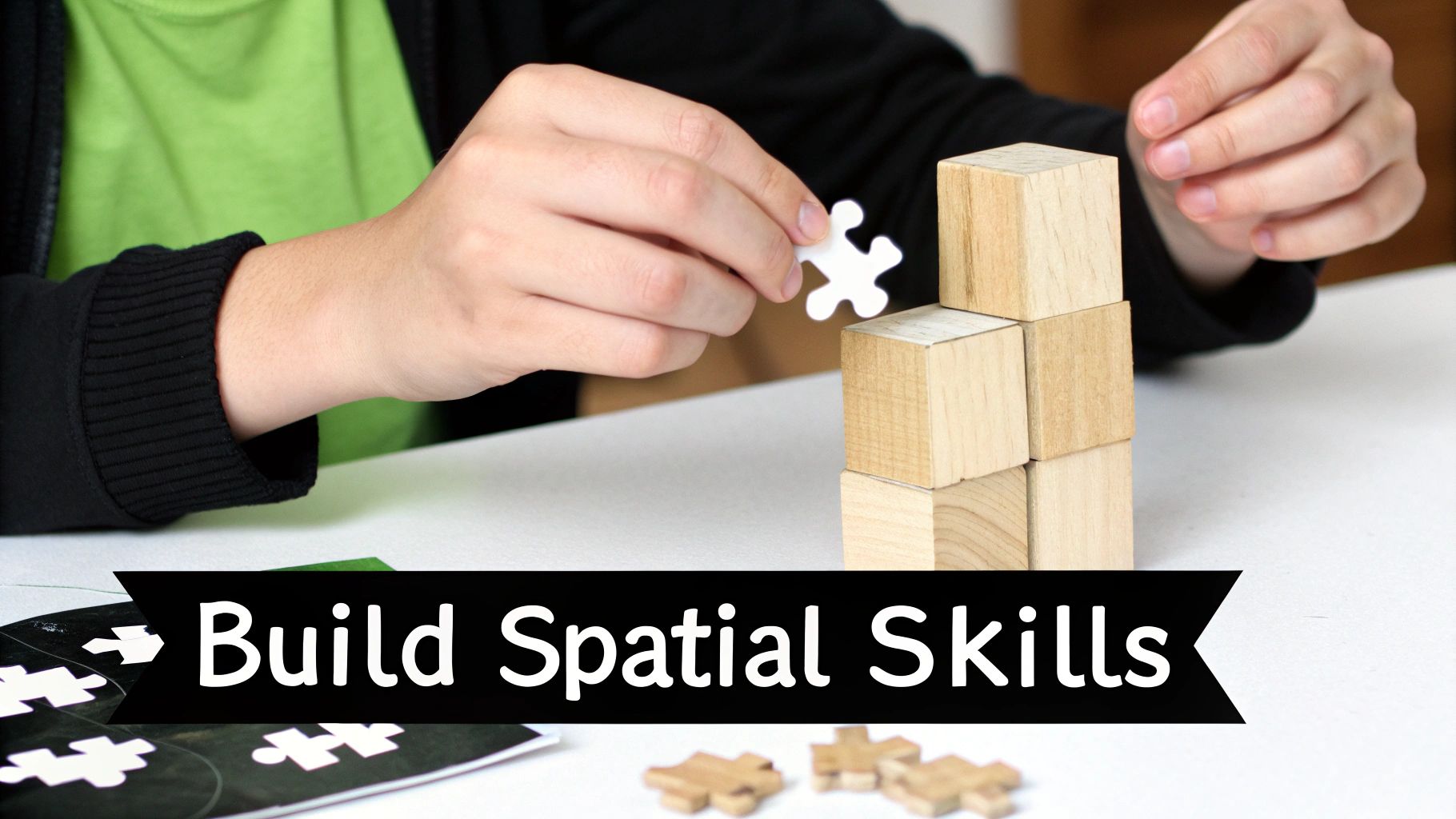
When we think of activities that build spatial skills, puzzles and building blocks often come to mind. But there's another fantastic tool that blends structure, creativity, and calm: the classic paint-by-number kit. It's much more than a simple craft—it’s a surprisingly targeted workout for your brain's visual processing centers.
At its heart, a paint-by-number canvas is a detailed map. Your job is to decode it by matching numbered paint pots to their corresponding sections. This simple task is a direct exercise in visual discrimination, the crucial ability to spot subtle differences between shapes, sizes, and symbols.
A Structured Workout for Your Brain
Think of the canvas as a complex jigsaw puzzle. Each numbered area is a unique piece you must identify and fill in correctly. This forces you to constantly scan the image, locate specific shapes, and tell them apart from all the others packed in around them.
This focused matching directly sharpens key spatial skills:
- Understanding Spatial Relationships: As you paint within the lines of complex shapes, you’re training your brain to recognize boundaries, contours, and how different forms fit together to create a bigger picture.
- Part-to-Whole Thinking: You start with what looks like a mess of abstract, disconnected shapes. By methodically filling them in, you are actively building a complete image, which is fantastic practice for seeing how individual parts create a whole.
- Mental Visualization: Before you even dip your brush, you’re likely picturing where a certain color will go or imagining how a section will look once it's done. This kind of forward-thinking is a cornerstone of strong spatial intelligence.
A paint-by-number kit breaks down a complex visual task into manageable, step-by-step actions. This structured approach makes it an incredibly accessible tool for improving spatial skills without feeling overwhelmed.
More Than Just a Hobby
This isn't just about the cognitive benefits, either. The steady, focused nature of painting can be incredibly calming. It’s a wonderful way to de-stress while still giving your brain a productive and engaging workout. For anyone looking to build their spatial awareness in a relaxed and rewarding way, it's a perfect fit.
If you’re new to the idea, our guide to painting by numbers for beginners is a great place to start. It just goes to show that building powerful cognitive skills doesn’t always have to feel like work.
Your Path to Sharper Spatial Reasoning
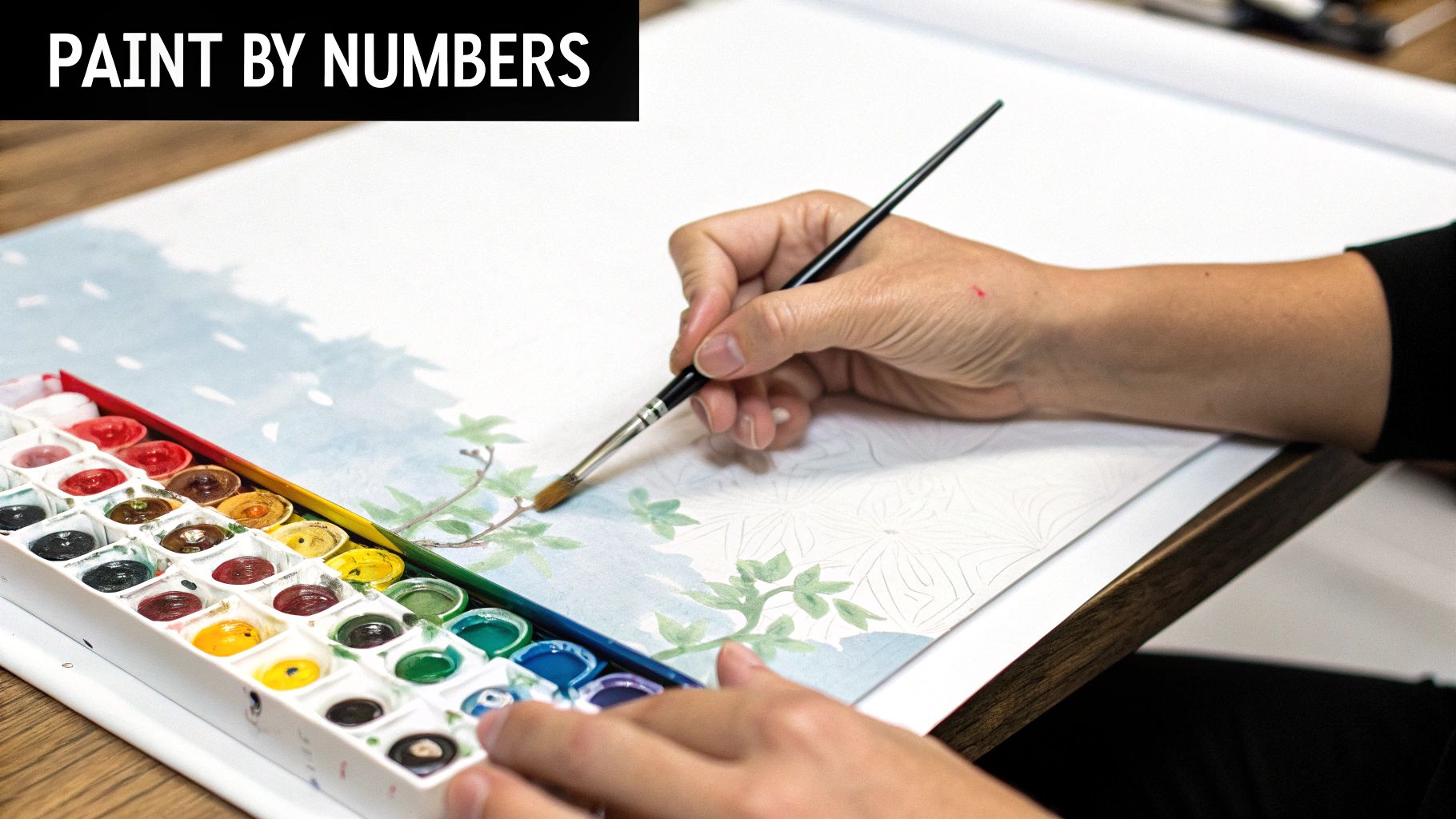
Now you know what visual-spatial skills are, and that's the perfect starting point for an exciting journey. It’s easy to think of spatial intelligence as a fixed talent—something you're either born with or not. But that’s not the whole story. Think of it more like a cognitive muscle. With the right kind of consistent, engaging practice, it gets stronger and sharper.
These abilities are the unsung heroes of our daily lives, running quietly in the background as we navigate a new city or just assemble a puzzle. They're the invisible engine that drives so much of our problem-solving, creativity, and success in everything from school to our careers. All those activities we explored, from classic building blocks to modern paint-by-number kits, are more than just hobbies. They're genuinely fun, accessible ways to give your brain a targeted workout.
Your environment is a playground for spatial practice. Every packed bag, sketched drawing, or followed map is an opportunity to sharpen your skills and build a more powerful connection between what you see and what you do.
The best part is that your journey to sharpening these skills can start right now. By leaning into playful, hands-on activities, you're not just passing the time—you're actively strengthening a vital part of how your mind works. You have the knowledge and the tools. Go ahead and start building a more spatially aware brain, one enjoyable challenge at a time. This is your invitation to see the world a little differently.
Got Questions About Visual Spatial Skills?
As you dig into the world of visual-spatial skills, it's totally normal for questions to pop up. Let's tackle some of the most common ones to give you a clearer picture of how this all works.
Are Visual Spatial Skills and Artistic Talent the Same Thing?
Not quite, but they're definitely close cousins. Think of it this way: a great artist almost certainly has strong visual-spatial skills. It's what allows them to nail perspective, balance a composition, and understand how objects relate to each other on a canvas.
But you can have incredible spatial awareness for things like navigating a new city or assembling complex machinery without being able to draw a stick figure. So, spatial skill is the raw ability, while art is just one of the many amazing things you can do with it.
Is It Too Late for Adults to Improve Their Spatial Skills?
Absolutely not! Your brain is remarkably adaptable throughout your entire life—a concept called neuroplasticity. While kids might pick up these skills more quickly, adults can see huge improvements with a bit of consistent practice.
So, what works for grown-ups?
- Puzzles and Brain Games: Jigsaw puzzles, especially complex ones, and 3D mechanical puzzles are a direct workout for your spatial reasoning.
- Strategy Games: Believe it or not, many 3D video games, a good game of chess, or even sports like basketball demand constant spatial calculations.
- Creative Hobbies: Getting hands-on with things like woodworking, sketching, or even a paint-by-number kit is a fantastic way to train those neural pathways.
The secret sauce is consistency. Just like you can't go to the gym once and expect to be fit, you need to regularly engage in these mental exercises to build and maintain that cognitive muscle. It’s never too late to sharpen your mind's eye.
Is There a Connection Between Visual Spatial Skills and Dyslexia?
Yes, research points to a significant link. Many people with dyslexia also struggle with aspects of visual-spatial processing. This can show up as difficulty telling 'b' and 'd' apart, trouble tracking words on a page without losing your place, or problems remembering the order of letters.
It’s important to note that this isn't a one-to-one relationship. Not everyone with spatial difficulties has dyslexia, and vice-versa. However, the overlap is common enough that it's something professionals look for when diagnosing and creating support strategies for reading. Understanding this connection helps create a more complete and effective plan.
Ready to create a masterpiece from a personal photo while giving your brain a boost? At Custom Paint By Numbers, we turn your favorite memories into unique kits. It's the perfect blend of relaxation, creativity, and a fun cognitive workout. Start your custom painting journey today!