
Welcome, parents and caregivers! The toddler years are a whirlwind of energy, curiosity, and boundless noise. While the chaos can be joyful, finding moments of calm is essential for everyone's well-being. This is where dedicated quiet time comes in.
This daily practice is more than just a parental break; it's a vital developmental tool. It helps toddlers build crucial skills like concentration, emotional regulation, and independent problem-solving. A structured quiet period allows them to decompress and engage with activities on their own terms, fostering a sense of confidence and creativity that will benefit them for years to come.
This guide moves beyond generic advice to provide a curated list of specific and actionable quiet time activities for toddlers. We will explore eight parent-approved ideas, from sensory bins to reusable sticker books, that are designed to captivate your little one's attention without overstimulating them. Each activity includes practical how-to steps, developmental benefits, and tips for making it a successful, cherished part of your daily routine. Forget the struggle and discover the simple joy of focused, independent play.
1. Sensory Bins
Sensory bins are a fantastic tool for encouraging focused, independent play. These are simply containers filled with tactile materials that invite toddlers to scoop, pour, and explore with their hands. The contained nature of the bin and the engaging textures make it one of the most effective quiet time activities for toddlers, promoting concentration and calm.
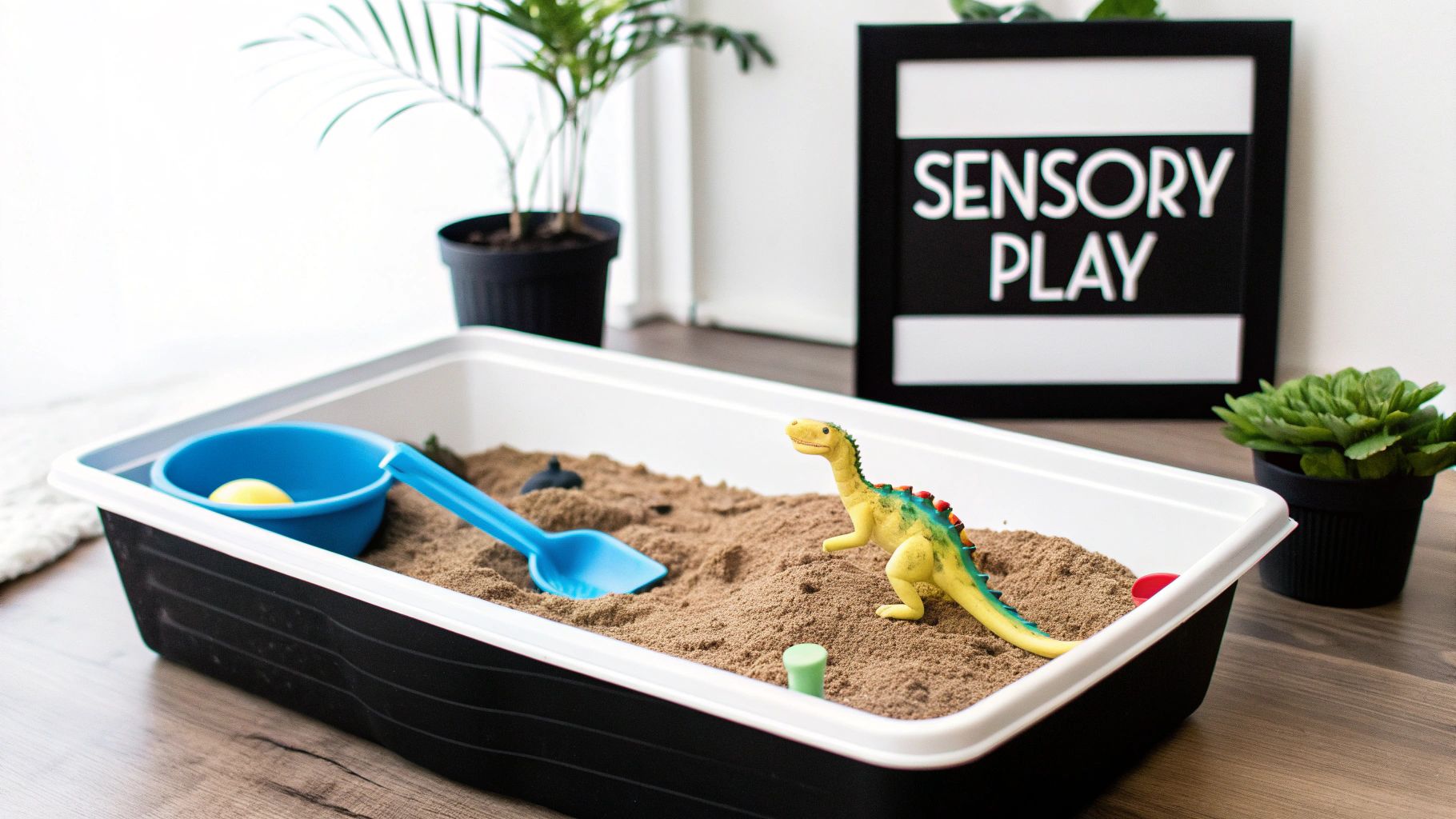
This activity supports fine motor skills as your child manipulates small objects, and it also introduces early math and science concepts like volume and texture. By providing a safe space for tactile exploration, sensory bins help toddlers regulate their emotions and wind down.
Getting Started
- Estimated Duration: 15-30 minutes
- Materials: A shallow bin or tub, a filler (like kinetic sand, dried beans, uncooked pasta, or water beads), and various tools (scoops, funnels, small toys).
- How-To: Fill the bin with your chosen material, add the tools and toys, and place it on a mat or towel for easy cleanup. Invite your toddler to explore freely.
Tips for Success
- Contain the Mess: Lay down an old sheet or a vinyl tablecloth under the bin. This defines the play space and makes cleanup much simpler.
- Rotate Fillers: Keep the activity fresh by changing the bin's contents every few weeks. A simple swap from rice to water beads can completely renew your child's interest.
- Supervise Safely: Always supervise children, especially those under three, to ensure small items are not put in their mouths. Choose fillers that are age-appropriate.
Sensory play is a cornerstone of early childhood development. For more ideas on how to incorporate these types of engaging projects, you can find more inspiration for creative activities for toddlers here on paint-by-number.com.
2. Independent Puzzle Play
Puzzles are a classic quiet time activity for a reason. They naturally draw toddlers into a state of focused concentration as they work to fit the pieces together. Age-appropriate puzzles with large, chunky pieces provide a perfect, self-contained challenge that promotes problem-solving and persistence without needing constant adult guidance. This makes them a go-to choice for a calm and productive quiet time.
This activity is a powerhouse for cognitive development, strengthening skills like shape recognition, memory, and spatial awareness. The act of grasping and placing pieces also provides an excellent workout for the small hand muscles needed for future writing. Beyond just keeping them busy, you can discover the many developmental benefits of puzzles for kids.
Getting Started
- Estimated Duration: 10-20 minutes
- Materials: An age-appropriate puzzle (chunky wooden puzzles, peg puzzles, or 4-12 piece jumbo floor puzzles).
- How-To: Set the puzzle out on a flat surface like a floor mat or a small table. You can demonstrate how one or two pieces fit, then encourage your toddler to try on their own.
Tips for Success
- Start Simple: Introduce puzzles with just 2-4 pieces first, such as simple shape sorters or chunky puzzles. This builds confidence and prevents frustration.
- Rotate Your Stock: Keep a few different puzzles on hand and swap them out every few weeks. The novelty of a "new" puzzle can reignite interest and engagement.
- Create a Puzzle Station: Designate a specific, comfortable spot for puzzle time. Keeping them accessible but organized in a low basket or on a shelf empowers your child to choose this activity independently.
Puzzles are a fantastic way to support your child’s development in a quiet, screen-free manner. To explore more engaging ways to build these essential skills, find more fine motor skills development activities here.
3. Quiet Time Trays or Activity Boxes
Quiet time trays, often called activity boxes, are curated collections of small, focused tasks presented on a tray or in a box. This Montessori-inspired approach helps toddlers concentrate by offering one simple activity at a time without overwhelming them. Presenting a single, engaging task like threading beads or sorting pom-poms makes this one of the best quiet time activities for toddlers, fostering independence and lengthening their attention span.
This method is excellent for developing fine motor skills, hand-eye coordination, and problem-solving abilities. By completing a task from start to finish, toddlers also gain a sense of accomplishment and learn to work independently, which are foundational skills for future learning.
Getting Started
- Estimated Duration: 10-25 minutes per tray
- Materials: A divided tray, small bin, or shoebox; materials for one or two simple activities (e.g., large pasta for threading onto a shoelace, colorful pom-poms and tongs for sorting, or a "Paint with Water" book and brush).
- How-To: Arrange the materials for a single activity on the tray. Place it on a low, accessible shelf and invite your toddler to choose it when quiet time begins. Show them how to use the materials once, then let them explore.
Tips for Success
- Prep in Batches: Prepare 5-7 trays at the beginning of the week. This saves time and ensures you always have a fresh activity ready to go.
- Mix Familiar and New: Include one familiar, mastered activity alongside one new one to build confidence while still providing a gentle challenge.
- Organize for Independence: Store trays on a child-height shelf. This empowers your toddler to select their own work and put it away, fostering responsibility.
- Adapt for Travel: For quiet time on the go, especially during car rides, an effective accessory to consider is choosing a car seat travel tray to keep small parts contained.
4. Picture Books and Story-Based Learning
Flipping through the pages of a high-quality picture book is one of the most classic quiet time activities for toddlers. Engaging illustrations and simple narratives allow young children to explore stories independently, fostering a love for reading and providing a calm, focused activity. This self-directed browsing encourages concentration, imagination, and pre-literacy skills without needing constant adult interaction.

This activity directly supports language development, vocabulary acquisition, and an understanding of narrative structure. As toddlers look at books like Dear Zoo or Goodnight Moon, they connect images with concepts and begin to recognize patterns. Creating a special reading space makes this solo activity feel inviting and helps establish a positive routine for quiet reflection.
Getting Started
- Estimated Duration: 15-45 minutes
- Materials: A selection of durable board books (examples: Brown Bear, Brown Bear, What Do You See?, Corduroy), a comfortable and accessible spot.
- How-To: Create a cozy reading nook with pillows or a small chair. Arrange a small, curated selection of books at your toddler's eye level so they can easily choose one and begin exploring on their own.
Tips for Success
- Create a Reading Nook: A dedicated, comfortable space signals that it's time to settle down with a book. It doesn't need to be elaborate; a few cushions in a quiet corner works perfectly.
- Rotate the Selection: Keep a small basket of 5-10 books available and swap them out weekly from a larger collection. This rotation keeps the activity fresh and exciting.
- Choose Durable Books: Opt for sturdy board books that can withstand enthusiastic page-turning and handling by little hands. This allows for truly independent, worry-free exploration.
5. Play-Dough and Modeling Activities
Play-dough and other modeling compounds are classic quiet time activities for toddlers for a good reason. The act of squishing, rolling, pinching, and shaping the soft dough is an inherently calming sensory experience. It allows toddlers to focus their energy into a quiet, creative outlet that keeps their hands and minds happily engaged.
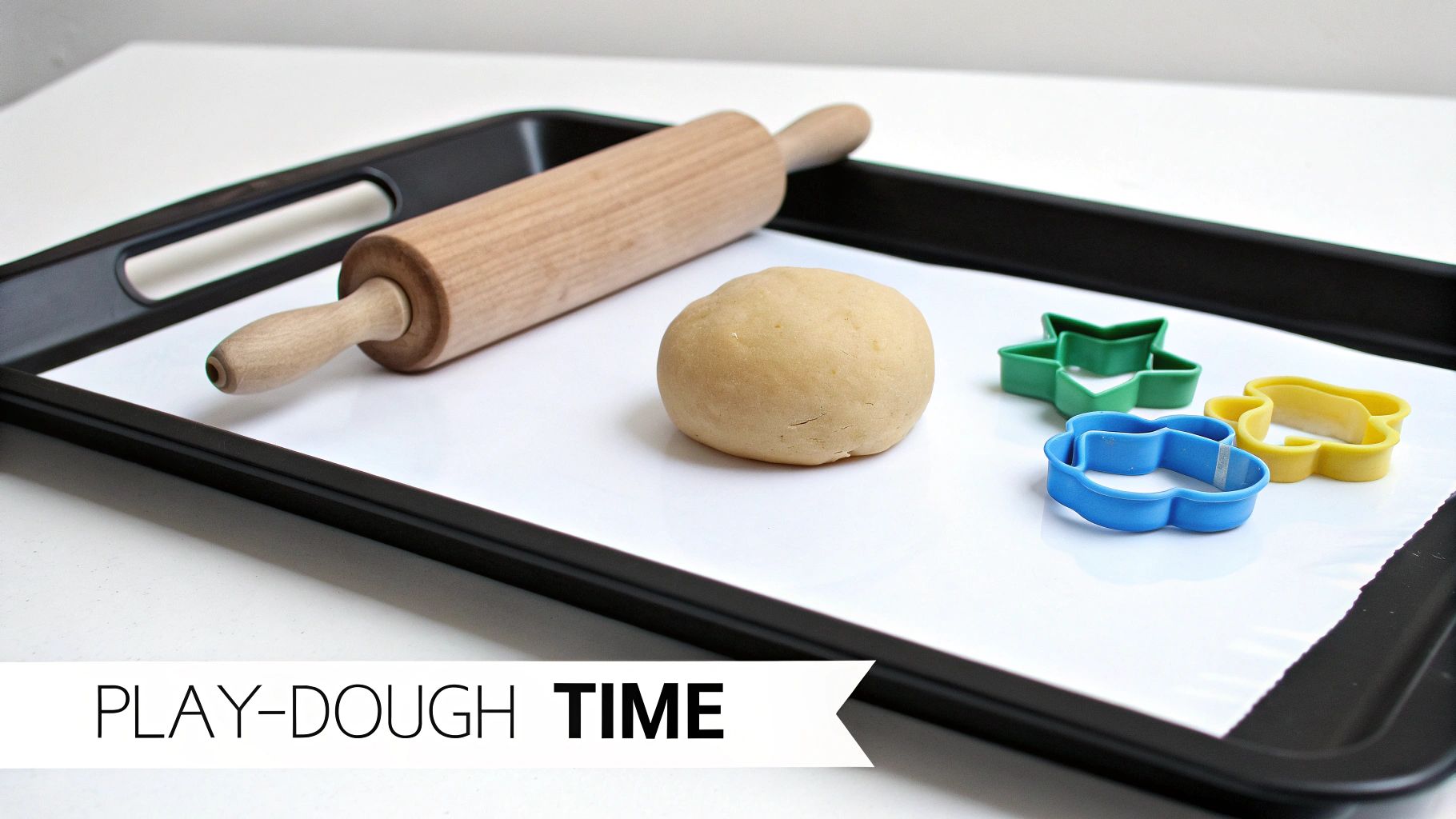
This simple activity is a powerhouse for development. It strengthens hand and finger muscles, which are crucial for later writing skills, and it encourages creative expression and imagination. Providing different colors and simple tools can introduce concepts like color mixing and shape recognition, all while your toddler enjoys peaceful, independent play.
Getting Started
- Estimated Duration: 20-40 minutes
- Materials: Store-bought play-dough (like Play-Doh) or homemade salt dough, a placemat or tray, and simple tools like plastic cookie cutters, a small rolling pin, or blunt plastic knives.
- How-To: Set up a dedicated space with a mat or tray. Place a few balls of different colored dough on the tray along with a selection of tools. Show your toddler how to roll or flatten the dough, then let them explore the textures and shapes on their own.
Tips for Success
- Define the Play Space: Using a dedicated mat or a baking tray with a rim clearly defines the play area and makes cleanup significantly easier.
- Offer Simple Tools: You don’t need fancy kits. Cookie cutters, bottle caps, and even textured leaves from the garden can provide new ways to interact with the dough.
- Make Your Own: Homemade play-dough is easy to create with flour, salt, water, and food coloring. Making a new batch together can be a fun activity in itself and ensures you always have a fresh supply.
- Store Properly: Keep your dough in an airtight container or zip-top bag to prevent it from drying out, extending its life for many more quiet time sessions.
The tactile nature of play-dough is similar to other hands-on art forms. If your child enjoys this type of creative expression, you can discover more hands-on projects by exploring painting activities for preschoolers.
6. Water Play and Pouring Activities
Controlled water play offers a wonderfully calming sensory experience that can captivate a toddler's attention for a surprising length of time. This activity centers on providing your child with containers of water and simple tools, allowing them to scoop, pour, and splash in a contained area. The repetitive, gentle sounds and feel of the water make this one of the most soothing quiet time activities for toddlers, helping them to settle and focus.
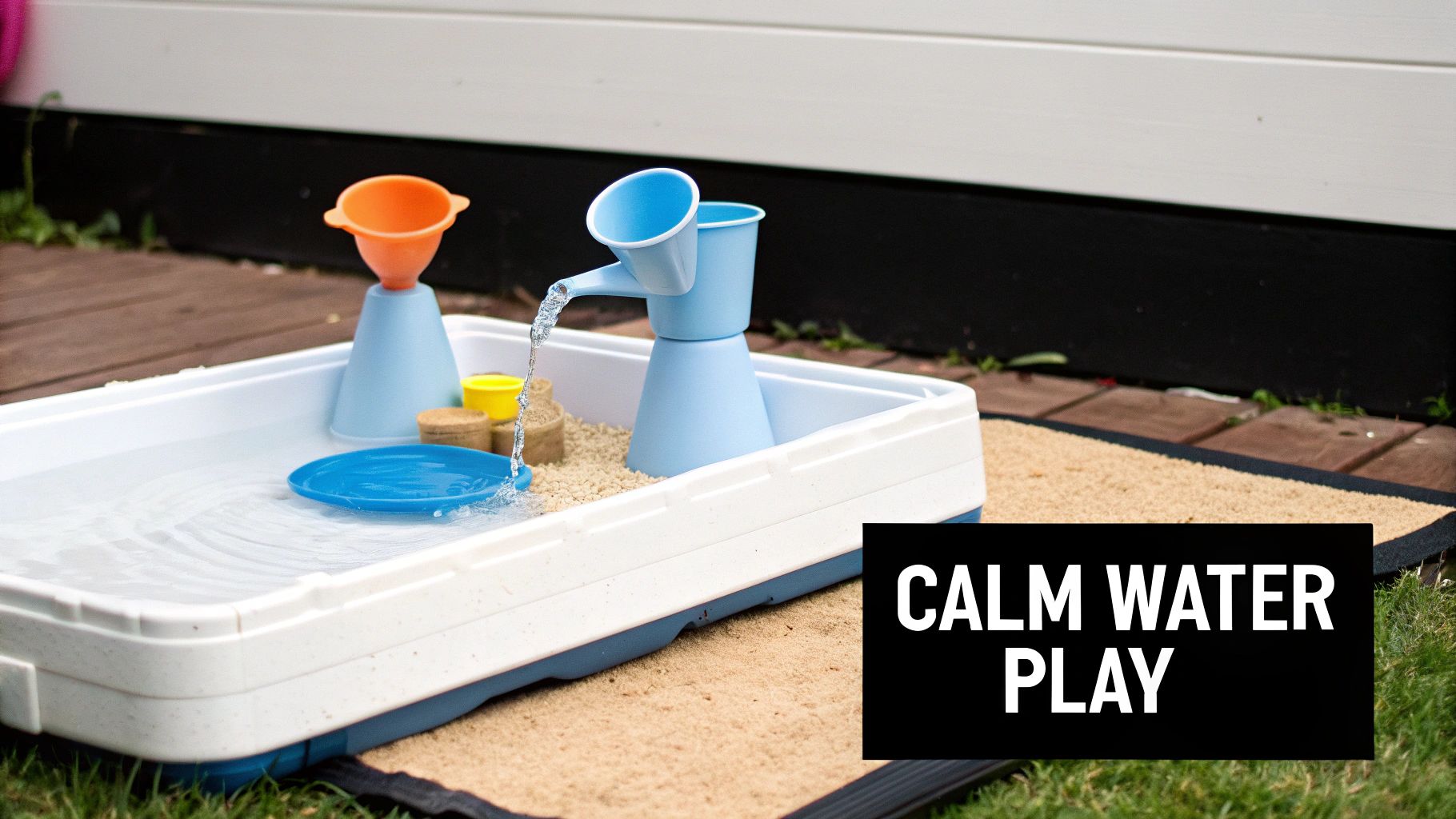
This simple setup is fantastic for developing fine motor skills, hand-eye coordination, and an early understanding of scientific concepts like cause-and-effect and volume. As toddlers manipulate funnels, cups, and sponges, they are engaging in focused, self-directed learning that naturally promotes a state of calm concentration.
Getting Started
- Estimated Duration: 20-40 minutes
- Materials: A large, shallow bin or a water table, water, and various tools (measuring cups, funnels, sponges, plastic droppers, and small floating toys).
- How-To: Fill a bin or water table with a few inches of water. Add your chosen tools and place the entire setup on a towel or an easily dried floor. Encourage your toddler to pour, scoop, and experiment freely with the materials.
Tips for Success
- Embrace the Splash: Set up outdoors if possible, or lay down several old towels indoors. Dressing your toddler in a swimsuit or an apron can also minimize mess and stress.
- Keep it Simple: Avoid overwhelming your child with too many toys at once. A few well-chosen items like a cup, a funnel, and a sponge are often more than enough to spark exploration.
- Add a Twist: For variety, you can add a drop of food coloring to the water or include some ice cubes for a new temperature and texture experience. Always supervise to ensure safety.
7. Sticker and Reusable Sticker Books
Sticker books are a classic toddler activity that brilliantly combines creativity with fine motor practice. Specifically, reusable sticker books use static cling technology, allowing little ones to place, peel, and reposition stickers endlessly on themed scenes. This simple, mess-free activity is one of the best quiet time activities for toddlers because it captivates their attention for extended periods without requiring constant adult intervention.
The focused act of peeling a sticker and carefully placing it on a scene helps toddlers develop the pincer grasp, hand-eye coordination, and spatial awareness. As they create stories and arrangements with the stickers, they are also engaging in imaginative play and building vocabulary. The repetitive nature of the activity is inherently calming, making it a perfect choice for helping a child wind down.
Getting Started
- Estimated Duration: 15-40 minutes
- Materials: A reusable sticker book or pad (like those from Melissa & Doug), or a simple pack of puffy stickers and a piece of laminated cardstock.
- How-To: Open the sticker book to a desired scene and show your toddler how to peel the stickers from the sheet and place them onto the background. Encourage them to move the stickers around to create different pictures and tell stories.
Tips for Success
- Choose Toddler-Friendly Stickers: Opt for books with thick, puffy, or large vinyl stickers. These are much easier for small, developing fingers to grasp and peel compared to thin paper stickers.
- Organize and Preserve: Store the sticker sheets flat inside the book or in a separate folder to prevent them from curling, which makes them harder to use. Keeping them organized ensures they last longer.
- Create DIY Boards: Make your own reusable sticker scenes by laminating a piece of paper or using a small, portable whiteboard. Regular puffy stickers will stick and peel off these surfaces easily, offering endless creative possibilities.
- Rotate Themes: Keep the activity feeling new and exciting by rotating different themed books every few weeks. A shift from a farm scene to an underwater world can completely reignite your toddler’s interest.
8. Color Sorting and Matching Activities
Sorting and matching activities are calm, structured tasks that tap into a toddler's natural desire to create order. These activities involve organizing items by color, matching them to designated spaces, or arranging them in a sequence. The clear objective and repetitive motions make this one of the best quiet time activities for toddlers, helping them build focus and logical thinking skills.
This activity directly supports cognitive development by teaching color recognition, classification, and pattern identification. As a toddler meticulously sorts objects, they are also strengthening fine motor skills and hand-eye coordination, laying a crucial foundation for future writing and self-care tasks.
Getting Started
- Estimated Duration: 10-20 minutes
- Materials: A collection of colorful items (pompoms, large beads, blocks, or buttons) and sorting containers (muffin tins, egg cartons, or colored bowls).
- How-To: Place a few colored items in front of your toddler along with the containers. You can model the activity by placing one colored item into the matching container and then invite them to continue.
Tips for Success
- Start Simple: Begin with just two or three primary colors, like red and blue. As your child masters these, you can gradually introduce more colors and shades.
- Use Everyday Objects: You don't need special toys. Gather colorful socks, bottle caps, or even different colored dried pastas for a low-cost, effective sorting game.
- Add a Fine Motor Challenge: For older toddlers, provide child-safe tweezers or tongs to pick up and sort the items. This adds an extra layer of difficulty that enhances their pincer grasp.
8 Quiet-Time Toddler Activities Compared
| Activity | 🔄 Implementation Complexity | ⚡ Resource / Efficiency | 📊 Expected Outcomes | 💡 Ideal Use Cases | ⭐ Key Advantages |
|---|---|---|---|---|---|
| Sensory Bins | Low–Moderate setup; occasional prep/rotation | Low material cost; needs storage and mat; supervision for very young | Tactile development; fine motor; sustained focus | Independent quiet play; sensory regulation; thematic activities | Highly engaging, customizable, reusable — ⭐⭐⭐ |
| Independent Puzzle Play | Low; minimal prep | Low cost; durable pieces; small storage | Spatial reasoning; problem-solving; patience | Short focused sessions; travel; independent skill practice | Builds cognition and confidence; screen-free — ⭐⭐ |
| Quiet Time Trays / Activity Boxes | High prep (curation and rotation) | Moderate–High: multiple trays, storage, initial material cost | Sustained calm play; improved concentration; routine adherence | Scheduled quiet time; children with sensory or attention needs | Predictable structure, very effective for sustained quiet — ⭐⭐⭐ |
| Picture Books & Story Learning | Low; little to no prep | Moderate: book collection or library access; shelf space | Language/vocabulary; pre-literacy; emotional development | Independent browsing; quiet wind-down; cozy reading nook | Portable, durable options; fosters early literacy — ⭐⭐ |
| Play-Dough & Modeling | Low–Moderate (homemade prep optional) | Low cost; airtight storage needed; potential mess management | Fine motor strength; creativity; calming sensory input | Creative sessions; calming activities; open-ended play | Reusable, calming, excellent for fine motor — ⭐⭐⭐ |
| Water Play & Pouring | Moderate (containment & safety) | Requires water table/bin, towels, outdoor space; cleanup | Coordination; cause-effect learning; calming repetition | Warm weather outdoor quiet time; sensory play | Highly calming and engaging; great tactile feedback — ⭐⭐⭐ |
| Sticker & Reusable Sticker Books | Low; ready-to-use | Low cost; portable; some adhesive wear over time | Pincer grasp; sustained concentration; fine motor | Travel, quiet seated activity, independent play | No-mess, reusable, very portable — ⭐⭐ |
| Color Sorting & Matching | Low–Moderate (setup of materials) | Very low cost; household items usable; simple prep | Color recognition; sorting logic; early math skills | Short learning sessions; adaptable to skill level | Highly customizable, low-cost, easy to differentiate — ⭐⭐ |
Making Quiet Time a Lasting Habit
Transitioning your toddler from constant activity to a period of calm, independent play can feel like a monumental task. As we've explored through sensory bins, puzzles, and water play, the secret isn't finding one magic activity. Instead, it's about building a flexible, sustainable routine that nurtures your child's ability to self-regulate and engage in focused play. The journey requires patience and observation, but the rewards are immense for both you and your little one.
Remember, the goal of quiet time is not just to keep a toddler occupied; it is a foundational skill. By providing these structured opportunities, you are teaching them how to find joy in solitude, how to problem-solve independently, and how to calm their own bodies and minds. This is a gift that will serve them well throughout their childhood and into their adult lives.
Key Takeaways for a Successful Quiet Time
The diverse range of quiet time activities for toddlers we've covered, from sorting colorful pom-poms to flipping through picture books, all share a common thread: they are engaging, low-stimulation, and foster independent exploration.
Here are the most important principles to carry forward:
- Consistency is Crucial: Aim for the same time each day to help set your child’s internal clock. A predictable routine creates a sense of security and makes it easier for them to transition into a calm state.
- Start Small and Build Up: Don’t expect a 60-minute quiet session on day one. Begin with just 5-10 minutes of a highly engaging activity and gradually increase the duration as your toddler becomes more comfortable with the concept.
- Observe and Adapt: Pay close attention to your child's cues. Do they gravitate toward sensory play or are they more interested in fine motor challenges like stickers and Play-Dough? Rotate activities based on their current interests to keep quiet time fresh and exciting.
- Environment Matters: A dedicated, comfortable, and clutter-free space signals to your child that it’s time to wind down. Dim lighting, soft music, or simply a special "quiet time" blanket can make all the difference.
Your Actionable Next Steps
Building this habit is a marathon, not a sprint. Don't be discouraged by off days or moments of resistance. Every attempt is a step in the right direction. This week, try implementing one or two of the activities from our list. Prepare a simple "Quiet Time Tray" the night before, filled with a puzzle and some reusable stickers. Introduce it with a positive and calm demeanor, framing it as a special time for them to enjoy their new toys.
By embracing this process with flexibility and a positive outlook, you will not only reclaim a few precious moments of peace in your day but also empower your child with invaluable life skills. You are cultivating their creativity, lengthening their attention span, and giving them the tools to find tranquility within themselves. Enjoy the journey and the quiet moments it brings.
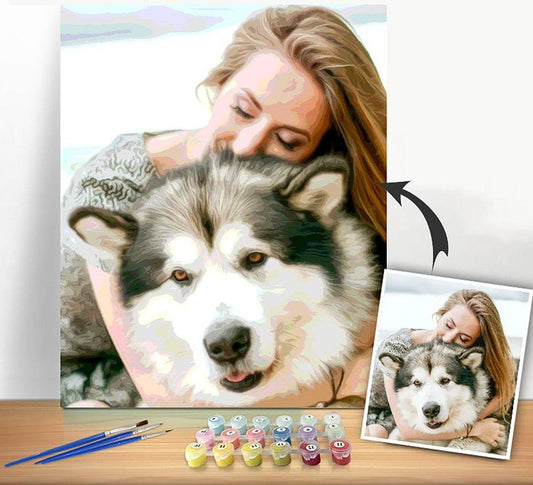
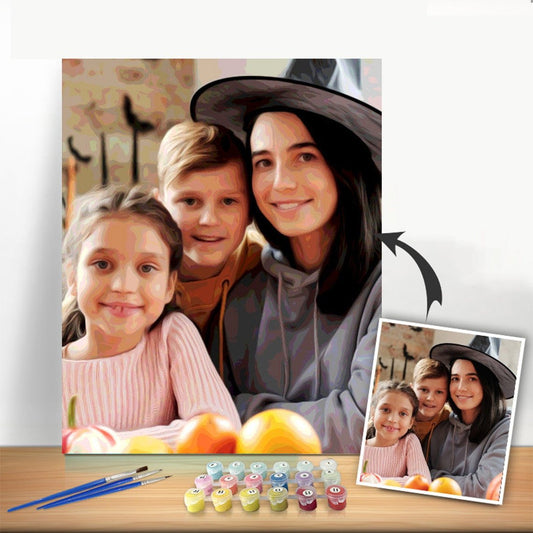
Ready to add a new, structured creative outlet to your rotation? Explore a Custom Paint By Numbers kit designed for little hands. It offers the perfect blend of guided creativity and quiet concentration, making it another wonderful tool for your quiet time arsenal. Custom Paint By Numbers